NXP+FPGA-Based Rail Transit 3U Chassis Structure Logic Control Unit (LCU)
NXP+FPGA-Based Rail Transit 3U Chassis Structure Logic Control Unit (LCU)
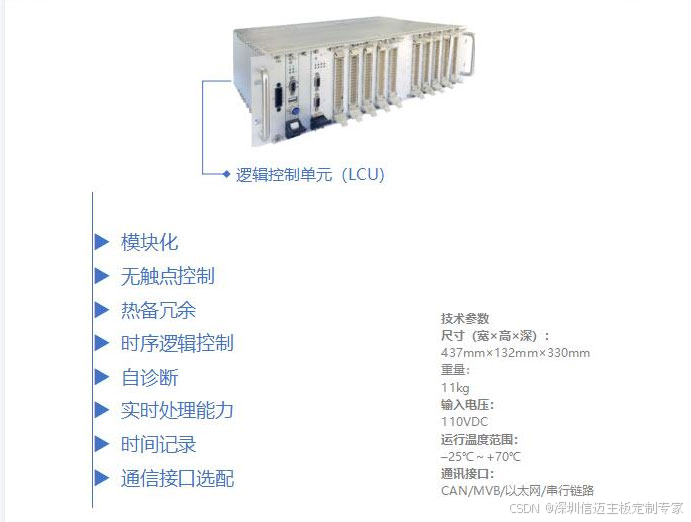
The Logic Control Unit (LCU) is a digital logic control device specifically designed for applications in rail transit environments. It is used to replace hardwired relay circuits in train control and implement their corresponding logic control functions.
Modular The LCU device adopts a modular design, mainly composed of an IO controller, a main controller, and a network controller. It collects DC110V signals from the driver's controller, push-button switch groups, disconnectors, contactor auxiliary contacts, etc., and after logical calculation, outputs to drive various vehicle loads, completing specified sequential control functions.
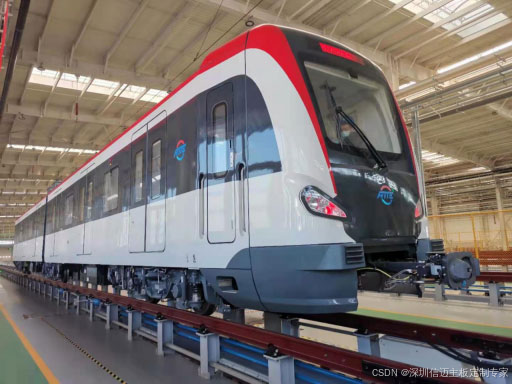
Contactless Control The introduction of contactless control fundamentally avoids inherent defects such as relay sticking, chattering, and poor contact. The application of digital control technology has led to the elimination of intermediate relays, solving the problem of layered relay driving.
Hot Standby Redundancy When the system requires hot standby redundancy, two LCU products can be used in a cascaded manner. The product can achieve seamless switching between two LCU boards after any single point of failure, with a switching response time of less than 100ms. The application of hot standby redundancy technology effectively enhances the overall reliability of subway train control circuits.
Sequential Logic Control By combining hardware and software, it provides fully programmable timing and delay functions, capable of completely replacing sequential circuits composed of contact-based control devices such as time relays, intermediate relays, and general relays in the original control circuit.
Self-Diagnosis Function It real-time detects the operating status of its own input/output channels, power supply, communication modules, and critical ICs, displaying them simultaneously on panel indicators and the TCMS.
Overcurrent Protection Function When a short circuit or overload occurs in the load, the output channel can immediately protect and automatically disconnect that output. It can automatically recover once the short circuit or overload disappears.
Real-time Processing Capability Any input-to-output response delay time of the LCU does not exceed 30ms.
Event Recording Function The system can record status changes of all input and output channels, serving as a supplement to the TCMS system's event recorder variables. Its log data can reach 120,000 entries, with a cyclic coverage duration of up to 24 hours and a minimum recording interval of 2ms. Fault data can reach 2,000 entries, and all recorded data can be downloaded and analyzed via the maintenance port.
Communication Interface Options Supports CAN, MVB, Ethernet, and serial link; the above interfaces are optional.
Technical Parameters Dimensions (W×H×D): 437mm×132mm×330mm Weight 11kg Input Voltage 110VDC Operating Temperature Range –25℃~+70℃ Communication Interfaces MVB/CAN/Ethernet/Serial Link