Application of ZYNQ MPSoC + QNX Real-time System + CPCI Board in Rail Transit Modular Systems
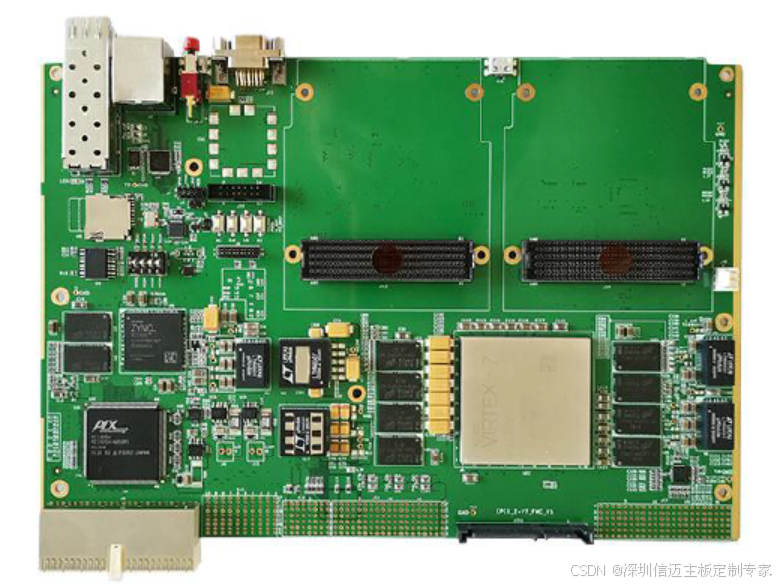
Application of ZYNQ MPSoC + QNX Real-time System + CPCI Board in Rail Transit Modular Systems
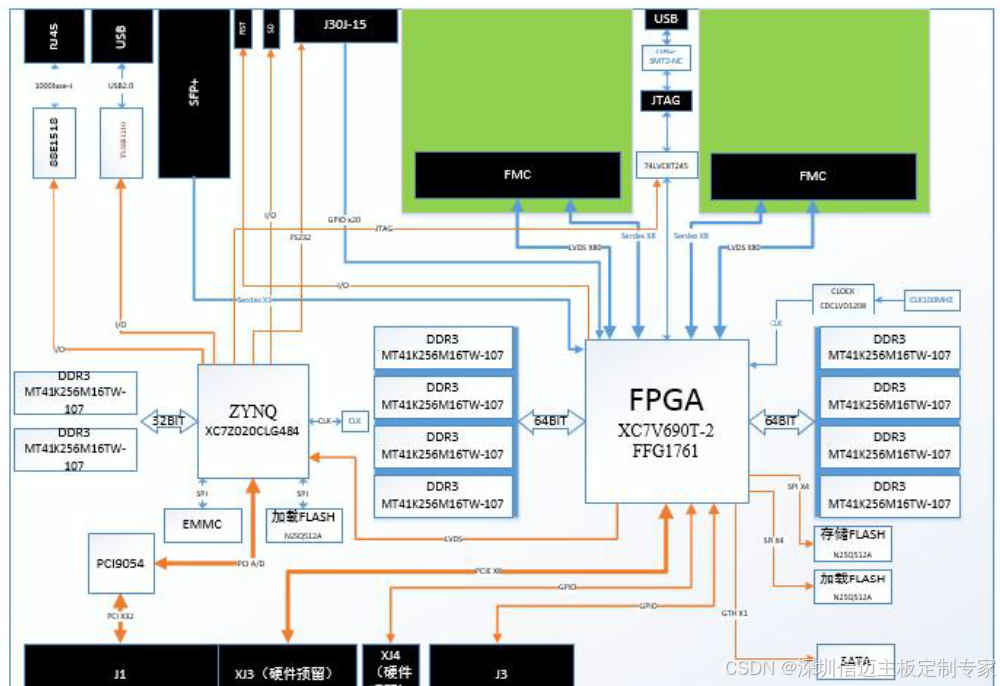
Block Diagram
Technical Specifications
— Dual Main Control Chips: XC7Z020-CLG484 and XC7VX690T-2FFG1761I;
— Memory:
-XC7VX690T with 8x 16-bit 1600 DDR3 SDRAM (up to 4GB supported), maximum bandwidth up to 25.6GB/s;
-XC7Z020 with 2x 16-bit 1600 DDR3 SDRAM (up to 4GB supported), maximum bandwidth up to 6.4GB/s;
-Supports SPI Flash for program loading;
-Features eMMC interface (can also be used as I/O expansion for XC7Z020); Features SD card interface;
— Communication and Networking
-Supports UART communication;
-Supports Ethernet communication;
-Supports USB2.0 OTG slave mode;
— Configuration: JTAG program download via Micro USB interface
— Expansion Connectors: 2x FMC-HPC interfaces
— 160 single-ended or 80 differential (34 pairs LA, 24 pairs HA, and 22 pairs HB) user-defined pins;
— High-speed pins: Supports 8 lanes;
— VADJ supports 1.2~3.3V adjustable;
— Supports IIC;
— Supports JTAG;
— Optical Fiber Interface - SFP+
— Control & I/O
— Multiple switches and buttons;
— Multiple LED indicators;
— Cooling:
— Supports 12V fan cooling;
— Supports air cooling (using a cold plate heat sink);
— Backplane Power Supply;
— Supports 12V and 5V external power supply;
— Operating Temperature Range: Commercial grade 0~70℃; Industrial grade -40℃~70℃.
— Physical Dimensions: 233.35mm x 160.00mm x 25.40mm
I. Hardware Architecture Design Highlights
-
ZYNQ MPSoC Heterogeneous Computing Advantages
- Leverages its quad-core Cortex-A53 processor to run the QNX real-time system, handling complex tasks such as train control and communication protocol stacks; the dual-core Cortex-R5 processor achieves hard real-time responses, such as emergency braking signal processing.
- The FPGA logic units (PL side) can be customized to implement rail transit-specific interfaces (e.g., MVB, CAN bus) or accelerate sensor data pre-processing.
-
CPCI Board Modular Features
- Supports hot-swappable design, facilitating on-board equipment maintenance and functional expansion, for example, rapidly deploying redundant control modules via the CPCI backplane.
- Integrates high-speed PCIe interfaces (Gen2/3) to achieve low-latency data transfer (≤1μs) between the ZYNQ MPSoC and the CPCI board, meeting train network communication requirements.
-
Storage and Boot Redundancy Design
- Utilizes a QSPI + eMMC dual-storage media configuration, where QSPI stores the bootloader for millisecond-level cold boot, and eMMC stores operation logs and configuration files, supporting rapid fault recovery.
- Through a separated design of PS-side DDR4 memory (5GB) + PL-side DDR4 memory (4GB), bandwidth requirements for system operation and hardware acceleration are ensured respectively.
II. Software System Implementation Plan
-
QNX Real-time System Optimization
- Leverages QNX microkernel architecture (memory footprint <2MB) to achieve deterministic task scheduling, ensuring critical task response times ≤10ms for signal light control, door status monitoring, and other functions.
- Supports IPC message passing mechanism to achieve data synchronization and abnormal status monitoring between PS-side A53/R5 cores.
-
Driver and Middleware Development
- Develops CPCI board drivers based on the V4L2 framework, supporting multi-channel video acquisition (e.g., carriage surveillance) and hardware video encoding/decoding (H.265 compression ratio ≥50:1).
- Integrates SDF cryptographic interface library, utilizing PL-side national cryptographic algorithm acceleration chips to achieve on-board communication data encryption (SM4 throughput ≥1Gbps).
III. Typical Application Scenarios
-
On-board Control System
- Runs Automatic Train Protection (ATP) algorithms, acquiring track circuit signals via CPCI expansion I/O modules, with FPGA implementing 32-channel ADC data parallel processing.
- The QNX system manages dual redundant networks (Ethernet + MVB), achieving fault-over time <500ms.
-
Trackside Monitoring Equipment
- Builds distributed acquisition nodes based on CPCI chassis, with ZYNQ MPSoC processing LiDAR point clouds (1 million points/second) to detect track geometric deformation with an accuracy of ±0.1mm.
IV. Reliability Assurance Measures
- Operating temperature range of -40℃~85℃, compliant with EN50155 standard for railway electronic equipment.
- Supports ECC memory error correction and watchdog circuitry, achieving 72 hours of fault-free operation.
- Boot process configured with a three-level rollback mechanism, enabling system recovery within 15 seconds in case of anomalies.