Intelligent Analysis Design and Implementation of Health Status for High-Speed Rail Equipment Based on NXP IMX8 + FPGA + PHM Technology (Part Two)
2.1.1 Basic Concepts of PHM for High-Speed Rail Equipment This article first clarifies the basic concepts in the field of PHM for high-speed rail equipment. Sensor: A device or apparatus capable of sensing relevant information from a specified measurand and converting it into a usable output signal according to certain rules, typically composed of a sensitive element, a transducer, and a measurement circuit [61].
Fault: A state of a product characterized by its inability to perform its required function. That is, a fault is a state caused by a failure [62]. Health: Concise information about the current ability of a system, subsystem, or component to perform its specified functions; it is a general term for the good state of an object. The health status of a general product cannot be directly observed and therefore requires evaluation. Health Monitoring: The process of evaluating a system's health status, including the measurement of state parameters and the identification of abnormal conditions. Health Assessment: The use of models, algorithms, or expert knowledge derived from human experience to determine the current health status of a target object. Health Management: The process of making and implementing action decisions based on the assessment of system health status and the system's anticipated future usage. Diagnosis: An act of determining the cause, location, and nature of an error. Remaining Useful Life (RUL): The length of time from the current moment until a system (or product) is no longer expected to perform its intended function within the anticipated specifications.
 Prognosis: Refers to a procedure for predicting the remaining useful life of a target system, by building a model that forecasts the current degradation process of a fault, load history, anticipated future tasks, and environmental conditions, to assess when the target system will no longer perform its specified functions in future tasks.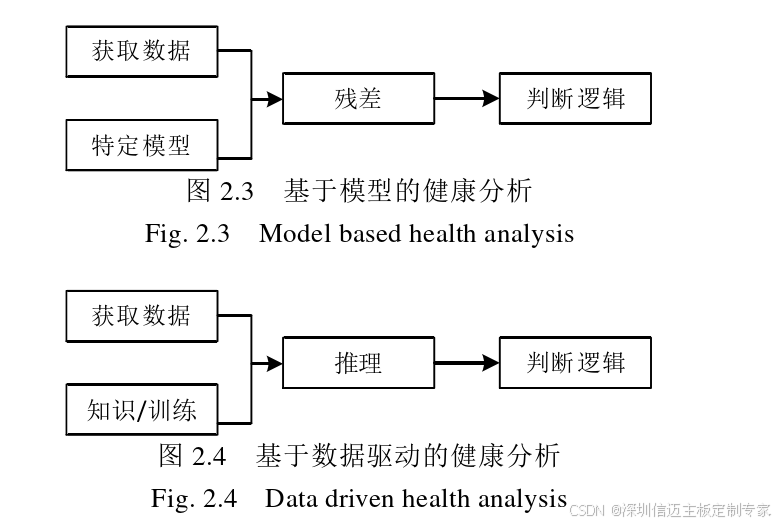
2.2 Business System of PHM for High-Speed Rail Equipment
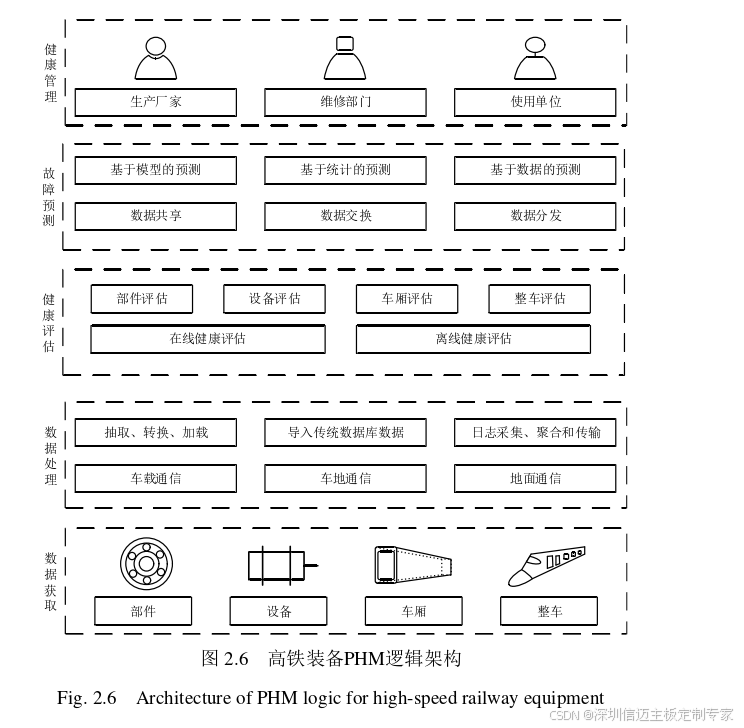
The PHM business system for high-speed rail equipment primarily provides various data and business logic and requirements for manufacturers regarding component design, maintenance department planning, user unit planning, and PHM analysis work. For example, the status information of high-speed multiple-unit trains is realized through a multi-scenario, multi-dimensional, three-dimensional integrated monitoring system. Each independent monitoring system, such as the on-board monitoring and diagnostic system, trackside monitoring equipment management system, and depot inspection and maintenance related systems, integrates corresponding data acquisition modules and belongs to the same functional level. For the PHM system of high-speed rail equipment, the input for data acquisition can usually be categorized by data content based on the acquisition methods of different business scenarios, such as:
(1) On-board monitoring and diagnostic data: operational status data, operation information, diagnostic data, etc.;
(2) Trackside equipment monitoring data: monitored object status data, diagnostic data, etc.;
(3) Depot inspection and maintenance data: inspection data, manual inspection data, maintenance data, etc.;
(4) Other configuration data: production management data (operating plans, routes, allocations, etc.), historical data (design/modification parameters, etc.), environmental data, knowledge base (technical regulations/indicators/manuals), etc.
The on-board monitoring and diagnostic system of high-speed rail equipment itself integrates expected values and status detection methods for various components or systems. When developing PHM technology, designers can refer to these detection methods and combine them with specific business requirements to design expected values, alarm levels, and diagnostic rules for monitored objects.
2.3 Technical Methods of PHM for High-Speed Rail Equipment The technical methods for PHM of high-speed rail equipment primarily cover application system development, data processing technology, data mining technology, network security technology, and other technical approaches. In recent years, research into PHM technology for high-speed rail equipment has increasingly applied relevant theories, models, and algorithms in related development. For example, data processing technology typically includes data preprocessing, feature extraction, and data mining. Since signals collected by sensors inevitably have characteristics such as noise, gaps, or inconsistencies, they need to be preprocessed, and feature vectors strongly correlated with equipment status must be extracted as a basis for fault mode identification. Common data preprocessing and feature extraction methods are as follows: (1) Low-pass filtering and high-pass filtering; (2) Principal Component Analysis (PCA); (3) Factor Analysis; (4) Fourier Transform. After data preprocessing, if data change patterns and trends need to be derived based on functional modules or business requirements, further appropriate analysis work is required. Common data analysis methods are as follows: (1) Descriptive analysis; (2) Dynamic analysis; (3) Correlation analysis; (4) Regression analysis; (5) Cluster analysis. Since high-speed rail equipment accumulates a large amount of data, including operational history data, maintenance data, and expert experience data, data mining functions such as classification, association, and clustering are needed to extract valuable data and patterns from massive, noisy, and ambiguous data. The core of data mining is algorithms, commonly used ones include: (1) Decision tree algorithms; (2) Artificial neural network algorithms; (3) Rough set algorithms; (4) Genetic algorithms. 2.4 Management System of PHM for High-Speed Rail Equipment The PHM management system for high-speed rail equipment primarily involves three aspects: management, organization, and technology, as shown in Figure 2.5. The management aspect mainly includes laws, regulations, and various training programs; the organizational aspect mainly covers institutions, personnel, and positions; and the technical aspect mainly involves safety technical mechanisms for equipment, systems, and operations, as well as status monitoring, intrusion monitoring, and key management. For example, outdated management methods of managers cannot adapt to cloud environments or big data.