[PHM] NXP IMX8 + FPGA + PHM Smart Maintenance Technology for Rail Transit and Marine Applications
The Evolution and Challenges of Smart Maintenance Technology
-
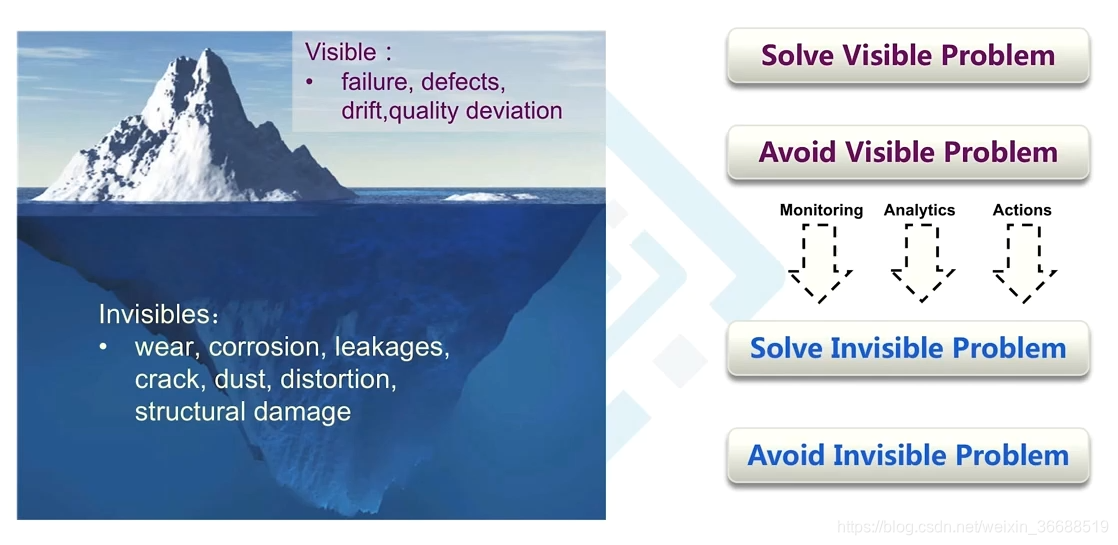
Maintenance Goals Regarding the background of PHM technology, we know that one goal of maintenance is to solve problems in manufacturing. These problems include equipment downtime, component damage, poor quality, and even low energy efficiency utilization or waste. To solve these problems, we cannot merely address their superficial manifestations, but must focus on their underlying causes. These causes are often invisible issues hidden behind the apparent problems, such as wear, corrosion, leaks in parts, or poor human operation, and environmental factors. These factors can manifest in various ways, often coupled and interacting, ultimately leading to failures. In such situations, it is crucial to address the root causes to prevent these problems. Therefore, the ultimate goal of maintenance is not just to detect failures, but to resolve and prevent them. This involves using monitoring analysis and even decision support tools to address and prevent invisible issues. This represents a macroscopic vision for maintenance technology. A key aspect of preventing invisible problems from occurring is prediction.
-
-
Evolution of Maintenance Strategies The evolution of maintenance strategies aligns closely with the direction of maintenance itself. Traditional reactive maintenance involves waiting for equipment to break down before repairing it. Later, it was realized that for some high-reliability equipment, its reliability requirements could not be met by traditional maintenance methods. This led to preventive over-maintenance, a purely time-based repair approach, which often involves excessive maintenance of high-reliability components, frequently replacing parts that could still be used for some time. This maintenance method is very costly. Subsequently, Condition-Based Maintenance (CBM) emerged. It no longer relies solely on time but uses actual physical quantities collected from equipment to detect early signs of faults, thereby preventing serious failures. Since data can be collected from equipment, why not go a step further and make predictions? This is the context in which PHM (Prognostics and Health Management) arose, sometimes referred to as CBM+. PHM essentially builds upon condition monitoring to further predict the remaining useful life (RUL) of equipment. With the development of maintenance technology, the maintenance cost throughout the equipment's lifecycle gradually decreases, but the complexity of the models tends to increase. This means the level of system intelligence is continuously growing. This summarizes the background for the emergence of PHM technology.

PHM Concepts and Methodology
- Definition of PHM
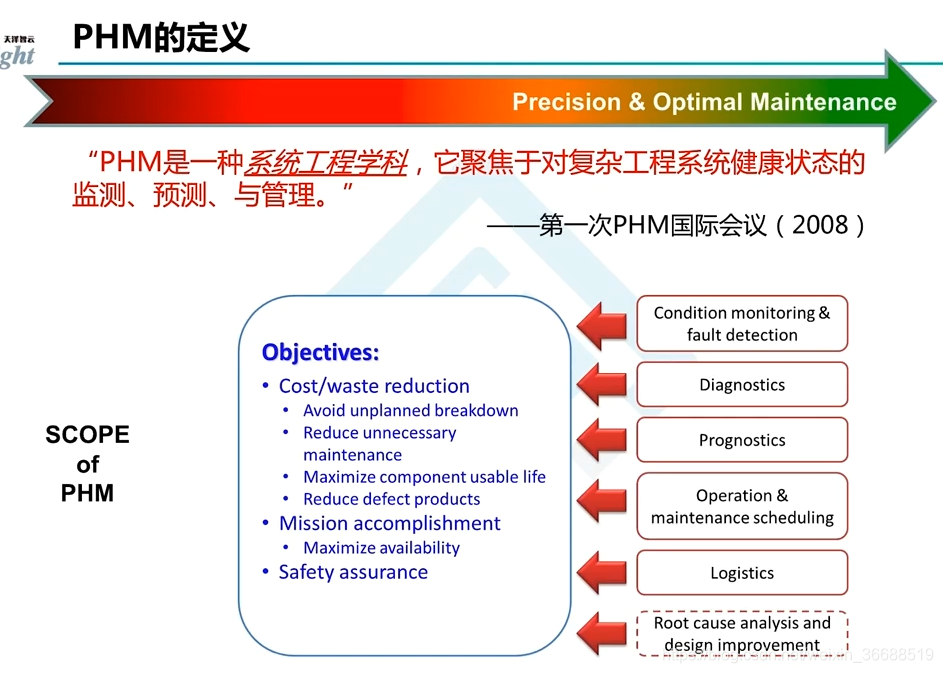
PHM itself is an engineering discipline, a synthesis and integration of knowledge from various engineering fields, forming a comprehensive theoretical system. Originating from engineering, it is an applied science focused on monitoring, predicting, and managing the health status of complex engineering systems. Therefore, it is a discipline born to achieve ultimate maintenance goals by precisely optimizing maintenance strategies.
The issues PHM addresses can be summarized as follows: primarily, cost reduction, achieved by predicting unexpected downtime events, reducing over-maintenance, maximizing the lifespan of components and equipment, and minimizing defective products in manufacturing.
- MTBD
Another aspect is improving equipment reliability. Here, a new concept is introduced: MTBD (Mean-Time-Before-Degradation), which corresponds to a very important concept in reliability theory: Mean Time to Failure (MTTF) or Mean Time Between Failures (MTBF). This concept typically applies to equipment with high repeatability and mass production, where reliability metrics can be statistically derived purely based on time.
When implementing PHM, we are more concerned not with the time to failure, but with the time to degradation before failure occurs. This is precisely the prediction capability that PHM offers for complex systems: determining when degradation will reach a critical level. Therefore, PHM focuses on a more refined reliability analysis.

- Concepts and Definitions First, the 'P' in PHM, which is called fault diagnosis in the industrial sector, refers specifically to the prediction of equipment's Remaining Useful Life (RUL) within the PHM discipline. RUL prediction requires several conditions: first, knowing when the equipment will fail, and typically having full lifecycle data. If the failure criteria can be quantified and correlated with full lifecycle process data leading to failure, then an RUL prediction model can be established. However, it is often difficult to obtain full lifecycle data, and the definition of failure criteria is often vague, which is very common in the industrial sector. If the definition of failure criteria is ambiguous, then quantifying it is out of the question. Therefore, what is more commonly done is assessing health trends, which we call health