RK3576/RK3588+FPGA+AI Service Robot Solution
Service Robot Solutions
For service robot scenarios, based on 3D vision perception technology, we achieve high-precision 3D depth information acquisition through self-developed ASIC chips, empowering service robots with functions such as perception, obstacle avoidance, and navigation. This can be widely applied in commercial cleaning, food delivery, building delivery, warehousing and logistics, education and entertainment, and other fields.
Xinmai has provided technology and product services to over 100 leading service robot brands, including Gaussian Robotics, Yunji Technology, and Pudu Technology.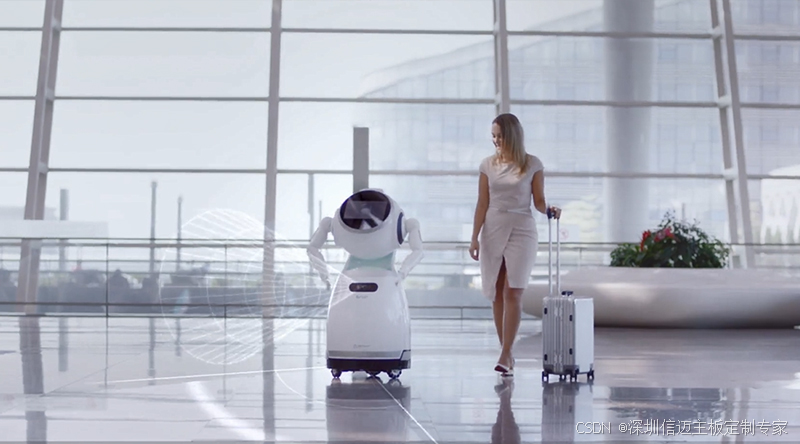
3D Vision Empowerment: One Cleaning Vehicle Frees Up Three Workers
Artificial intelligence is entering an explosive period of deep integration with industries and applications. A group of AI industry chain enterprises, represented by us, are empowering the implementation of AI applications in fields such as robotics and smart cockpits by independently developing key core technologies and increasing investment in application-oriented talent.
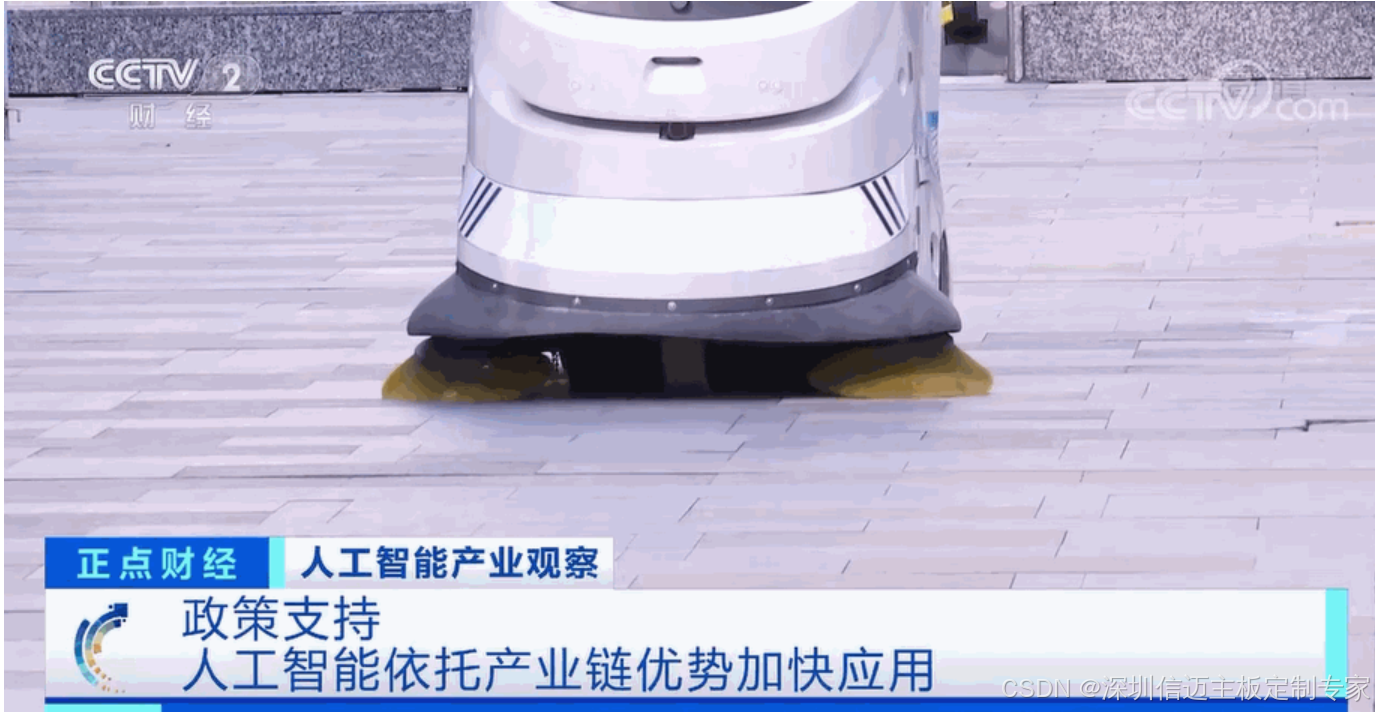
At Shenzhen Tian'an Cloud Valley Industrial Park, reporters observed a Gaussian cleaning robot, equipped with a 3D vision sensor and Xinmai robot controller, sweeping fallen leaves from the ground. With its "smart eyes" powered by 3D vision, the robot can automatically identify and clear trash, and autonomously avoid obstacles in complex outdoor environments, greatly improving cleaning efficiency. The park's cleaning operations manager stated, "The park covers tens of thousands of square meters, and the dining areas alone require three cleaning staff to work in rotation. Now, just one commercial cleaning vehicle can free up three workers."
Currently, as AI application scenarios proliferate, related products are continuously being deployed in fields such as robotics, smart cockpits, virtual reality, and industrial applications. Addressing the rising demand in the smart robot industry, Xinmai has launched various robot vision perception solutions, including binocular structured light, monocular structured light, iToF, and LiDAR, to help robots achieve functions such as mapping, localization, obstacle avoidance, and scene recognition.
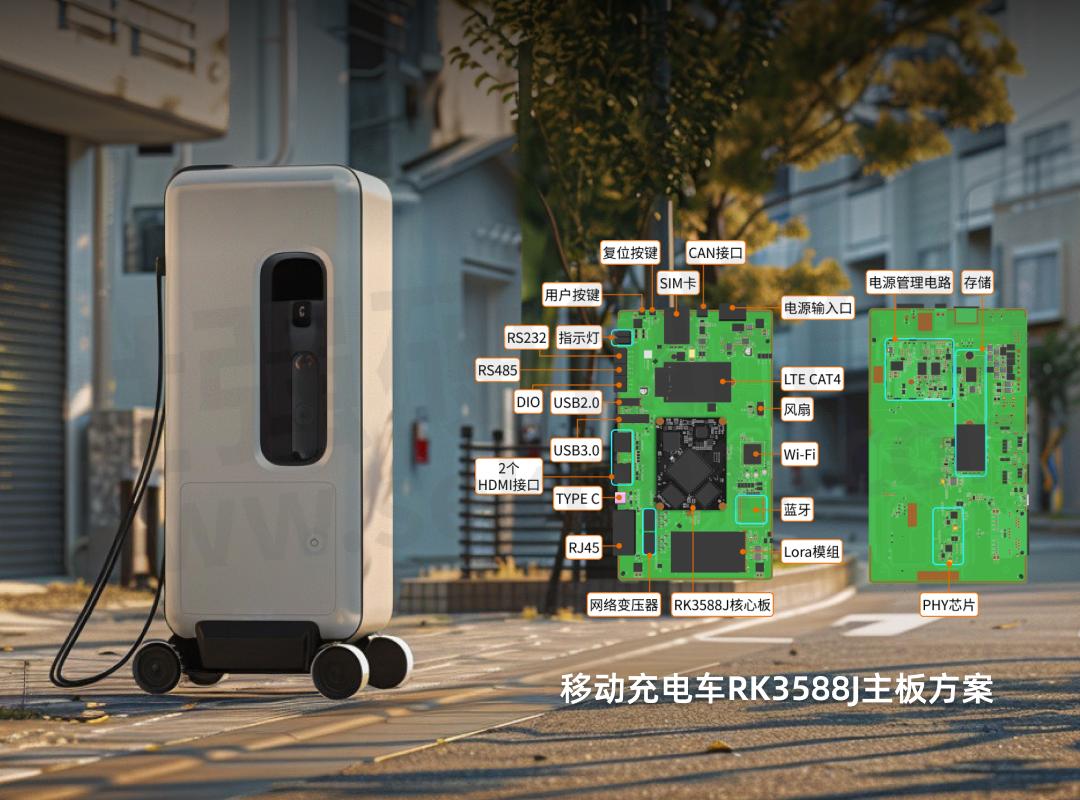
What are the features of the RK3588-based smart robot control board?
As the core brain of a robot, a smart robot control board needs to possess a series of key features to support its efficient and intelligent operation. The following are the main features required for a smart robot control board:
NPU Acceleration
-
Supports offline large models: Capable of handling complex AI tasks and running large neural network models even in unstable network or offline conditions.
-
Object recognition and other algorithms: Built-in or loadable algorithms for various object recognition, facial recognition, scene understanding, etc., enhancing the robot's perception capabilities.
-
Monocular ranging algorithm: Supports distance measurement via a monocular camera, enhancing the robot's spatial perception capabilities.
-
Flexible computing power stacking: Provides flexible computing power expansion capabilities, allowing NPU computing resources to be adjusted according to task requirements.
Operating System Support
-
Supports Linux and Android systems: Offers extensive support for Linux and Android operating systems, making it convenient for developers to choose the appropriate OS for development.
-
Android-friendly UI design: Provides user-friendly interface design tools and frameworks for robots using the Android system.
-
Linux standard adaptation for ROS/ROS2: Perfectly compatible with ROS (Robot Operating System) and ROS2, providing strong ecosystem support for robot application development.
Smart Voice Interaction
-
Multi-microphone array: Configures multiple microphone arrays to improve voice capture clarity and directionality.
-
Offline voice wake-up word: Supports offline voice wake-up functionality, allowing the robot to be activated by a specific wake-up word even without a network connection.
AMP Architecture Support
-
Strong real-time performance: Ensures the robot control board has extremely high response speed and real-time capability when processing critical tasks.
-
High stability: Adopts a stable hardware and software architecture design to reduce system failure rates and enhance the reliability of robot operation.
-
Lower hardware cost: Achieves a balance between performance and cost by optimizing the AMP (Asymmetric Multiprocessing) architecture.
ROS Compatibility
-
Compatible with standard ROS/ROS2: Seamlessly integrates ROS and ROS2, enabling robots to easily access various libraries, tools, and applications within the robot ecosystem.
-
Compatible with various radars: Supports multiple radar sensors (such as LiDAR, millimeter-wave radar, etc.), enhancing the robot's perception capabilities in complex environments.
-
Compatible with RK structured light: Highly compatible with Rockchip's self-developed structured light modules, achieving more precise 3D perception and measurement.

Advantages of RK3588 on Robot Control Boards
-
High CPU computing power: Up to 93KDMIPS of CPU computing power provides robust data processing capabilities for the robot control board, ensuring the robot can quickly respond to various commands and tasks.
-
High GPU computing power: Up to 512GFLOPs of GPU computing power supports complex graphics rendering and multimedia processing, enhancing the robot's visual perception and interactive experience.
-
High NPU computing power: Triple-core NPU with up to 6TOPs (INT8) of computing power, supporting deep learning frameworks, provides efficient and precise computing support for AI applications on the robot control board. For example, with the YOLO-v8n model, a single core can achieve an inference speed of 59.6fps, meeting the requirements of real-time applications.
-
Rockchip self-developed modules: Rockchip's self-developed structured light modules and RK1808 compute sticks provide more specialized hardware support for robot control boards, enhancing the robot's overall performance and functionality.
-
Industrial-grade chip standard: Supports a wide operating temperature range from -40°C to 85°C, ensuring stable operation of robots in various harsh environments.
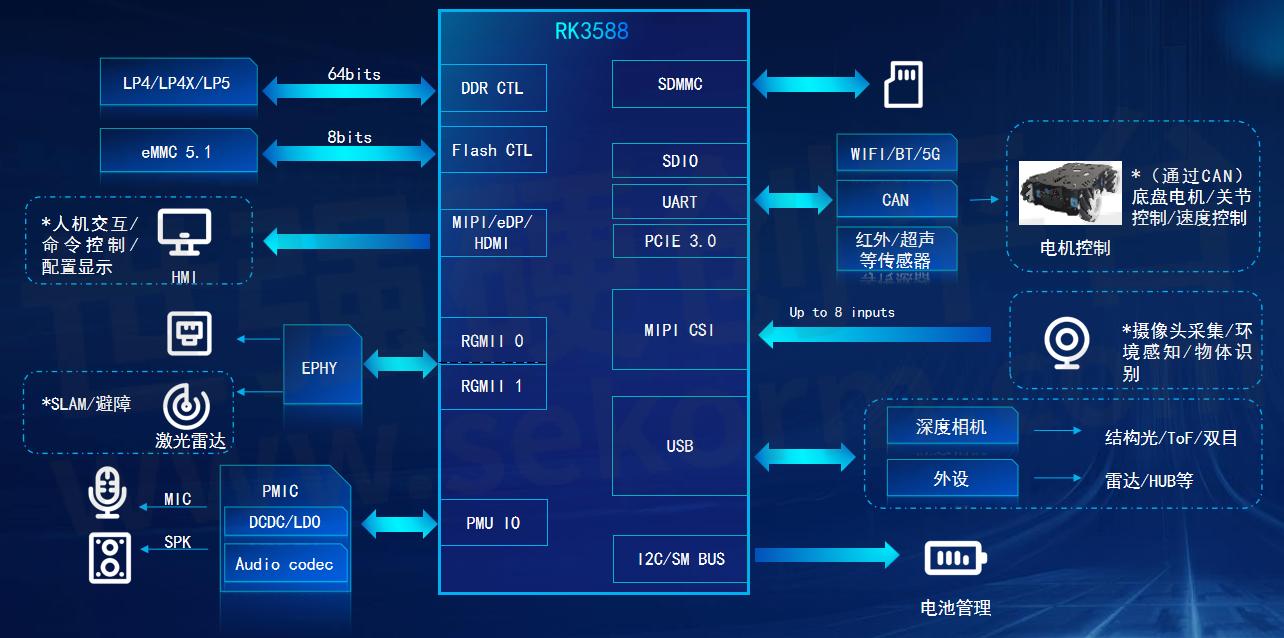
RK3588-based Robot Control Board Design Block Diagram