【Domestic Virtual Instruments】DSP6748+FPGA-based 4-channel Vibration/Voltage Portable Edge Computing Acquisition Board
4-channel Vibration/Voltage Portable Edge Computing Acquisition Board
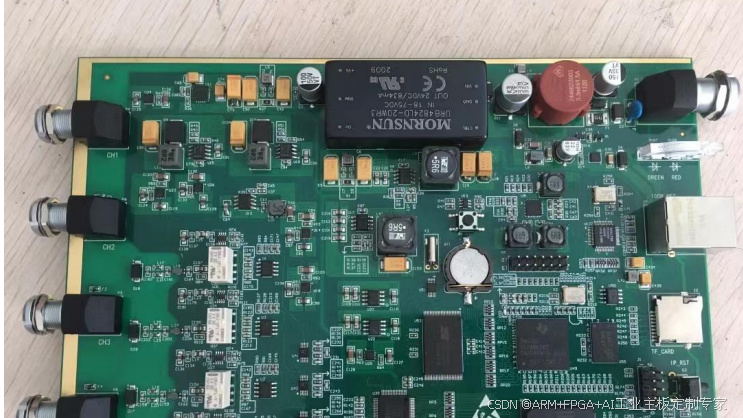
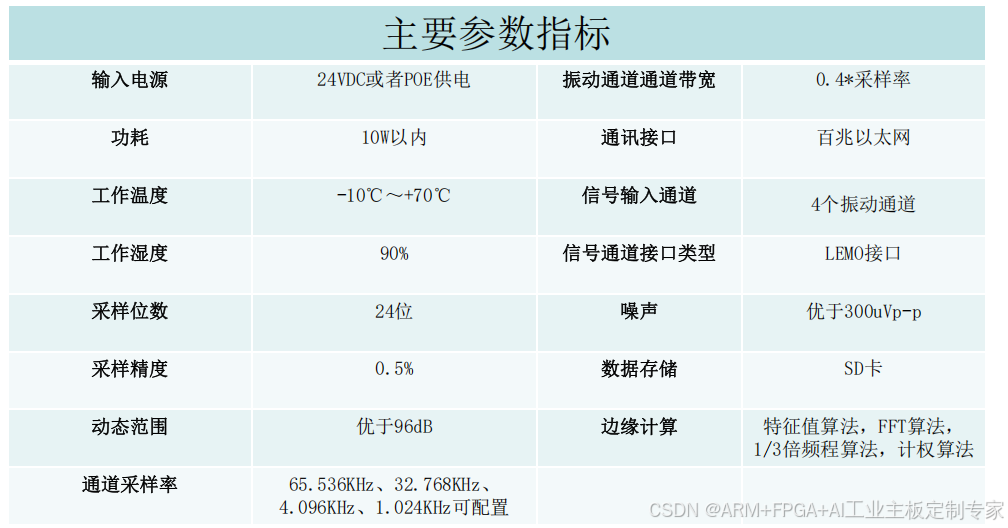
It adopts an EP4CE30F23I7 + TMS320C6748 architecture, primarily adding a DSP for edge computing of data. It is mainly applied in scenarios where the channel count requirements are not high, but high sampling resolution and accuracy, noise sensitivity, cost sensitivity, and certain edge computing capabilities are required.
NI boards, fully known as National Instruments boards, are a series of hardware devices launched by National Instruments (NI) for data acquisition, control, and signal processing. These boards are widely used in various test, measurement, and control systems, providing engineers and scientists with powerful data acquisition and processing capabilities.
Main features of NI boards: High Performance: NI boards possess high-speed data transfer capabilities, enabling high-speed, high-precision data acquisition and control. For example, some NI board models support sampling rates of up to millions of samples per second, and data resolution of up to 16 bits or higher. Flexibility: NI boards support various signal types, including digital and analog signals. Users can choose suitable board types according to their actual needs, such as analog input/output boards, digital I/O boards, multifunction RIO boards, etc. Programmability: Many NI boards are equipped with programmable FPGA (Field-Programmable Gate Array) chips. Users can use NI's LabVIEW FPGA Module or other programming languages to program the FPGA on the board, achieving custom on-board processing and flexible I/O operations. Ease of Use: NI provides a wealth of software tools and libraries, such as LabVIEW, MATLAB/Simulink, etc. These tools seamlessly integrate with NI boards, allowing users to easily perform data acquisition, analysis, and control.
Common types of NI boards: Analog Input/Output Boards: Used for the acquisition and output of analog signals, such as voltage, current, etc. These boards typically have multiple channels and support simultaneous acquisition of multiple signals. Digital I/O Boards: Used for the input and output of digital signals, such as switch states, encoders, etc. These boards typically feature high-speed data transfer capabilities and programmable digital lines, which can be used to implement various custom digital logic. Multifunction RIO Boards: Combine analog input/output and digital I/O functionalities, and also feature FPGA programming capabilities. These boards are typically used in applications requiring high-precision data acquisition and flexible I/O operations.
Application areas of NI boards: NI boards are widely used in various fields, including automated testing, automotive electronics, aerospace, energy, biomedical, etc. For example, in the automotive electronics field, NI boards can be used for testing and verification of systems such as engine control, chassis control, and body control. In the biomedical field, NI boards can be used in applications such as physiological signal acquisition and bioelectrical signal analysis.