RK3588 + Ascend AI | 40 TOPS AI Computing Box Design Solution
- Introduction to Integrated Video AI Analytics System
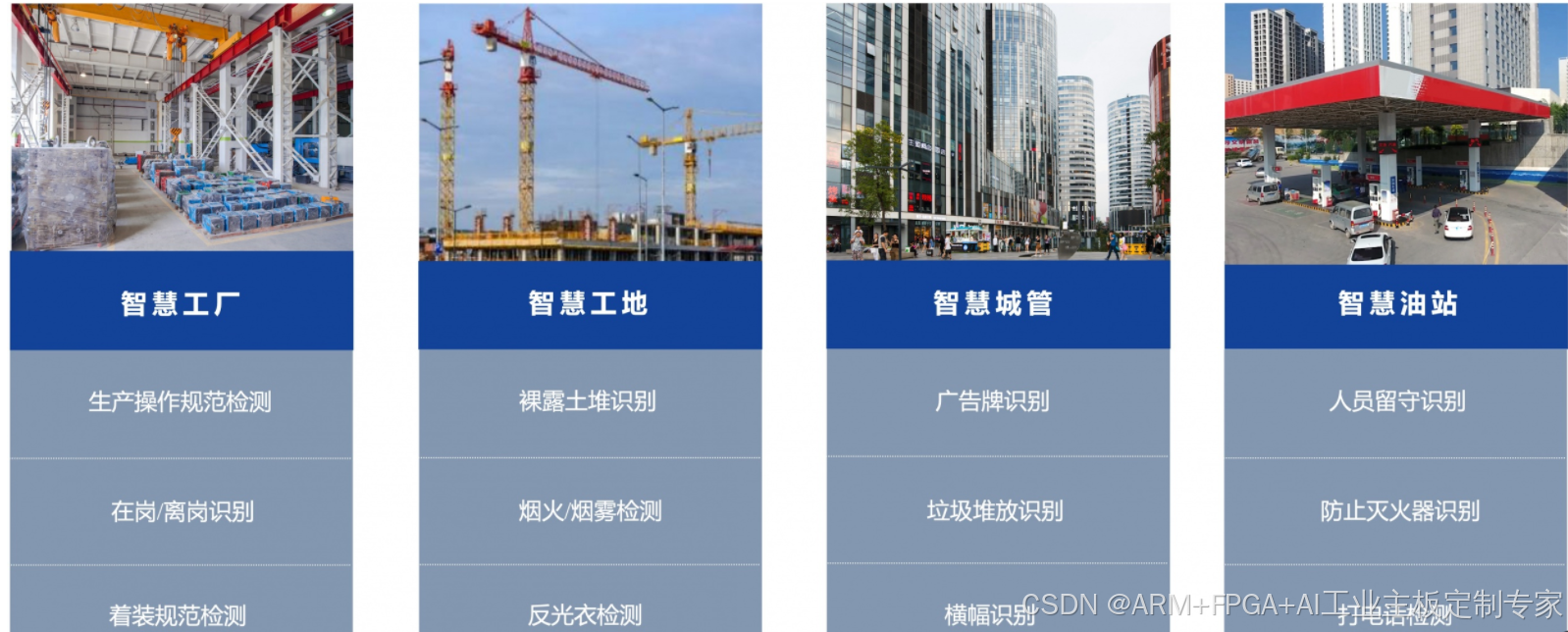
Based on computer vision technology, AI empowers various industries. Relying on AI visual analytics technology and robust "edge-to-cloud" computing power, it performs real-time analysis of events such as smoke, fire, and intrusion. In conjunction with a cloud-based early warning platform, it achieves a closed-loop process for event detection, early warning, and handling.
-
- Design Architecture
- System Architecture
- Design Architecture
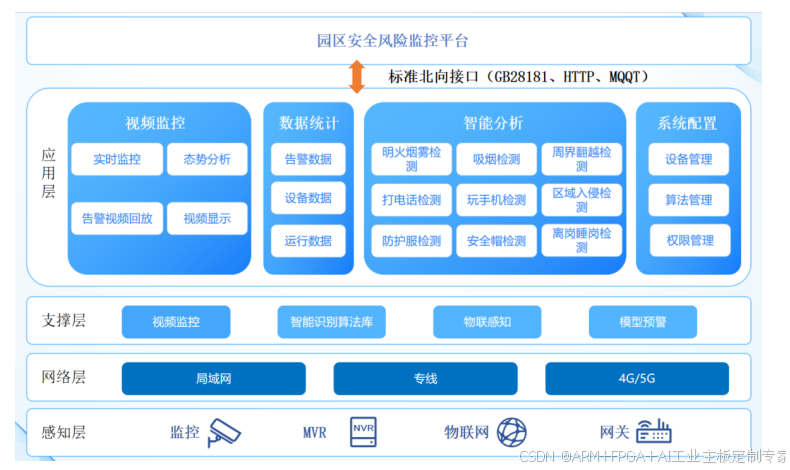
The video intelligent recognition system is divided into four layers from bottom to top: "Perception Layer, Network Layer, Support Layer, and Application Layer." The system's logical architecture is shown in the figure below:
Perception Layer
Connects to front-end sensing devices, such as video surveillance cameras, NVRs, and other IoT sensing devices. It performs real-time monitoring and analysis of critical channels and locations, providing the data foundation for scene analysis. The types of data collected include image streams and video streams.
Network Layer
The network layer connects to the main local area networks (LANs) and dedicated video networks within the factory area.
Support Layer
The support layer provides the main capabilities for the application layer, including video surveillance, intelligent algorithm repositories, other IoT sensing data, and the establishment of alarm models. It provides capability support for future, more intelligent business applications and management needs.
Application Layer
The application layer primarily handles integrated video intelligent early warning business applications, including but not limited to video surveillance, device management, event centers, and various safety and fire hazard applications.
-
-
- Deployment Architecture
-
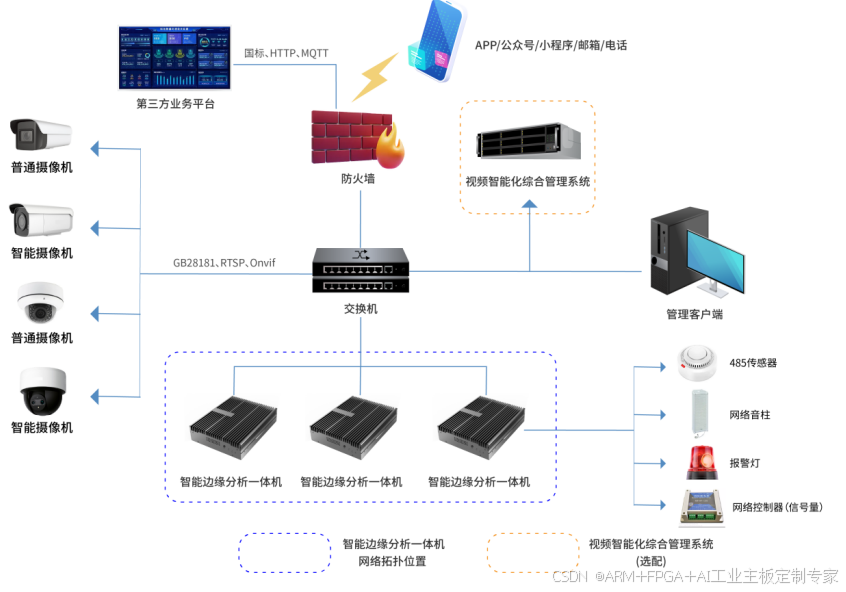
Data collection is performed using both new and existing cameras. Video streams are accessed via edge and cloud platforms, and AI intelligent analysis is performed on events. The system also supports transmitting results to third-party platforms for data display. The network architecture diagram of the system is shown below:
System Components:
- Existing Surveillance Cameras
Existing surveillance cameras refer to fully utilizing existing video surveillance and video storage infrastructure as data collection endpoints for video AI analysis.
- New Smart Cameras
New smart cameras refer to directly deploying surveillance cameras with AI analysis capabilities for newly added or supplemented surveillance blind spots, to actively identify and detect production safety incidents.
- AI Intelligent Analysis Server
The AI intelligent analysis server possesses two fundamental capabilities: it detects, analyzes, and recognizes various behaviors in real-time video from existing surveillance cameras, and it also receives and stores alarm events identified by new smart cameras. The intelligent analysis AI all-in-one machine highly integrates video preview, AI algorithm models, and the comprehensive video intelligent AI analysis business system.
The integrated video intelligent AI analysis business system primarily analyzes video data using intelligent analysis algorithms via common protocols such as RTSP, comprehensively displays the analysis results, and provides other business functions. It also supports interfacing alarm data with third-party business systems.
=================RK3588 + Ascend AI | 40 TOPS Computing Box================
● Equipped with quad-core A76 + quad-core A55, CPU clock speed up to 2.4GHz, expandable with 2 Ascend AI acceleration modules, with computing power up to 40 TOPS.
● 2-channel 4K UI, capable of smoothly running complex graphics processing.
● Supports development tools such as MindStudio, MindEdge, and CANN computing architecture.
● Supports Docker, Ubuntu 22.04.
● Expandable with wireless communication modules like 4G/WIFI6/BT.
● Expandable with mSATA SSD.
● Operating Temperature: -20℃ ~ 70℃.

This wide-temperature edge computing box, with built-in 40 TOPS computing power, is capable of decoding up to 80 channels of 1080p video and supporting 8K@30fps HDMI output. It features strong environmental adaptability, ultra-high computing performance, cloud-edge collaboration, large-capacity storage, flexible configuration, wide temperature range support, and easy maintenance and management. It can be widely deployed in edge environments.
Item
Type
Model Parameters
Description
Core
Configu-
ration
Processor
CPU
Quad-core ARM Cortex-A76@2.4GHz
Quad-core ARM Cortex-A55@1.8GHz
GPU
Quad-core ARM Mali-G610 MP4
NPU
6 TOPS@INT8
Memory
LPDDR4X
Default configuration 16 GB
Flash Storage
eMMC
Default configuration 64 GB
Codec Performance
Video Decoding
16 x 1080P@30fps H.264 AVC/MVC
32 x 1080P@30fps H.265/VP9/AVS2
Video Encoding
16 x 1080P@30fps H.264/H.265
Image Codec
Supports high-quality JPEG encoding
Hardware Features
Ethernet Port
(Ethernet)
x1
Ethernet port, supports 10/100/1000M network access
x8
Switch network port, supports 10/100/1000M network access
SFP
x1
For Gigabit optical-electrical signal conversion and data transmission
RS232
x1
Can connect to alarm input devices such as smoke detectors, infrared detectors, access control systems, or alarm output devices such as sirens (Note: RS232 cable length is recommended not to exceed 10m)
RS485
x2
Can connect to alarm input devices such as smoke detectors, infrared detectors, access control systems, or alarm output devices such as sirens
HDMI OUT
x1
HDMI 2.1 interface, can output 4K@120fps/8K@30fps video source to display terminals, compatible with audio output
LINE IN/OUT
x1
1 audio input interface, 1 audio output interface, 3.5mm stereo jack
USB3.0
x2
Can connect devices such as USB flash drives, USB mice, USB keyboards
CAN
x1
Standard CAN 2.0 interface
TF Card Slot
x1
Can insert TF card to expand storage space
SIM Card Slot
x1
For wireless network connection
ADB
x1
For device image flashing (Type-C)
DBG
x1
For wired device debugging (Type-C)
Power Interface
x1
DC 12V
Expandable
Features
Reserved two AI module expansion interfaces
(Dual module specification)
NPU
40 TOPS@INT8
Video Decoding
80 x 1080P@30fps H.264/H.265 video decoding
Video Encoding
40 x 1080P@30fps H.264/H.265 video encoding
WiFi+BT
x1
WIFI6, dual-band 2.4GHz and 5GHz;
Bluetooth BT5.4;
Requires a case with expandable external antenna and antenna.
4G/5G
x1
Expandable 4G/5G wireless communication module, requires antenna
mSATA
x1
Expandable mSATA large-capacity SSD
SATA
x1
Supports optional 1 x 3.5-inch SATA hard drive
SIM Card Slot
x1
Used with 4G/5G wireless communication module
Linux
File System
ext4
Ubuntu22.04 LTS
Software
Develop-
ment
Media Processing
Gstreamer
Compatible with rkmpp plugin, including interfaces for video decoding, video encoding, image encoding, image decoding, display, RGA, etc.
Computing Architecture
AI Frameworks
Supports deep learning frameworks such as TensorFlow, Caffe, Pytorch, Tflite, ONNX, MindSpore
CANN
By providing AscendCL programming interfaces (supporting Python and C++ languages), it enables users to quickly build AI applications and services based on Ascend AI processors.
Basic
Modules
Network Settings
Command Execution
Supports static and DHCP network parameter settings
Running Status
CPU, Memory, Disk
Device Information
Hardware operating frequency, device junction temperature
Log Management
Running status, operation errors, etc.
Time
NTP, manual time synchronization
Upgrade Management
Flashing Upgrade
Supports TF card upgrade