【AI Servers】Domestic PCIe 5.0 Switch SerDes Testing and Analysis, Taking an 11-slot PCIe GPU Backplane (PCIe 4.0/5.0) as an Example (Part 2)
3 Comparison of PCIe 4.0 SerDes and 5.0 SerDes Requirements
Table 2 summarizes the differences between PCIe 4.0 and 5.0 SerDes requirements. The PCIe standard comprises three interdependent specifications designed to ensure interoperability of SerDes and channels from different vendors:
● The PCIe BASE specification defines the chip-level performance for the entire protocol stack, a comprehensive document exceeding one thousand pages.
● The PCIe CEM (Card Electromechanical) specification defines the minimum performance of devices at the add-in card connector.
● The Test specification defines the rules for compliance testing.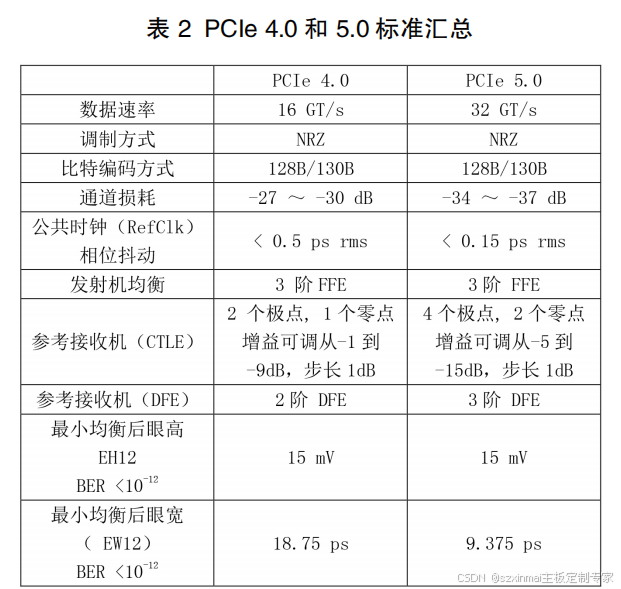
As seen from Table 2, PCIe 4.0 and 5.0 share many commonalities. Both use NRZ modulation, 128B/130B encoding, the same 10^-12 bit error rate target, and have identical connector pinouts. The transmitter uses the same Feed-Forward Equalizer (FFE) scheme and has 11 sets of tap presets, P0-P10. Key features:
First, PCIe 5.0's reference receiver equalization scheme is more complex; unlike the 2-pole 1-zero Continuous Time Linear Equalizer (CTLE) response used in PCIe 4.0, PCIe 5.0 uses a 4-pole 2-zero CTLE filter response (see Figure 2).

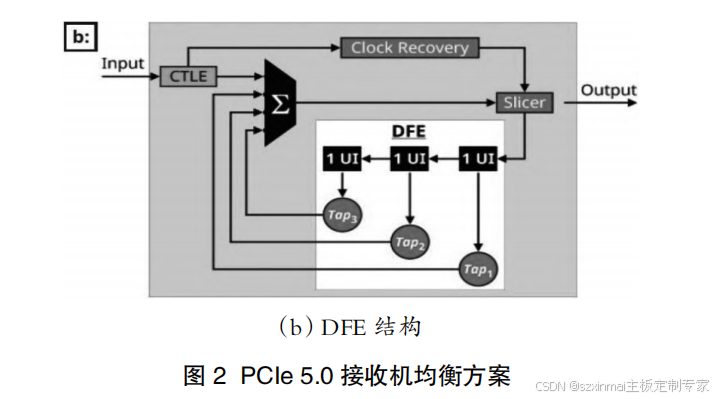
Second, the new CTLE is more flexible and offers greater gain, ranging from -5 to -15 dB. PCIe 5.0 also adds a third tap to the reference receiver Decision Feedback Equalizer (DFE).
Third, transmitter swing requirements remain unchanged. In PCIe 4.0 and 5.0, jitter requirements are the same in UI units but proportionally narrower in ps units. A Distributed Reference Clock or Common Clock (CC) architecture was optional in PCIe 4.0 but is now mandatory in PCIe 5.0.
Fourth, since the biggest challenge in increasing from 16 GT/s to 32 GT/s is the increase in maximum allowed loss from -28 dB to -36 dB, it is not surprising that channel requirements have been redefined. Add-in cards in the CEM specification are now only permitted to use surface-mount connectors, meaning through-hole connectors are no longer allowed.
Fifth, the increased loss has led PCIe 5.0 to introduce new compliance test boards. Acceptable PCIe test fixtures for compliance testing can only be obtained from the PCI-SIG organization. Test fixtures include a Compliance Base Board (CBB) that emulates the motherboard and a Compliance Load Board (CLB) that emulates add-in cards and channels; both can be externally controlled via reset and transmitter preset switching.
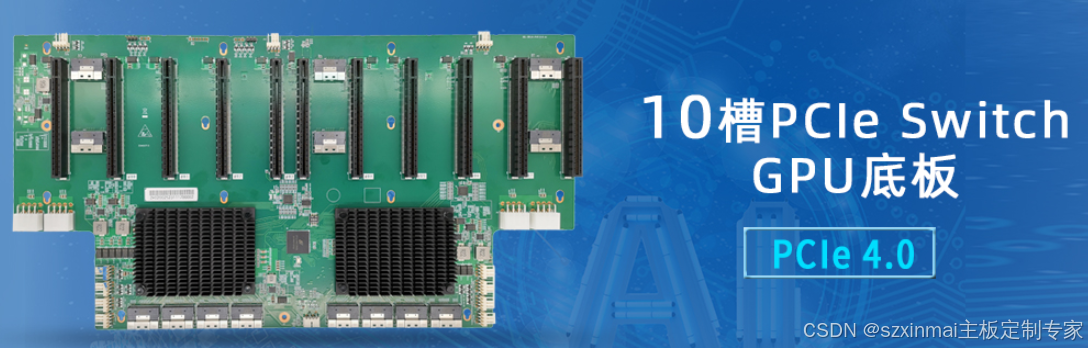
============10-slot PCIe Switch GPU Backplane (PCIe 4.0 / PCIe 5.0)==========
• 1 direct-connected single-width slot; • 14* SFF-8654x4 PCIe4.0/5.0 host interfaces; • 11* PCIe4.0 x16 slots; • 4*CPU 8Pin power interfaces; • 11* 4-pin fan interfaces; • 1*IPMB interface;
Functional Features
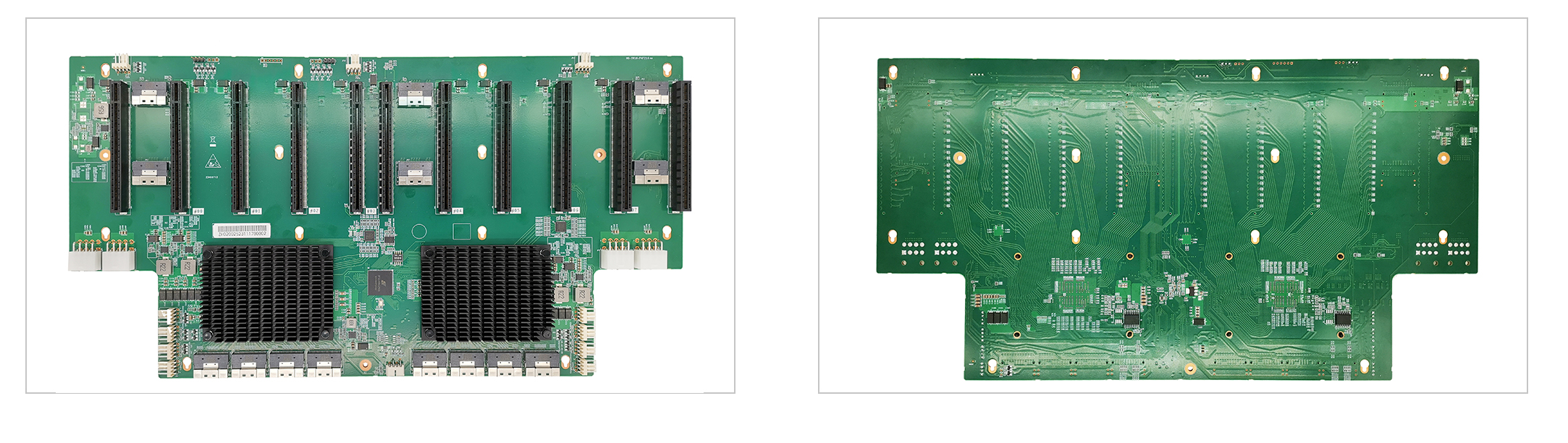
Product Specifications 10-slot switch backplane (PCIe 4.0) Model MG-SW10-P4F216-V11 Host Interface 14* SFF-8654x8 PCIe4.0 Number of PCIe Slots 11* PCIe4.0 x16 Power Interface 4* CPU 8PIN IPMB Interface 1*4Pin BMC I2C Dimensions 420(L) x 225(W) x 2.5(H) (mm)
☑Supports OEM/ODM customization services