Signal Integrity Design and Implementation of Locally-Produced PCIe 4.0/5.0 Switches for AI Server HBA Cards, Customizable (Part 2)

Table 2 shows the relative permittivity and loss tangent at different frequencies for the selected PCB dielectric materials: PSR4000AUS703, R-5670G-3313, R-5775G-3313, R-5670G-2116 x3, and R-5775G-2116. The R-5670G/R-5775G materials chosen for this design are resin-based laminates from the high-performance, ultra-low loss category, offering very low dielectric constant and loss tangent, excellent moisture and chemical resistance, good resistance to Conductive Anodic Filament (CAF), and strong thermal stability, among other advantages.
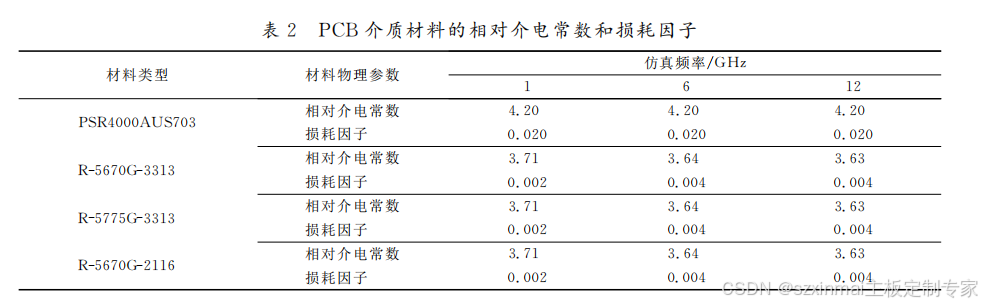
Many design challenges were encountered during the design process. Initially, factors affecting signal integrity were not fully considered, leading to poor signal integrity. Therefore, the design files were modified. For example, by switching to PCB dielectric materials with smaller dielectric constants and loss tangents, signal propagation speed was increased, signal loss was reduced, and signal transmission quality was improved. Selecting appropriate stack-up thickness, specifically choosing suitable copper thickness for the TOP and BOTTOM layers, reduced reflections from differential impedance mismatch and improved signal transmission quality. Furthermore, changing the corners of the main differential signal transmission lines from 45° routing to arc routing reduced the length of these lines.
2 Simulation and Measurement Analysis
2.1 S-Parameter Extraction
2.1.1 Basic Concepts of S-Parameters
S-parameters, or scattering parameters, are important metrics for measuring signal integrity. S-parameters are defined as the ratio of the sinusoidal wave scattered from a specific port of the device under test (DUT) to the sinusoidal wave incident on a port of the DUT [11]. S_mag represents the magnitude value; the magnitude of an S-parameter is the ratio of the amplitudes of the output and input sinusoidal waves, corresponding to the transformation when a sinusoidal wave enters port 'a' and exits port 'b'. The S-parameter is defined as follows: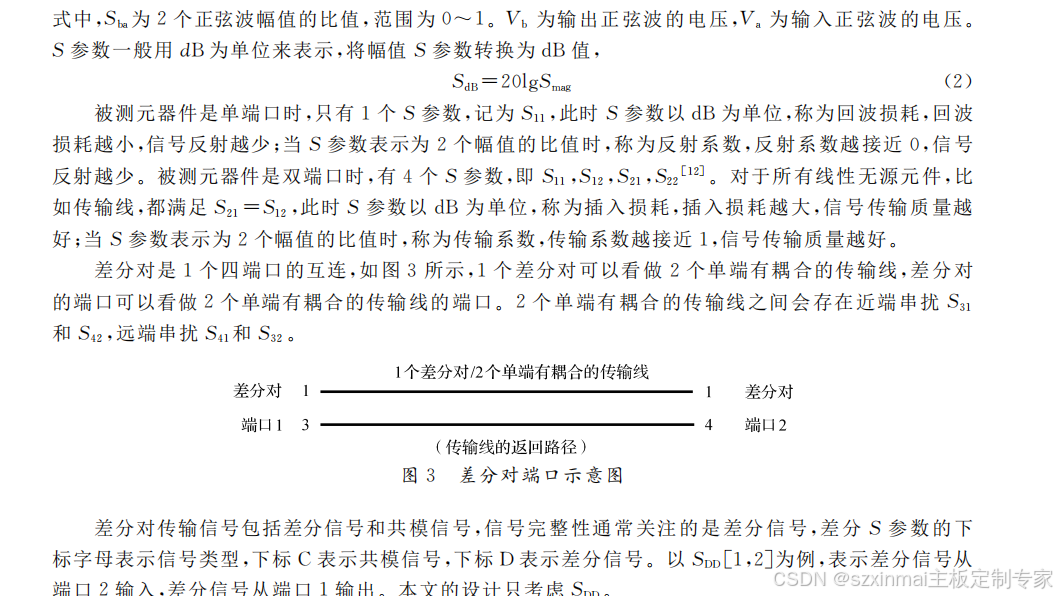
=========================
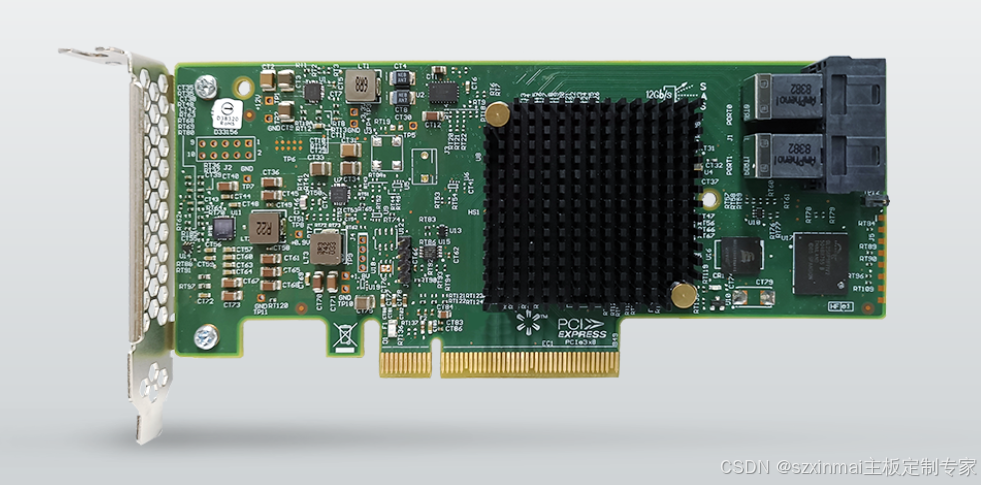
Technical Specifications
Data Transfer Rate
12GB/s SAS 3.0 Compliant
SAS Lane Width
Half Duplex (x8 wide bus)
9600MB/s
Port Configuration
8 ea, x1 ports (single drive)
2 ea, x4 wide ports
LED Management
Refer to SFF-8485 (SGPIO) compliant
PCI Power
13W
Host Bus
x8 lane, PCIe 3.0
PCI Data Transfer Rate
Half Duplex
x8 PCIe 3.0 8000MB/s
Environmental
Operating Temperature: 0℃-55℃
Storage: -45℃-105℃
5-90% non-condensing
Airflow: 200LFM
Integrated RAID
14 spread across 2 volumes
RAID 0 10 per volume
RAID 1 2 per volume plus hot spare
RAID 1E 10 per volume
RAID 10 10 per volume
MTBF
2,800,000 hours