In Vitro Diagnostics: Applications of ARM+FPGA Embedded Computers in Fully Automatic Blood Gas Analyzers and Automatic Biochemical Analyzers
In Vitro Diagnostics

We provide computer hardware such as core boards, 2.5-inch motherboards, Mini-ITX motherboards, 4-inch motherboards, PICO-ITX motherboards, and embedded barebone systems based on Intel, AMD, and NXP platforms. Our products support independent dual displays like VGA+HDMI and offer a rich array of I/O interfaces including serial ports, USB, GPIO, and PCIe expansion slots. With strong expandability, ultra-high stability, and reliability, they are suitable for various in vitro diagnostic instruments, such as biochemical analyzers, immunoassay analyzers, and electrolyte and blood gas analyzers.
Applications of Embedded Computers in Fully Automatic Blood Gas Analyzers
In recent years, driven by the rapid advancements in the internet, computer technology, and laboratory medicine, China's in vitro diagnostics industry has become increasingly active. Particularly in clinical medical applications, this has led to higher demands for the quality and performance of various IVD devices.
01
Currently, in vitro diagnostics are extensively used in clinical medicine. Most disease diagnoses rely on various IVD devices to test samples such as human body fluids, cells, and tissues for etiology confirmation. The test data from IVD serves as a crucial reference for doctors in determining treatment plans. With the rapid development of science and technology and laboratory medicine, and increasing health awareness among people, there are higher demands for the depth, accuracy, and efficiency of IVD methods. IVD instruments are gradually entering the semi-automatic/fully automatic era.
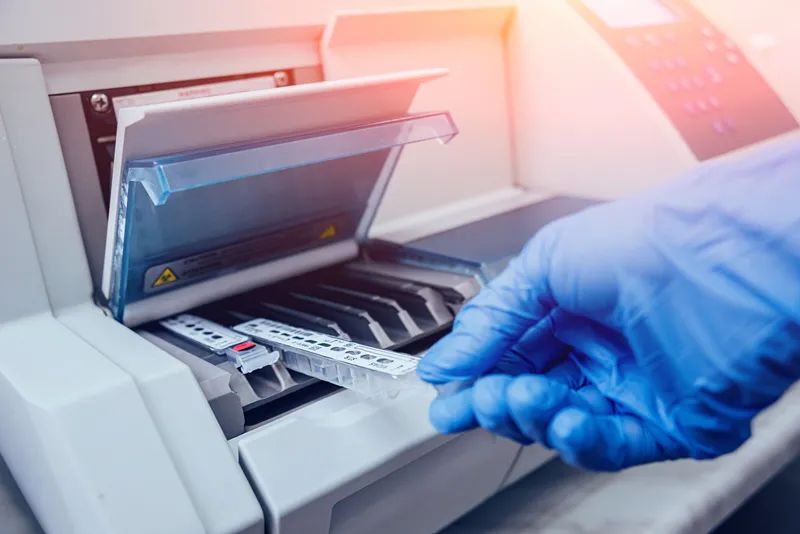
Image source: qiantu.com (Please contact us to remove if infringement occurs)
Taking the fully automatic blood gas analyzer as an example, it employs advanced electrical impedance detection, an independent measurement system, and all-digital cell signal processing technology. Controlled by a computer and complemented by a high-definition display interface, it can quickly detect changes in parameters such as oxygen and carbon dioxide content and blood pH in a patient's blood, and provides rich data and charts. Its characteristics of efficient detection, comprehensive parameters, and high degree of automation can significantly improve diagnostic efficiency and treatment outcomes. Therefore, it is widely used in critical care units, operating rooms, and emergency departments.
It is understood that medical institutions and relevant personnel have extremely high requirements for the quality and measurement functions of fully automatic blood gas analyzers. To ensure accurate and efficient detection by blood gas analyzers, professional, reliable, and high-performance computer hardware must serve as its technical foundation.
02
Xinmai Technology is a well-known professional provider of embedded computer products in China. It actively targets the medical device market, developing diverse computer board cards and embedded barebone systems using processors from platforms like Intel, AMD, and NXP. These products support the widespread application of IVD devices such as fully automatic blood gas analyzers, biochemical analyzers, and immunoassay analyzers.
Addressing the multi-parameter and multi-functional detection requirements of fully automatic blood gas analyzers, we have developed computer hardware such as embedded core boards, 2.5-inch motherboards, and Mini-ITX motherboards, featuring excellent architecture and highly integrated functions. Our products integrate efficient processing cores, supporting higher frequency and larger capacity data processing. They feature onboard memory and support high-speed SATA storage. Multiple high-performance Gigabit Ethernet ports provide a flexible network application environment. A rich array of I/O functional interfaces, including serial ports, USB, GPIO, and PCIe expansion slots, supports the connection of various external devices. They support watchdog functionality and Windows/Linux operating systems, ensuring ease of use and maintenance.
To ensure the high stability and reliability required for efficient operation of fully automatic blood gas analyzers, Xinmai Technology has developed a medical device-specific fanless embedded barebone system with finned heatsinks. The fanless design is energy-efficient and environmentally friendly. It features onboard memory, supports application algorithms, and enables large-capacity, high-frequency data transmission, storage, and processing. The CPU integrates graphics control, supporting VGA+DVI/HDMI+DP display interfaces and high resolutions. It supports Gigabit Ethernet/WIFI/3G/4G networks, watchdog functionality, Windows/Linux operating systems, and desktop/wall-mount installation. Built strictly to industrial-grade standards, it features low power consumption, excellent electromagnetic compatibility, high stability, and high reliability.
Currently, fully automatic biochemical analyzers are widely used in hospitals at all levels, playing an active role in clinical diagnosis and treatment. Continuously focusing on the in vitro diagnostics industry, we offer comprehensive embedded computer products with both X86 and ARM architectures to provide hardware support!
Rapid Development of the IVD Industry, Offering Dedicated Computers for Automatic Biochemical Analyzers
With the acceleration of China's economic development and the gradual implementation of healthcare reform policies such as the "Healthy China 2030" plan, domestic medical resources are being decentralized. This has led to a surge in demand for in vitro diagnostic equipment in grassroots medical systems, ushering in rapid development for the domestic IVD industry.
01
In vitro diagnostics (IVD) refers to products and services that obtain clinical diagnostic information by testing samples outside the human body, such as blood, body fluids, and tissues, to assess bodily functions or diagnose diseases. As a branch of IVD medical devices, automatic biochemical analyzers can perform analytical determinations for various reaction types, such as timed assays and continuous monitoring for special compounds like hormones and drug concentrations, in addition to general biochemical parameters. Furthermore, steps such as sampling, colorimetry, result calculation, and report generation can all be completed by instruments that mimic manual operations. They are characterized by simplicity, efficiency, sensitivity, and standardization, playing a positive role in further improving disease prevention, diagnosis, and treatment.
![195