X86+FPGA+AI-based Telemedicine System Supporting 12th/13th Gen Intel Core Processors
Industrial Motherboard: Supports 12th/13th Gen Intel Core Processors, Suitable for Telemedicine Systems
In response to the trends of digitalization, networking, and intelligentization, China's healthcare industry reform is actively progressing. New models and business forms such as telemedicine and smart healthcare are innovating and developing, and the market space is continuously expanding. Industrial motherboards built on 12th/13th Gen Intel Core processors support telemedicine system applications.
Widespread Application of Telemedicine Technology
Telemedicine, in essence, is a new medical service model that relies on computer technology, sensor technology, remote sensing/telemetry/remote control technology, etc., to effectively connect medical resources with patients, achieving resource sharing and optimized allocation for hospitals. It can break geographical and temporal limitations, bringing higher-quality medical technologies and methods from large hospitals or specialized medical centers to remote areas with poorer medical conditions, providing patients with more efficient, convenient, and precise medical services.

Against the backdrop of an aging population, the driving force of new-generation information technology development, and the deepening of China's healthcare reform policies, domestic telemedicine technology has achieved rapid development and widespread application in recent years. Specifically, by establishing advanced telemedicine systems, medical institutions can provide services such as remote consultation, remote monitoring, remote surgery, and health management for medical staff and patients, based on advanced algorithms, high-speed networks, real-time voice, and high-resolution image communication. This significantly improves the service efficiency and quality of medical institutions at all levels, making medical care more comfortable and reassuring for people.
However, when it comes to practical application, the establishment and operation of telemedicine systems place stringent demands on the computing power, communication capabilities, multimedia performance, scalability, and stability of the main control computer platform. It requires industrial computer products with stronger data processing capabilities, richer functional interfaces, and greater security and reliability to provide critical support, such as industrial motherboards built on 12th/13th Gen Intel Core processors.
Industrial Motherboard Product Introduction
The industrial motherboard supports 12th/13th Gen Intel Core processors, offering high computing power and excellent graphics processing performance. Its rich I/O functional interfaces support multiple expansions, are compatible with various operating systems, and boast advantages such as low power consumption and high reliability. It can be highly integrated into telemedicine systems.
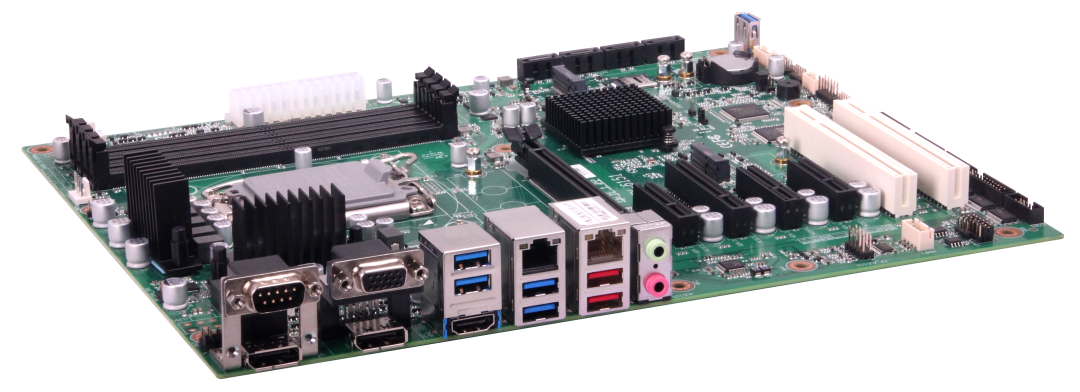
The main technical features of the industrial motherboard are as follows:
- Supports Intel Q670E chipset and 12th/13th Gen Intel Core i3/i5/i7/i9 processors, achieving improved single-thread and multi-thread processing performance based on Intel's high-performance hybrid architecture, resulting in stronger data processing capabilities;
- Supports DDR5 4800MHz, with 4*UDIMM memory slots, supporting up to 128GB on the entire board, further amplifying bandwidth and data throughput advantages;
- Supports 4SATA 3.0 and 1M.2 M KEY 2280 PCIe x4 (GEN4) NVMe SSD for high-speed caching and further expanded storage capacity.
- Integrated Intel® UHD Graphics (model depends on CPU processor), supports 1PCIe x16 (16-lanes) GEN5 allowing high-end graphics cards to achieve ultimate performance, supports 1VGA, 1HDMI, 2DP display interfaces to meet 4K resolution display and independent multi-display requirements;
- Supports 2*LAN 10/100/1000Mbps RJ45;
- Supports 1*M.2 B Key 3042/3052 interface for 4G/5G module expansion;
- Supports 1*M.2 E Key 2230 interface for Wifi/Bluetooth module expansion;
- Supports 4USB3.2 GEN2 (10 Gbps), 3USB3.2 GEN1 (5 Gbps), 5*USB2.0 interfaces for multi-device networking;
- Supports 8RS232, 2RS232/RS422/RS485 interfaces for higher-speed data transmission;
- Supports 2Line out, 2Mic in, 1*Line in audio interfaces;
- Supports 1PCIe x4 (4-lanes) GEN4, 2PCIe x4 (4-lanes) GEN3, 1PCIe x8 (4-lanes) GEN3, 2PCI for enhanced scalability;
- Supports 1PS/2 interface, 8GPIO, 1CPUFAN, 1SYSFAN, 1JFP, 1SIM, 1*AMP interfaces to meet the needs for more peripheral connections;
- Supports Windows 10, Linux operating systems;
- Supports TPM2.0, meeting Windows 11 system operating requirements;
- Supports AMI EFI BIOS, shortening system boot time;
- Supports Intel AMT and Intel vPro Technology, providing hardware-based security-related features;
- Developed watchdog function, supporting software power-on auto-start;
- Supports standard ATX 24Pin +8Pin power supply, and meets 0℃~60℃ wide temperature operation requirements, suitable for various harsh environments such as complex electromagnetic environments;
- Dimensions of 305mm x 244mm, highly integrated functionality, easy to deploy.
As a provider of industry-specific embedded computer products, Sinmai has always been committed to providing customers in various industries with customized production services for diverse embedded motherboards, embedded barebones/industrial PCs, and industrial panel PC products based on X86 and ARM architectures.