Managed Board-Type Industrial Ethernet Switch for Rail Transit Applications
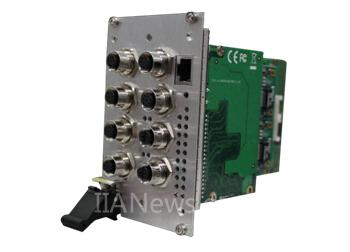
This is a managed CompactPCI board-type redundant ring network switch. The front panel features six 10/100/1000Base-T(X) M12 interfaces. The rear CPCI interface provides eight 10/100/1000Base-T(X) Ethernet interfaces. It is a rugged switch specifically designed to meet the EN50155 standard requirements for the rail transit industry. It also possesses the following features:
● Supports 2-wire Ethernet distance extension ports, saving cabling costs.
● Media Redundancy Protocol (MRP) allows switches in a ring network to recover quickly upon signal failure, achieving faster recovery times than Spanning Tree Protocol networks.
● Provides advanced IP-based bandwidth management: Users can now set the maximum bandwidth for each IP device. When using IP cameras and NVRs, bandwidth management can allocate greater bandwidth to them.
● Supports application-level QoS: Application-level QoS allows setting different priorities for data streams based on TCP/UDP ports.
● Device Binding function: The device binding feature only allows specified MAC addresses to access the network; others cannot access the network without permission. It effectively prevents unauthorized network access.
● Advanced DOS/DDOS automatic protection: If IP flooding behavior suddenly increases within a short period, the switch will lock the source IP address for a certain duration to prevent attacks. This is hardware-level protection, so it can be enabled immediately, providing instant protection against DOS/DDOS attacks.
● TCP/IP Network Modbus Protocol
● IEEE 802.3az Energy-Efficient Ethernet (EEE) technology: Allows reducing hardware power consumption when data volume is low. Reduces power consumption by over 50% while maintaining compatibility with existing devices.
● Supports Ethernet redundancy protocols MSTP (RSTP/STP compatible), enabling critical applications to quickly resume communication in case of network interruption or short-term failure.
● Wide operating temperature range of -40°C to 70°C to meet demanding industrial environment requirements. Also provides Telnet and console (CLI) configuration methods.
Applications:
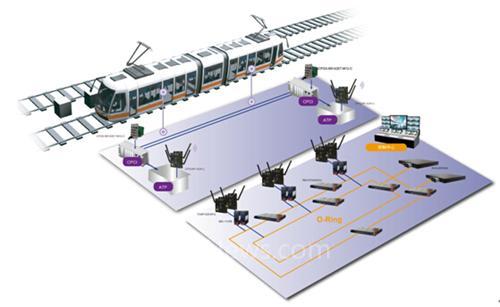
To ensure the reliability of information transmission in on-board CBTC systems, the switch is used in on-board CBTC systems to complement the application of on-board ATC computers. This switch is installed inside the on-board ATC computer to transmit critical signal data such as on-board ATP. Some switch ports can be routed out via the CPCI backplane.
It complies with the TTDP (Train Topology Discovery Protocol). Two units are deployed, one in the locomotive and one in the carriage, allowing for a transmission distance of 100-300 meters without the need for additional switches in between, thereby reducing potential failure points and improving transmission efficiency. TTDP (Train Topology Discovery Protocol) was developed to improve the efficiency of rail transit network configuration. This protocol allows network switches to automatically negotiate with other network devices when the network topology changes, and assign an IP address to network devices based on instructions from new train carriages. Network administrators or other operational personnel do not need to manually reconfigure network devices. With this technology, train operators can significantly improve their operational efficiency and minimize configuration errors. The system also features a hardware bypass function; when a node fails, the system quickly finds another path and continues operation, ensuring uninterrupted network connectivity.