Domestically Produced + AI Port Video Management and Monitoring System
The Port Video Management and Monitoring System addresses port operations, port area safety, and the regulatory requirements of superior authorities such as port authorities, customs, tax authorities, maritime affairs, border inspection, and public security. Utilizing modern information technology, it organically integrates terminal operation areas, anchorages, waterways, berths, container yards, gatehouses, warehouses, port perimeters, road surveillance, gate control, entrance/exit surveillance, and building surveillance. This creates a video management system with "unified encoding and decoding standards, unified networking protocols, unified control protocols, unified numbering rules, unified image annotation, and unified location identification." It integrates video and image resources from various sources and formats to achieve network-wide sharing of video and image information, meeting the 24-hour monitoring and evidence collection needs of various business units.
Background and Challenges
In China's "National Coastal Port Layout Plan," the layout of coastal ports will strategically form five port clusters: Bohai Rim, Yangtze River Delta, Southeast Coast, Pearl River Delta, and Southwest Coast, increasing the new throughput capacity of coastal ports by over 80%. Currently, China has over 150 coastal ports along its 18,400-kilometer coastline.
The "Regulations of the People's Republic of China on Port Facility Security" clearly stipulate the security rules system for port facilities, with explicit requirements for the construction of surveillance systems. Currently, port security has become one of the focal points of concern in the global port industry. In accordance with the amendments to the SOLAS Convention adopted by the International Maritime Organization in December 2002, the "International Ship and Port Facility Security Code" (ISPS Code) was specifically added. China is a member state, and therefore all Chinese ports will install relevant surveillance systems in accordance with the treaty provisions.
Port surveillance is often divided into sub-system projects such as operation areas, anchorages, waterways, berths, container yards, gatehouses, public security traffic, environmental monitoring, and maritime affairs. Currently, the construction of most sub-systems in port surveillance projects is relatively fragmented. The video resources that can be shared by cross-departmental entities such as terminal companies, customs, border defense, and public security are limited, making it difficult to form an effective integrated prevention and control system. Technical obstacles exist in maintaining port order, ensuring safe production, and facilitating emergency command.
Solution
Addressing the characteristics of port surveillance, which involves a wide coverage area, numerous and dispersed monitoring points, Feilike Port Video Management and Monitoring System builds a comprehensive port video surveillance system for ports. It covers key areas such as terminals, berths, container yards, warehouses, waterways, roads within the port area, intersections, and checkpoints. It involves six major surveillance systems: land cargo transportation system surveillance, terminal operation system surveillance, yard and warehouse operation system surveillance, port perimeter security, port building surveillance, and port road surveillance, providing visual management and prevention/control for port production elements (storage, containers, loading/unloading machinery, vehicles, personnel) and the perimeter.
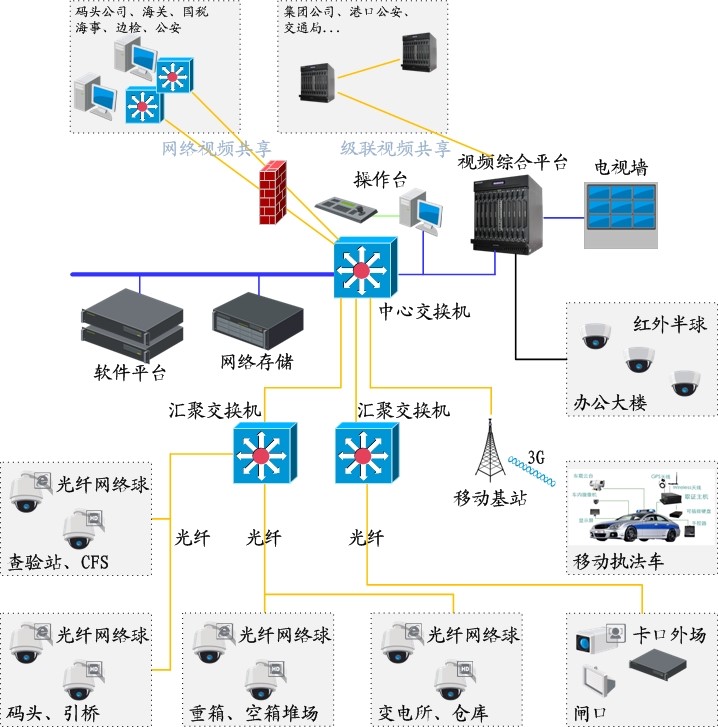
The system connects outdoor IP surveillance points (or HD surveillance points) such as inspection stations, CFS (Container Freight Stations), terminals, approach bridges, full/empty container yards, substations, and warehouses, as well as analog surveillance points in office buildings, HD snapshot surveillance points at gates, and mobile law enforcement vehicle surveillance points to a unified platform. Through the comprehensive video platform, it achieves unified switching, control, output display, and cascaded sharing of analog, digital, and IP video signals. It supports video resource sharing among multiple cross-departmental entities such as terminal companies, customs, tax authorities, maritime affairs, border inspection, and public security, and also supports unified coordination and emergency command.
Solution Highlights
1) IP HD Surveillance System, Conforming to Future Development Trends
The system uses IP technology for networking, featuring simple networking, strong scalability, and high management convenience. Furthermore, from a development trend perspective, it lays the technical foundation for the integration of video networks and business networks.
2) Multi-Service Integrated Surveillance, High Monitoring Efficiency
Common port operations such as pilotage, dispatch, safety supervision, engineering construction, and operational arrangements can all be integrated within the video surveillance system.
3) Open Standard Protocols, Good Interoperability
The system supports various international and industry standard protocols, offering good openness. At the device access layer, the system supports international open standards such as Onvif and PSIA, greatly facilitating the integration of existing or newly installed devices. At the central interconnection access layer, the system supports the GB/T 28059-2011 "Technical Specification for Interconnection of Highway Network Image Information Management System Platforms" standard protocol. The system supports the GB/T 28181-2011 "Technical Requirements for Information Transmission, Exchange, and Control of Security Video Surveillance Network Systems" standard protocol.
4) Seamless Compatibility with Existing Surveillance Systems, Good Legacy System Utilization
After years of development, port surveillance systems have largely formed standard-definition CCTV surveillance systems, typically represented by analog matrices. These are primarily used for the aggregation, forwarding, switching, control, display, storage, and external output of front-end analog video images. Given the current demand for upgrading from standard definition to high definition, Feilike utilizes a comprehensive video platform to achieve hybrid access, encoding, decoding, transmission, and display on video walls for analog, digital, and network video. It can directly connect to the original analog matrix system, ensuring seamless compatibility between new and old systems.
5) Adopting Video Cloud Storage System, Supporting Mass Video Storage
The video cloud storage system breaks through the bottlenecks of traditional video storage models in terms of capacity and performance. It can store and manage petabytes of massive video data. It achieves load balancing and concurrent access through cluster technology, providing efficient and fast storage/retrieval performance and high reliability. It offers users efficient, stable, and fast video storage and retrieval service applications, enabling convenient and reliable unified management and operation & maintenance. Storage resources can be uniformly managed and flexibly allocated. It supports online expansion, ensuring that system interruption does not occur during expansion, thus not affecting business operations.