Fully Domestic + AI Bus Vehicle-Mounted Video Surveillance System Solution
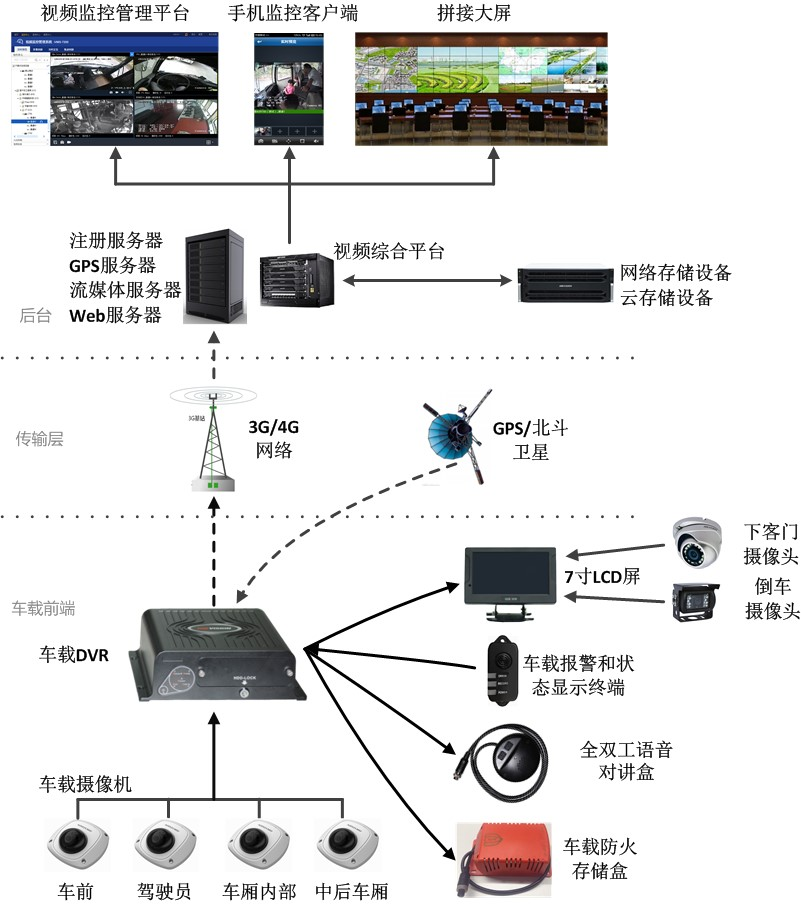
The bus vehicle-mounted video surveillance system is based on the iVMS-7200 Mobile Video Surveillance Management Platform. It connects to vehicle-mounted front-end devices via 3G/4G networks, enabling functions such as real-time monitoring, video playback, GIS map positioning, track playback, device status inquiry, and emergency alarms.
Vehicle-mounted front-end devices include a Vehicle-mounted Hard Disk Video Recorder (referred to as Vehicle DVR or MDVR), vehicle-specific cameras, a vehicle-mounted LCD display, an alarm button and status display terminal, a full-duplex voice intercom box, a vehicle-specific fireproof storage box, and accompanying cables and wiring. The Vehicle DVR has built-in wireless network communication modules, as well as GPS and Beidou positioning modules.
Solution Advantages
1) Fanless, Fully Enclosed Design
The casing of the Vehicle DVR host features a fanless, fully sealed integrated design, which effectively prevents dust, moisture, and debris inside the bus from entering the device's interior, thus adapting to the complex environment within a bus. Utilizing a die-cast aluminum / extruded aluminum enclosure, and designed with main heat-generating components attached to the outer casing, it effectively ensures that internal heat is transferred to the casing for external dissipation.
2) Dedicated Aviation Connector Interface
The power interface, audio/video interface, communication interface, and other ports of the Vehicle DVR all utilize a dedicated aviation connector design. This integrates mixed signal lines such as power, ground, and signal lines, ensuring reliable signal connection through robust pins, sockets, and threads, thereby preventing vibrations during bus operation from affecting the electrical continuity of the contact pairs.
3) Independent Vehicle Power Module
The Vehicle DVR's built-in power module complies with ISO7637-2 (JAE1455) international standards, adapting to different vehicle types (12V and 24V). It supports 8V to 36V wide voltage input, with 12V and 5V regulated outputs. Each power supply module features a fast self-recovery electronic short-circuit protection function, effectively preventing overcurrent effects and providing overload and short-circuit protection. External power supply supports hot-swapping, offering effective protection against surges and load transients, and is capable of effectively suppressing 200V, 400ms high voltage generated during load dump. The independent power module design facilitates direct module replacement during future maintenance.
4) Multi-Mode Recording Methods
The Vehicle DVR can accommodate two built-in 2.5-inch hard drives and can store video data using normal, redundant, or mirrored recording methods. This protects the working life of mechanical hard drives and ensures video integrity.
5) Built-in Supercapacitor Module
The Vehicle DVR has a built-in supercapacitor module, which can provide short-term power supply. When the power supplied by the battery is disconnected due to a vehicle accident or severe collision, it provides a short-term power supply to ensure that critical video data in memory can be completely written to the hard drive. In the event of an abnormal power loss to the device, it ensures that the hard drive performs a normal shutdown procedure, such as the read/write heads returning to their home position, thereby significantly protecting the hard drive's lifespan. Compared to backup power sources like lead-acid batteries and lithium batteries, the supercapacitor module offers millions of charge-discharge cycles, a wider operating temperature range of -40℃ to 70℃, and is maintenance-free.
6) Replaceable Communication Module
The new Vehicle DVR adopts a pluggable communication module design, differing from previous methods where communication modules were directly soldered or attached to the motherboard. This allows for convenient direct replacement of communication modules for different network standards without disassembling the chassis, making it easy to upgrade network standards later without needing to return the device to the factory.
7) Alarm Video Backup
When the driver triggers the emergency alarm button, the alarm signal can be transmitted to the Vehicle DVR host. At this point, video recording data from a period before and after the alarm trigger can be stored in the built-in SD card or an external fireproof storage box, providing a backup function for critical video data. This is particularly useful in the event of a vehicle fire, better protecting emergency video data recorded at the scene.