Maritime Law Enforcement Vessel Video Surveillance System Solution
The Maritime Law Enforcement Vessel Video Surveillance System Solution addresses the operational needs of maritime law enforcement evidence collection and emergency command. It provides a comprehensive video surveillance system for law enforcement vessels, integrating high-definition video surveillance technology, remote wireless transmission technology, and portable individual device technology. This system not only enhances maritime law enforcement capabilities, creates a deterrent effect, and raises awareness among vessel operators for compliant navigation, thereby reducing illegal vessel activities and ensuring safety of life and property on water, but also improves the public image of maritime law enforcement teams, establishing an efficient and orderly maritime supervision and enforcement mechanism.
Background and Challenges
In recent years, with socio-economic development, some "unlawful elements" engage in illegal activities such as smuggling to achieve "quick riches." Additionally, some vessel operators fail to use navigation lights as required. The increase in illegal vessel activities such as smuggling, overloading, and navigating outside designated channels has intensified the pressure on maritime law enforcement agencies – the Maritime Bureau – for evidence collection. Maritime law enforcement is not merely about enforcement; it also involves a service aspect. It faces challenges such as complex administrative counterparts, difficulties in manual evidence collection, command and dispatch, and low enforcement efficiency.
Solution
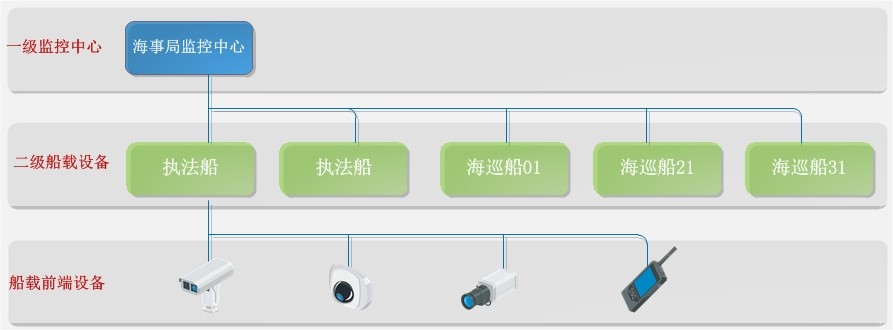
The Maritime Law Enforcement Vessel Video Surveillance System generally adopts a two-tier architecture, comprising the Maritime Bureau Monitoring Center and the Law Enforcement Vessel Onboard Surveillance System, as shown below:
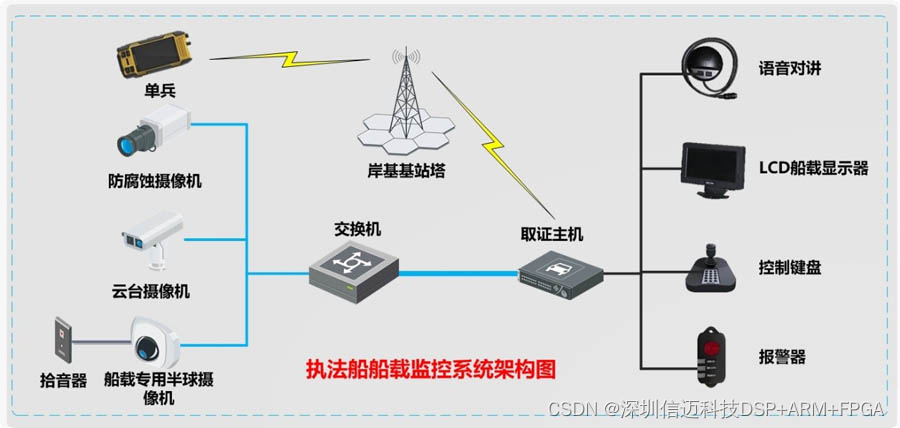
This solution primarily involves the construction of onboard video surveillance systems for law enforcement vessels and patrol boats, which connect to the Maritime Bureau Video Monitoring Center via a carrier wireless transmission network. Equipment deployment is as follows:
Solution Advantages
1) Adaptability to Onboard Environment
The onboard video surveillance system's environmental adaptability, electromagnetic compatibility, and other features comply with relevant national technical standards. It can operate continuously without failure for extended periods in harsh environments characterized by vibration, bumps, high temperatures, and wide power voltage fluctuations, enabling all-weather operation.
2) Strong Network Adaptability
Mobile wireless network technology has developed rapidly in recent years, and remote wireless real-time high-definition surveillance has gradually become a focal point. Currently, both domestically and internationally, multiple wireless communication standards coexist, and the network conditions of various wireless carriers also exhibit regional differences. The onboard dynamic evidence collection system in this solution possesses the capability to communicate across multiple wireless network platforms (supporting EVDO, WCDMA, and TD-SCDMA), offering good network adaptability and strong network penetration. Data transmission can be achieved safely and reliably.
3) Portable Individual Device Enforcement
Portable individual devices assist law enforcement personnel in mobile enforcement during situations requiring boarding, such as handling suspected overloaded transport or illegal mooring in non-designated berths. Upon arrival at the scene, law enforcement personnel can record videos and take snapshots. Captured images can be saved locally or instantly uploaded to the central management platform. In special circumstances, real-time communication can be established between the portable individual device and the command center or other portable individual device users.
4) Convenient Data Storage and Retrieval
Data from the onboard video surveillance system is directly stored on the hard drive of the onboard evidence collection host, while data from portable individual devices is directly stored on their built-in SD cards. Both types of devices can wirelessly upload data directly to the shore-based command center, making data storage and retrieval extremely convenient.