Nvidia/Sanneng + FPGA + AI High-Performance Edge Computing Box: DJI RoboMaster AI Challenge
NVIDIA Jetson TX2 Powers Robot Teams to Win RoboMaster AI Challenge Championship and Runner-Up
A competition arena bringing together millions of robotics experts and researchers, a contest combining engineering, strategy, and team challenges – this describes the DJI RoboMaster AI Challenge, which recently concluded at the ICRA conference in Brisbane, Australia. This year's champion, I Hiter, and runner-up, Critical HIT, both built their robot teams based on the modular NVIDIA Jetson TX2 supercomputer. The high-performance Jetson TX2 served as the "brain" for the winning robot teams, endowing them with greater intelligence and stronger combat capabilities, making them invincible in the final showdown.
Each RoboMaster team competes with 1 to 2 AI-powered robots. In a 5x8 meter arena filled with obstacles, competing robots must navigate autonomously while firing plastic projectiles at opponent robots. The winner must defeat two advanced AI robots provided by RoboMaster.
Each participating team consists of up to 10 graduate and undergraduate students, who submitted their technical proposals in December last year. The competition process lasted several months, with the shortlisted teams announced in April this year. Finally, the finalist teams traveled to Brisbane to compete for the $20,000 grand prize at the ICRA conference.
Many top universities worldwide participated in the competition, including Harbin Institute of Technology in China, Johns Hopkins University in the United States, the University of Melbourne in Australia, and the University of Alberta in Canada, among others.
NVIDIA provided the winning teams with TITAN GPUs and Jetson TX2 developer kits as prizes.
Robots Powered by NVIDIA Jetson
In this year's competition, there were both experienced teams and first-time participants. The hardware platform dominating the competition – Jetson TX2 – also shone brightly. Out of the 22 robots that made it to the finals, 14 used Jetson.
RoboMaster head judge Shuo Yang believes Jetson's powerful technical capabilities and ease of use are the reasons for its popularity. Yang stated: "We use the TX2 because it has excellent tools for neural network training, machine learning, and object tracking and detection. The Jetson API is very easy for students to use."
University students also believe the Jetson TX2, with its small size, lightweight design, and exceptional GPU power, is their ideal hardware platform.
Zhong Xingguang, captain of the first-place Harbin Institute of Technology team, explained: "Jetson allows us to use neural networks for parallel computing, which in turn facilitates visual computing, detecting opponent robot armor, and precisely shooting targets. We would not be able to achieve this with other platforms."
Ruiqing (Rui) Yin from the Johns Hopkins University team also believes the CUDA compatibility of the Jetson TX2 module is a very important factor. He stated: "The Jetson TX2 provides our robots with powerful, CUDA-enabled modules, and it's a very cost-effective way to do so."
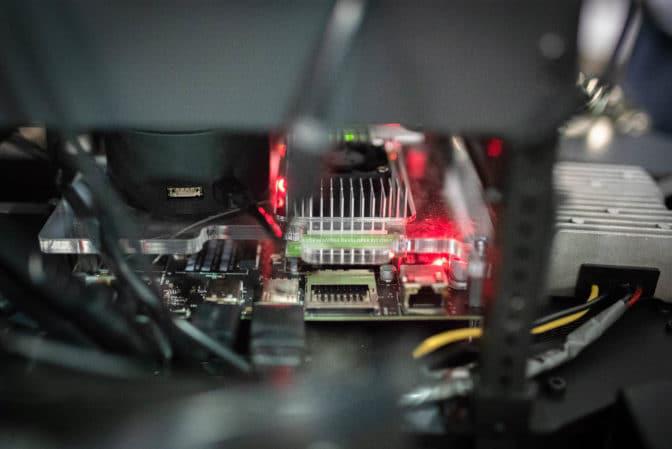
A competing robot equipped with Jetson
A Global Robotics Competition
RoboMaster attracts many aspiring engineers to participate and has garnered widespread attention from the engineering community. Last year, over 7,000 participants from 200 universities worldwide registered for the competition. The finals garnered over 814,000 views on Twitch.tv.
Paul Xu, Vice President of SZ DJI Technology Co., Ltd., a global leader in drone manufacturing and the main sponsor of this competition, stated: "DJI is not only passionate about developing excellent drone technology but also hopes to encourage and help young engineers showcase their talents to the world and demonstrate the wonderful world that robots can help us achieve."
