Intel x86+FPGA: Application of Intelligent AI Computer System in Bronchial Navigation Robots

With the rapid development of artificial intelligence, technological breakthroughs, and the gradual expansion of its application fields, medical robots, as a deepening application of the AI era in the medical field, can effectively assist doctors with a range of medical diagnoses and auxiliary treatments, promoting the development of medical informatization while effectively alleviating the strain on medical resources.
Smart Healthcare Scenario Applications
From an application scenario perspective, there is a significant demand for surgical robots in scenarios requiring precise operations, such as neurosurgery, orthopedics, and endoscopic surgery. Surgical robots play a crucial role in clinical and surgical settings. Surgical robots are innovative medical devices invented based on the development of foundational technologies such as minimally invasive surgery and computer technology. Controlled by computer systems and equipped with robotic arms, positioning and navigation systems, and vision systems, they can assist doctors in performing more precise surgical operations from visual and tactile perspectives, reducing the risk of human error and improving surgical accuracy and safety.

Global lung cancer mortality far exceeds other cancer types, ranking first in cancer deaths. Bronchoscopy is an efficient method for diagnosing lung cancer, allowing not only direct observation of lesions but also the collection of cells and small tissue samples from the affected area for cytological and pathological examination. Utilizing advanced flexible bronchoscopic surgical robot systems extends the doctor's "eyes," "brain," and "hands," providing patients with higher precision and safer surgical operations. A domestic company specializing in natural orifice flexible surgical robots sought a high-performance AI computer system for its bronchial navigation robot, with the following requirements:

Strong expandability, assisting with real-time AI image processing, supporting PCIe expansion for GPU cards and image acquisition cards;
Multiple independent network ports and serial ports for connecting peripherals and expansion, supporting triple independent displays;
The entire system must be vibration-resistant, shock-resistant, with a wide temperature design, and a long product lifecycle for medical applications.
Scenario Solution
To achieve high-precision positioning and efficient image processing for bronchial navigation robots, the robot control system platform must meet technical requirements such as powerful data processing capabilities, flexible expandability, and high stability.
Scenario Empowering Product Innovation
It adopts an Intel Core multi-core high-performance CPU based on the X86 architecture, perfectly meeting the data computation requirements of the bronchial navigation robot. It features four PCIe expansion slots for video capture cards and GPU cards. In this project, an RTX 3060 GPU card is used to analyze and process image data via the GPU. It has 3 independent network ports and 4 serial ports for connecting peripherals and expansion; 1VGA, 2DP for triple independent displays, enabling integrated visual and electromagnetic positioning for precise assisted diagnosis and treatment throughout the examination, helping doctors perform more accurate lung biopsies and treatments. It uses wide-voltage DC 9-36V power input with short-circuit, over-voltage, and over-current protection, offering vibration and shock resistance, stable power supply, and preventing crashes; its wide temperature design allows normal operation in storage temperatures from -40°C to 85°C. Since its launch, the entire product has been widely applied in smart transportation, industrial automation, and other fields, receiving widespread acclaim and boasting an ultra-long service life.
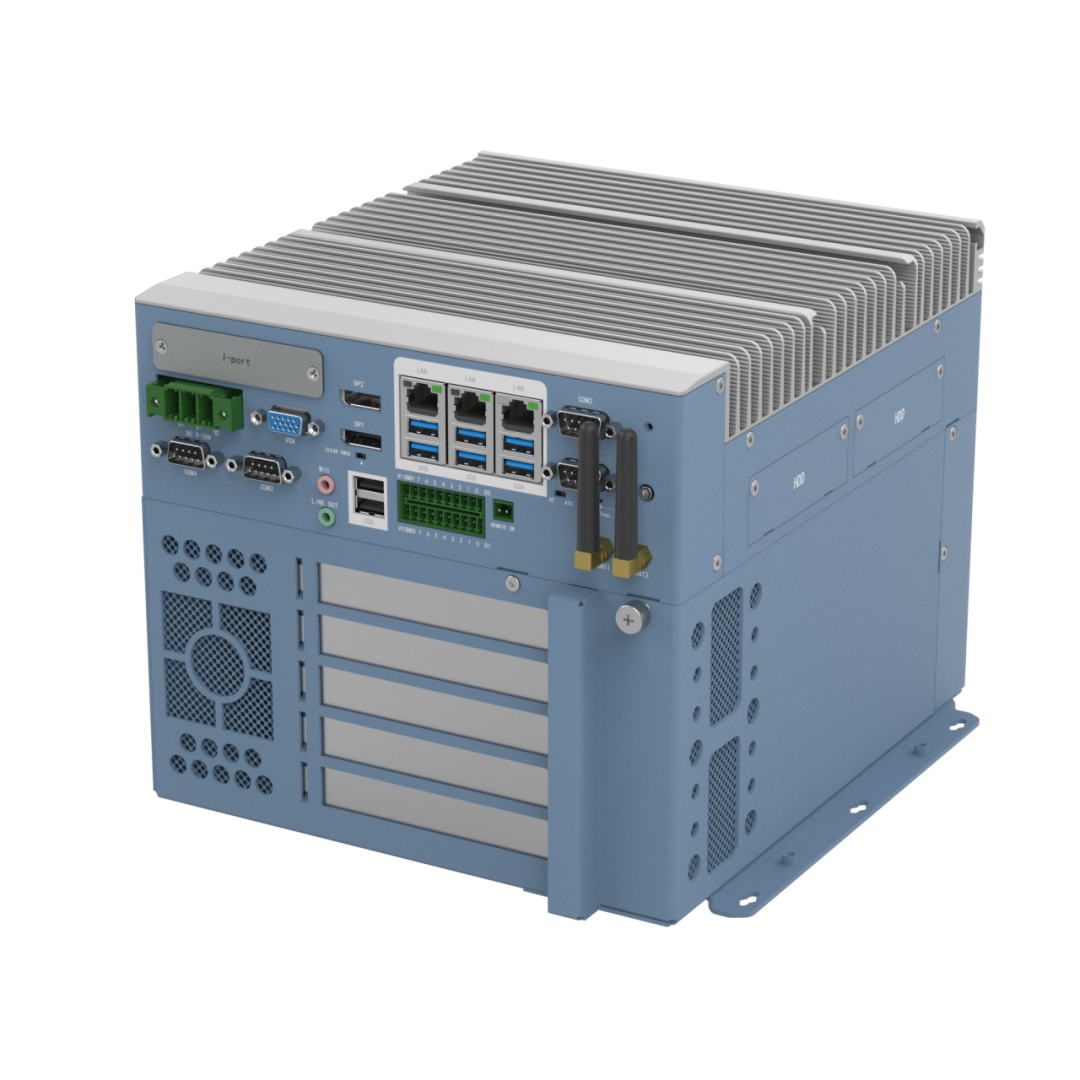
Intel® 8th/9th Gen Coffee Lake LGA1151 Series CPU
Intel® Q370 High-Performance Chipset
4*DDR4 2400/2666MHz SODIMM, up to 128GB
Supports 2DP dual 4K and 1VGA, 3 independent displays
3LAN, 6USB3.1, 2USB2.0, 4COM, 16-bit Iso. DIO
1*Mini PCIe with SIM card slot, supporting 4G and WIFI/BT, etc.
1*M.2 B-Key 3052, with SIM card slot, supporting 5G module
1*M.2 E-key 2230, supporting Gigabit WIFI/BT module
2PCIeX16 (X8 signal) and 2PCIeX16 (X4 signal) for four expansions
2*SATA3.0 SATA Bays, supporting RAID0,1 hot-swappable design
Optional 1mSATA and 1M.2 M-Key supporting NVMe high-speed storage
Wide-voltage DC 9-36V power input, with short-circuit, over-voltage, and over-current protection