Nvidia Jetson/Orin/SOPHON +FPGA+High-Performance AI Edge Computing Box: Drone Autonomous Flight Software Platform
Project Overview
· The Generalized Autonomy Aviation System (GAAS), which we led the development of, is an open-source drone autonomous flight framework designed for unmanned aerial vehicles (UAVs) and Urban Air Mobility (UAM). Through functionalities such as SLAM, path planning, and Global Optimization Graph, it provides UAVs with autonomous flight capabilities in situations without GPS and external communication.
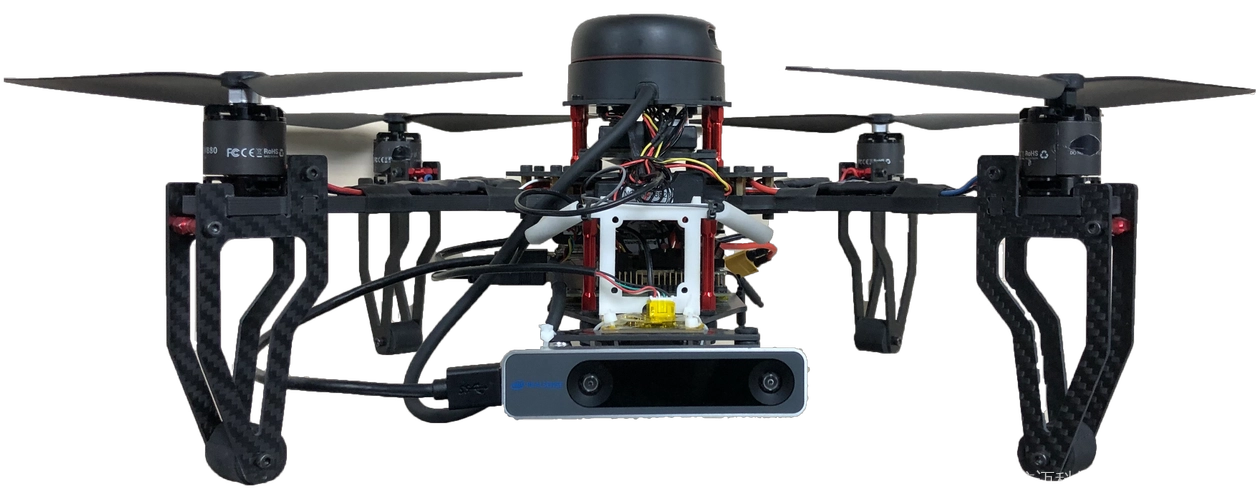
· In this case, GAAS, powered by NVIDIA Jetson TX2, achieved on-board processing of visual sensor data on the UAV, assisting the UAV in fully autonomous aircraft inspection.
· This case primarily utilized NVIDIA Jetson TX2.
Background
The Generalized Intelligence team comprises experts and scholars from various fields including machine learning, SLAM, and UAVs; and holds multiple leading domestic and international patented technologies. The goal of Generalized Intelligence is to upgrade UAVs from "flying cameras" into robots capable of utilizing 3D space, thereby accelerating the advent of various UAV applications and UAM air traffic.
GAAS (Generalized Autonomy Aviation System) is an open-source software platform for autonomous drone flight. GAAS is one of the fastest-growing aviation-related open-source projects globally, with developers from over 35 countries and regions. As a project protected by the BSD license, any enterprise, researcher, or drone enthusiast can legally and compliantly modify our code to meet their customized needs. GAAS can provide UAVs with autonomous flight functionalities including: autonomous flight without GPS signals and external communication, complex scene landing, global perception, global tracking, object recognition, 3D reconstruction, and 3D path planning/obstacle avoidance navigation.
Challenges
Although UAVs are called "unmanned" aircraft, it merely means there are no people in the sky, not that people are unnecessary. On the contrary, UAVs are heavily dependent on human operation. In the United States, an average industrial-grade UAV requires a five-person service team: two pilots, one maintenance technician, one ground station engineer, and one path planner. In China, an industrial-grade UAV also requires a team of 3-5 people for service. This does not even account for the significant human resources required to process the data collected by UAVs.
As UAV hardware matures, the problem of UAVs' reliance on human operation has gradually emerged. Over the past decade, the main development direction for UAVs has been how to prevent failures during flight (colloquially known as "crashing"). Starting in 2008, with the continuous development of various open-source flight controllers, the difficulty of UAV operation was simplified while enhancing UAV stability. This allowed pilots to fly UAVs without worrying about the aircraft itself suddenly malfunctioning. However, with the maturity of flight controllers, the industry gradually realized that reliance on human labor is a new bottleneck for UAVs. It is estimated that by the end of this year, the number of industrial-grade UAVs in China will reach 460,000 units, but as of the end of 2018, the cumulative number of licensed UAV pilots nationwide was only 44,573. There is a huge shortage of pilots.
At the same time, even with pilots, successful UAV operations cannot be guaranteed. For example, Airbus uses UAVs for aircraft inspection, requiring a flight error within 10cm, a precision that pilots cannot achieve. Furthermore, the coordination between pilots and UAVs relies on GNSS geolocation systems like GPS, which makes UAVs unusable in many scenarios. For instance, there is no GNSS signal under bridges during bridge inspection; or UAVs cannot be used in strong interference environments like substations. Even though these scenarios are essential for UAV inspection.
The functionalities of traditional UAVs, which are merely based on GPS waypoint flight, are completely insufficient to meet the demands of next-generation autonomous UAV flight. Because UAVs have limited endurance and payload capacity, autonomous flight requires high-performance,