PCIe 4.0 16GT/s PCIe Switch Chip for AI Servers and More
The PCIe 4.0 Switch chip is available in multiple configurations such as 104, 64, and 48 ports, supporting PCIe data rates of 2.5GT/s, 5GT/s, 8GT/s, and 16GT/s. It delivers a high-performance, low-latency, scalable, and cost-effective PCIe interconnect solution.
The product comes with a comprehensive software development kit (SDK), featuring simple and easy-to-use standard API interfaces that meet diverse development requirements for applications in data centers, AI servers, all-flash storage, and embedded systems. This significantly shortens time-to-market, reduces deployment risks and total cost of ownership (TCO), and enhances product competitiveness.
PCIe 4.0/3.0/2.0/1.0
• Link rate auto-negotiation
• Configurable UP/DP on any port
• P2P transfers between any DP ports
• Standard and aggressive hot-plug support
• GPIO/UART/I2C interfaces
• PCIe error handling with AER
• Lane reversal
• Polarity inversion
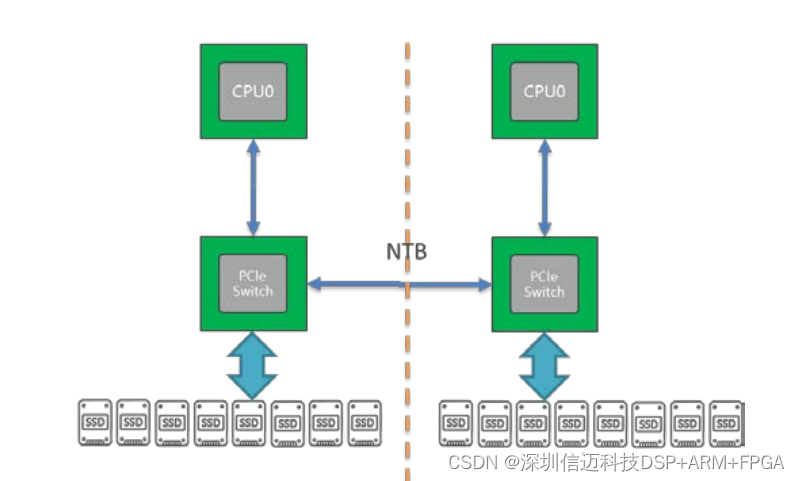
• NTB interconnect
• Base switch and NT modes
• SRNS, SRIS
• L0s, L1, L2 low-power states
Applications:
• GPU interconnection in AI servers
• NVMe SSD expansion in all-flash storage
• Embedded PCIe port expansion
SDK Components and Flexible Software Development
• Hardware abstraction layer (HAL), real-time operating system (RTOS), configuration profiles and tools, command-line interface (CLI), logging and event management
• Chassis management via SCSI Enclosure Services (SES)
• System customization through standard XML configuration files
Features
Product Overview
PCIe 4.0 Switch Chip
16GT/s PCIe Switch
The PCIe 4.0 Switch chip is available in multiple configurations such as 104, 64, and 48 ports, supporting PCIe data rates of 2.5GT/s, 5GT/s, 8GT/s, and 16GT/s. It delivers a high-performance, low-latency, scalable, and cost-effective PCIe interconnect solution.
The product comes with a comprehensive software development kit (SDK), featuring simple and easy-to-use standard API interfaces that meet diverse development requirements for applications in data centers, AI servers, all-flash storage, and embedded systems. This significantly shortens time-to-market, reduces deployment risks and total cost of ownership (TCO), and enhances product competitiveness.
Secure Boot Authentication
• Built-in SM2/SM3 cryptographic security modules
• Secure boot authentication for user boot loader during BOOT phase (hardware SecureBoot)