Soft PLC Solution on an ARM+LINUX Real-Time Hardware Platform Based on RK3588 + Codesys + Xenomai
- Product Overview
The company launches an AI edge computing motherboard based on the Rockchip RK3588 architecture. The RK3588 is a new generation of high-end domestic 64-bit octa-core processor manufactured using 8nm process technology, featuring high computing power, low power consumption, superior multimedia capabilities, and rich data interfaces. It integrates an octa-core CPU consisting of quad-core A76 and quad-core A55 clusters, along with an ARM G610MP4 GPU. The chip includes an embedded neural processing unit (NPU) delivering up to 6 TOPs of computing power, and supports integration of the Hailo AI accelerator chip, which provides 26 TOPs per chip, enabling total system computing power to be expanded up to 32 TOPs. It supports 8K@60fps video decoding and 8K@30fps encoding, with abundant peripheral interfaces and exceptional expandability. The RK3588's built-in NPU supports up to 6.0 TOPs and interfaces such as PCI-e/USB3.0/RGMII, enabling structured recognition and analysis of video streams from up to 32 channels of 1080P IP cameras.
The Rockchip RK3588-based edge computing motherboard delivers powerful computing performance and rich, highly expandable I/O interfaces. The PCB is designed with a 10-layer immersion gold process, ensuring excellent electrical characteristics, strong anti-interference capability, stable and reliable operation, and compliance with industrial-grade standards. It is widely applicable in AI terminal fields such as smart cities, intelligent security, smart healthcare, and industrial internet.
CODESYS Control Linux ARM SL
An IEC 61131-3-compliant soft PLC solution for ARM & Linux hardware platforms.
Product Description
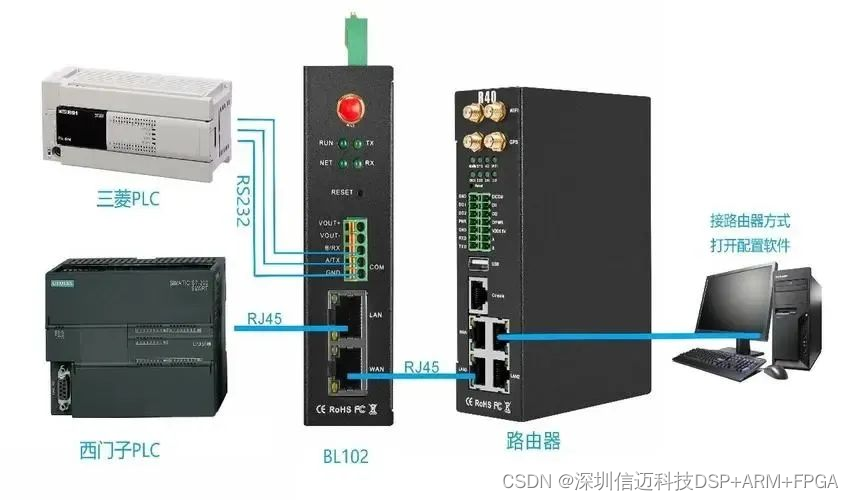
CODESYS Control Linux ARM SL is a CODESYS Runtime designed for ARM & Linux hardware platforms. The Runtime's functionality can be extended based on the target system's hardware properties. After installing the included CODESYS Deployment Tool plugin in the CODESYS IDE, users can install this product onto the target controller’s Linux operating system directly from the CODESYS IDE. The CODESYS Runtime automatically starts after each reboot. It supports unrestricted operation for two hours without a license.
Product Features
The CODESYS Runtime supports a wide range of I/O interfaces, including local I/O and bus-based I/O, and includes integrated IEC 61131-3 protocol stacks. Fieldbuses can be configured directly within the CODESYS IDE without requiring third-party tools.
- Online programming and debugging of the Runtime via CODESYS IDE
- Supports logic control functions and web-based HMI (Human-Machine Interface)
- Supports operation of I/O systems and fieldbuses
- Supports CODESYS multi-core functionality
For more details, refer to the CODESYS Online Help (https://zh.helpme-codesys.com/).
This product can be extended with the following components:
Runtime Extension SDK
The standalone Runtime Extension SDK is integrated into the CODESYS Runtime package and supports the following features:
- Integration of C code
- Implementation of external functions
- Start/stop switch functionality
- Local I/O extension
- External event-triggered tasks
- Implementation of power-loss data retention
Fieldbus Protocol Stacks:
- CODESYS CANopen Manager SL
- CODESYS EtherCAT Master SL
- CODESYS EtherNet/IP Scanner / Adapter SL
- CODESYS Modbus TCP Master / Slave SL
- CODESYS Modbus Serial Master / Slave SL
- CODESYS PROFINET Controller / Device SL
Communication Protocol Stacks:
- CODESYS BACnet SL
- CODESYS IIoT Libraries SL
- CODESYS KNX SL
- CODESYS OPC UA Server SL
- CODESYS OPC UA Client SL
- CODESYS OPC UA PubSub SL
Motion Control Features:
- CODESYS SoftMotion SL
- CODESYS SoftMotion CNC+Robotics SL
- CODESYS SoftMotion Light SL
Redundancy:
- CODESYS Redundancy SL
Visualization:
- CODESYS WebVisu SL
-
Platform Features
-
Rockchip RK3588 is manufactured using 8nm LP process technology and features a 64-bit high-performance octa-core CPU architecture combining four Cortex-A76 cores and four Cortex-A55 cores, with a maximum clock frequency of 2.4GHz. The RK3588 delivers outstanding performance for various AI applications, offering a 3x CPU performance improvement over the RK3399.
-
Integrated NPU with up to 6.0 TOPs of computing power, featuring a triple-core architecture with flexible compute allocation. Supports Hailo 26 TOPs AI accelerator expansion, enabling total system AI performance up to 32 TOPs. This dedicated deep learning acceleration chip has a typical power consumption of 2.5W. The high-performance NPU supports mixed-precision operations including INT4/INT8/INT16/FP16, and its strong compatibility enables easy conversion of network models developed using frameworks such as TensorFlow, MXNet, PyTorch, and Caffe.
-
Capable of decoding up to 32 channels of 1080P video. The chip integrates multiple powerful embedded hardware engines supporting 8K@60fps H.265 and VP9 decoding, 8K@30fps H.264 decoding, and 4K@60fps AV1 decoding. It also supports 8K@30fps H.264 and H.265 encoding, high-quality JPEG encoding/decoding, and dedicated image pre- and post-processors. GPU performance is improved by 6x compared to the RK3399.
-
Integrated 3D GPU supporting OpenGL ES1.1/2.0/3.2, OpenCL 2.2, and Vulkan 1.2. A dedicated 2D hardware engine with MMU maximizes display performance and ensures smooth user experience.
-
Built-in Rockchip-developed 48MP ISP (Image Signal Processor) supporting various algorithm accelerators such as HDR, 3A (Auto Focus, Auto Exposure, Auto White Balance), LSC (Lens Shading Correction), 3DNR, 2DNR, sharpening, defogging, fisheye correction, and gamma correction.
-
Supports up to 32GB of large-capacity RAM, enabling faster response times and improved real-time performance. Features a high-performance quad-channel external memory interface (LPDDR4/LPDDR4X/LPDDR5) capable of meeting demanding memory bandwidth requirements.
-
Equipped with multiple video output interfaces including HDMI 2.1, MIPI-DSI, DP1.4, and VGA, as well as video input interfaces such as HDMI RX 2.0 and MIPI-CSI. Supports multi-channel 8K video output and 4K video input, enabling up to four independent displays.
-
Four standard SATA3.0 interfaces allow simultaneous expansion of multiple 2.5"/3.5" SSDs/HDDs. Onboard high-speed M.2 SATA3.0 interface supports M.2 2242 SSDs, enabling easy expansion to multi-terabyte storage capacity.
-
Onboard standard PCIe 3.0 (4-lane) interface, with each lane achieving data transfer rates of up to 8Gbps, enabling a maximum aggregate bandwidth of 32Gbps. Ensures high-speed, stable connectivity for expanding standard PCIe 3.0 devices.
-
Rich expansion interfaces including RS485, RS232, I2S, I2C, UART, CAN, SPDIF, MIPI CSI, MIPI DSI, USB3.0, USB2.0, SPI, and GPIO, meeting interface requirements for edge computing, smart healthcare, industrial control, and other intelligent terminal applications.
-
Operating temperature range from -20°C to +70°C, with an automotive-grade RK3588 chip variant available for -40°C to +85°C.
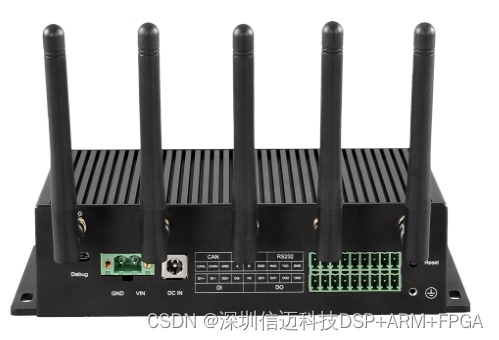
RK3588Motherboard Image
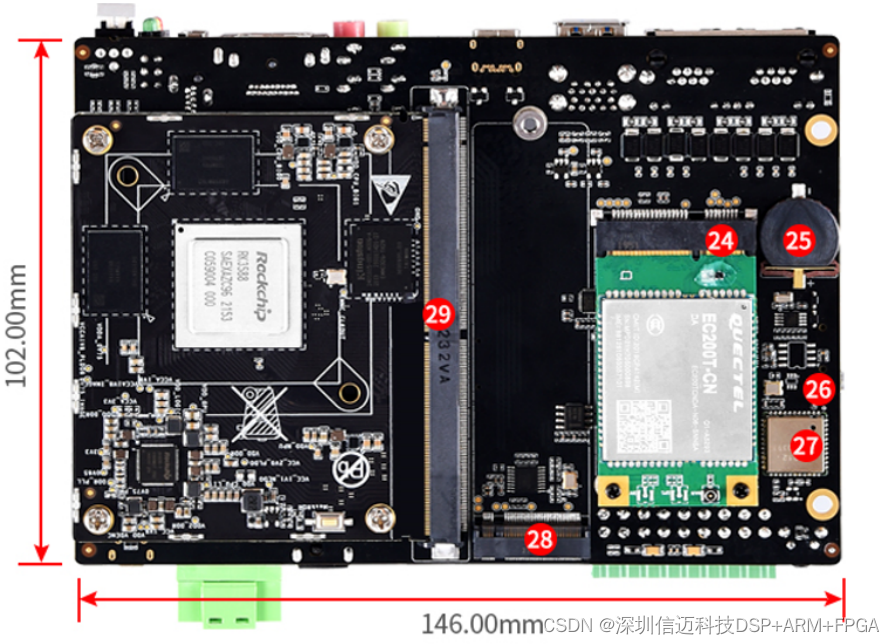
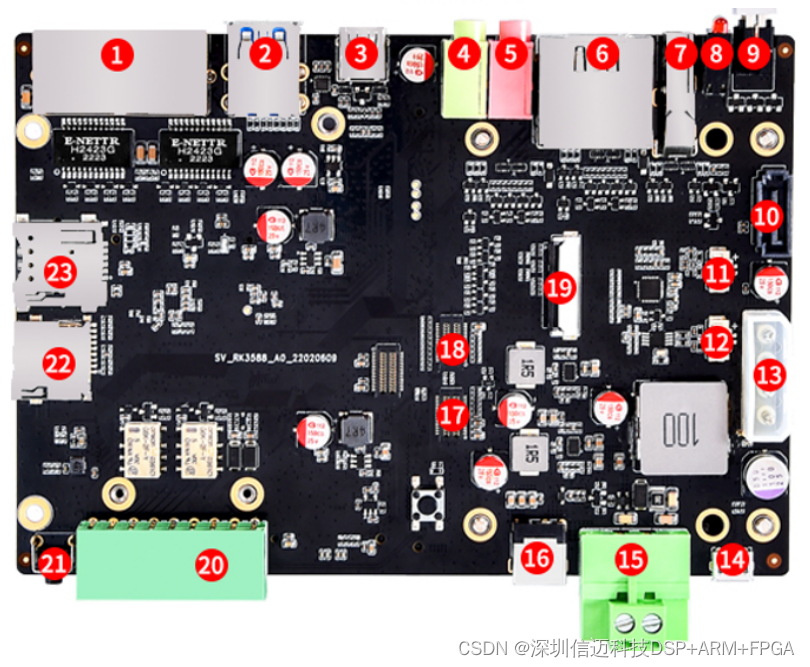
- Motherboard Interfaces
RK3588********Edge Computing Motherboard Interface Description
Function
Interface Description
CPU
RK3588
Storage
Standard configuration: 8GB RAM, 32GB ROM; customizable storage options available
NPU
Integrated 6 TOPs NPU; expandable up to 32 TOPs via Hailo 26 TOPs AI accelerator module
Supports mixed-precision computation (INT4/INT8/INT16/FP16) and model conversion from frameworks such as TensorFlow, MXNet, PyTorch, and Caffe
Networking
Supports single-band (2.4GHz) and dual-band (2.4GHz/5GHz) Wi-Fi; brands such as AMPAK and Bilian available
Supports mainstream 5G/4G modules (e.g., Quectel)
Dual Gigabit Ethernet ports via RJ45
Motherboard Interfaces
Display interfaces: eDP, MIPI, DP; supports touch panel (TP) interface
Dual MIPI-CSI stereo camera interface; supports MIPI DSI camera input
Audio: 1x Headphone, 1x MIC, 1x Speaker, 1x LINE-IN
USB3.0 ×1, USB2.0 ×1, Type-C ×1, TF card ×1
Digital Input (DI) ×2, Digital Output (DO with Relay) ×2
RS485 ×1, RS232 ×1, CAN ×1
HDMI IN ×1, HDMI OUT ×2
5G/4G MINI-PCIE interface ×1
5G/4G SIM card slot ×1
SATA interface ×1
M.2 interface ×1
RTC battery ×1
POWER button ×1, RESET button ×1, RECOVERY button ×1
LED status indicators ×4
Debug serial port ×1
DC IN ×2 (DC jack + Phoenix terminal, 12V~65V)