Joint Solution for Domestic Computing Module Based on Phytium ARM + FPGA
Overview of the Joint Solution
With the increasing demand for independent innovation in electronic information systems for specialized fields, continuous development and upgrading of domestically produced computing systems and modules capable of withstanding harsh environments are required. Independent innovation in electronic information systems for specialized fields refers to achieving full control over the research, design, production, upgrade, and maintenance of information systems—from hardware to software—using proprietary technologies and security mechanisms. Among these efforts, the independent development of computing modules for harsh environments is a critical component. The self-reliant development of such modules requires not only indigenous processor subsystems but also comprehensive domestication of peripheral interfaces and functional units. For specialized application scenarios, highly integrated designs are necessary, supporting multiple service forms.
Solution Details
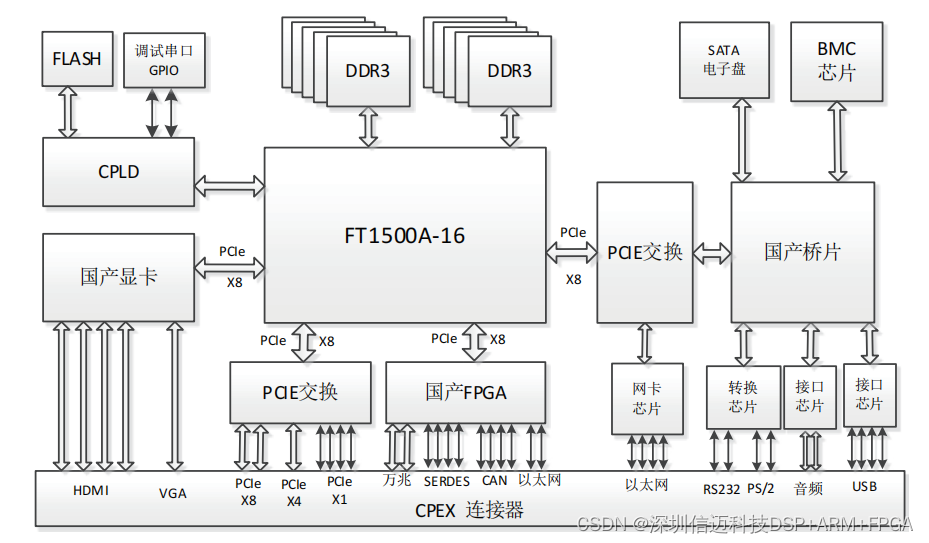
The domestically produced computing module based on Phytium processors adopts an All-In-One high-integration design philosophy. Its technical specifications comply with the reinforced CPEX computer main module standard. Centered around the Phytium FT-1500A/16 processor, the module features surface-mounted dual-channel DDR3 memory with a total capacity of 8 GB. It integrates a domestic graphics card supporting four HDMI and one VGA display interfaces. The module provides two 10-Gigabit and four Gigabit Ethernet ports, two RS232 serial ports, and eight USB interfaces. Additionally, it offers PCIe expansion interfaces including two x8 lanes, one x4 lane, and four x1 lanes, enabling flexible expansion of peripheral board cards. An onboard BMC management chip collects board temperature, voltage, and other operational data, reporting health status via the IPMI bus. Designed to the standard 6U CPEX form factor, the module is available in both ruggedized and industrial control mechanical configurations, offering flexible deployment options. The module supports Kunlun firmware and is compatible with domestic operating systems including Kylin Server and Desktop OS, as well as the Jari-Works embedded OS. It serves a wide range of applications such as embedded desktop terminals, lightweight computing servers, multi-active storage controllers, and cybersecurity management systems.
The overall hardware architecture of the computing module is shown below:
Implementation Benefits
• Full independent innovation with high domestic content
All core components and peripheral interface devices are domestically sourced, achieving over 95% domestic component type coverage and over 99% in quantity, indicating a high level of self-reliance.
• Rich external interfaces with highly integrated design
Based on the 6U CPEX architecture and employing an All-In-One integration approach, the module provides abundant external interface resources and multiple PCIe interfaces for flexible expansion of various peripherals, delivering comprehensive hardware interface support for applications.
• Support for domestic firmware and operating systems across multiple application scenarios
The module runs on domestic Kunlun firmware, enabling online configuration, firmware updates, and port management. It supports domestic Kylin Server and Desktop operating systems, as well as the Jari-Works embedded OS, making it suitable for diverse application scenarios.
Partner Products
Phytium-based ruggedized computers and display & control console hardware and software products.
Success Case
The Phytium-based rugged computing module has been successfully deployed in a certain model of display and control console.
Case Background
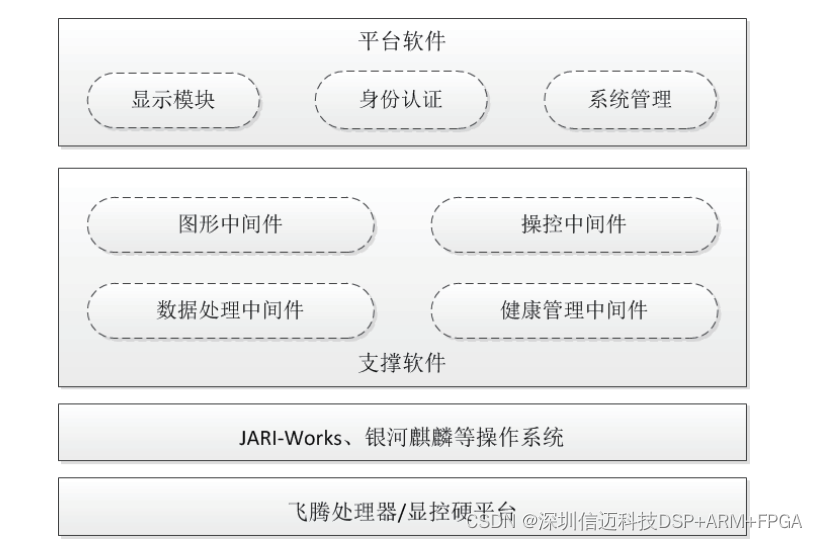
A specific model of display and control console employs a hardware platform built on a Phytium processor-based computing module and external expansion modules. It runs either the domestic Kylin Desktop OS or the Jari-Works embedded OS. On top of the operating system, middleware layers—including graphics, control, and data processing middleware—are deployed. Above the middleware layer, platform software such as display modules, identity authentication, and system management run, providing support for various user application software.