Data Acquisition Card: 16-Channel, 16-Bit, 250KHz ADC, Supports Single-Point Acquisition and Programmable Gain
Overview
The USB-XM1603 is a highly cost-effective, multi-functional, general-purpose A/D board. Meticulously designed, it utilizes a USB 2.0 bus, supporting hot-swapping and plug-and-play functionality without the need for address jumpers. It is suitable for measurement applications such as transmitter output and DC voltage measurements. The USB-XM1603 features 16-channel single-ended 16-bit programmable gain analog inputs, 4-channel 16-bit analog outputs, 16 digital I/O channels (8 TTL inputs and 8 TTL outputs), 2 frequency measurement channels, 2 PWM pulse output functions, and 1 (1-255) frequency divider. The logic control of the USB-XM1603 is implemented using Field-Programmable Gate Arrays (FPGAs) to enhance reliability. Additionally, digital ground (GND) and analog ground (AGND) are separated with single-point grounding to eliminate ground loop interference. This board offers very stable performance, with AD sampling stable at the mV level.
Key Features and Performance
A/D Converter: 250KHz, 16-bit no-missing-code A/D
Excellent Linearity:
±1LSB typ, ±1.5LSB max INL; ±0.6LSB typ, ±1LSB max DNL
±1mV max offset; ±12LSB typ gain error
16 single-ended inputs, input impedance 10MΩ, -14V ≤ input voltage ≤ +14V, IDC-26 input connector
Bipolar input range: ±5V, Unipolar input range: 5V, 10V
Programmable gain control, with four selectable amplification factors. The U18 position on the USB-XM1603 card houses a high-performance programmable amplifier chip; soldering AD8251 results in Type A, and soldering AD8253 results in Type B. The factory default is Type A.
Type
Amplification Factor
Type A
1
2
4
8
Type B
1
10
100
1000
Note: The input signal of an AD channel, when multiplied by its amplification factor, must not exceed the AD's range.
For example: If the user's AD range is ±5V (refer to AD input range selection for AD range settings), and a channel is set to 10x amplification, then the input signal range for that channel is ±0.5V.
Software-configurable AD sampling frequency, range (91.6Hz to 250000Hz)
Software-configurable AD start channel and number of channels, with individual amplification factor settings for each channel
Supports external clock and external trigger, 4K-word FIFO memory
4-channel 16-bit D/A, output voltage 5V or 10V. 16-bit resolution, analog output settling time: 30
Analog output linearity: ±1/2 LSB, where DA0 and DA1 can output synchronously; DA2 and DA3 can output synchronously.
Analog output drive capability: ±5mA max.
16 digital I/O channels, TTL level, 8 inputs, 8 outputs. IDC-34 pin flat cable socket for input and output. Digital outputs: low level after power-on or reset.
Input Voltage:
Low: Min. 0V ; Max. 0.8V; High: Min. +2.0V
Input Load:
Low: +0.5V @ -0.2mA max.; High: +2.7V @+20mA max.
Output Voltage:
Low: Min. 0V ; Max. 0.4V; High: Min. +2.4V
Drive Capability:
Low: Max. +0.5V at 8.0mA(Sink); High: Min. 2.7V at 0.4mA(Source)
2 frequency measurement functions (measures square waves). Frequency measurement range 0.12Hz to 2MHz, 1 (1-255) frequency divider.
2 PWM pulse outputs
High-performance Hurricane II FPGA for overall digital logic control
Onboard SW 4-bit DIP switch for identifying card ID, supports multi-card operation
Open EEPROM operation, allowing users to store and retrieve relevant information on the USB-XM1603 card. Data is retained after power-off.
USB 2.0 bus, supports hot-swapping, truly plug-and-play.
Provides drivers and dynamic link libraries for WIN7 /WIN8/WIN10/NT/XP/vista.
Enclosure Dimensions: 12(W) X 10(L) X 2.7(H) (cm)
Board Appearance:
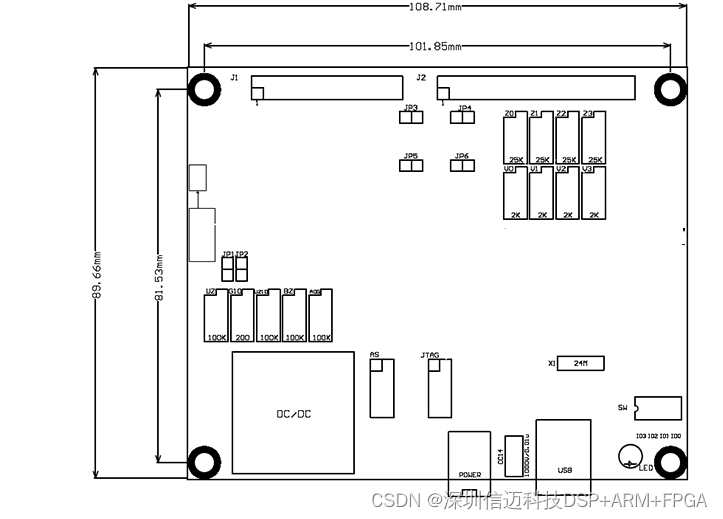
Board Dimensions: