RV1126 Edge AI Box, Supports 4-6 Channels of 1080p Video, 2 TOPS Computing Power
1 Product Overview
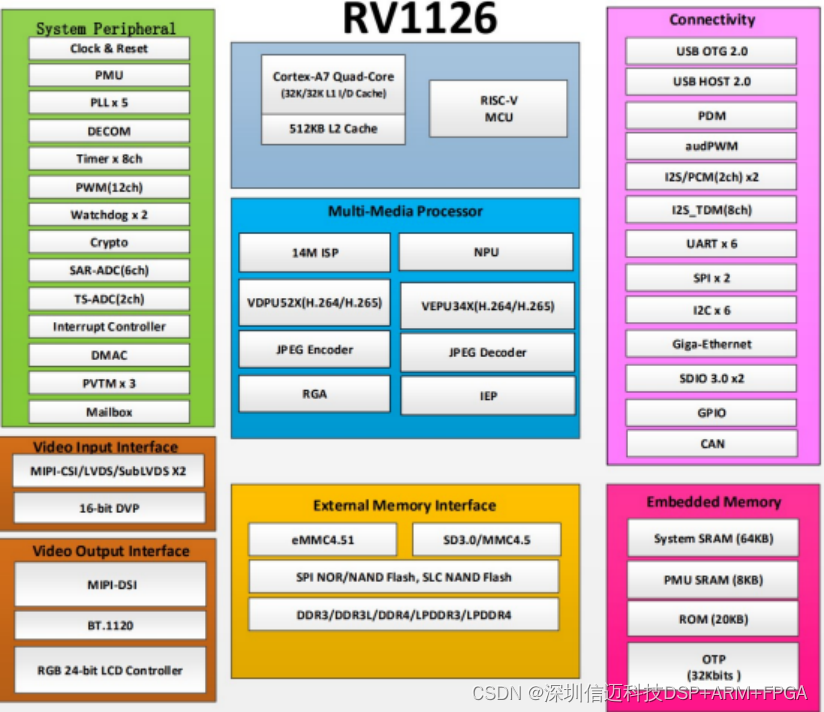
Xinmai has launched an AI edge computing motherboard based on the Rockchip RV1126 architecture. The RV1126 chip features a quad-core ARM Cortex-A7 at 1.5GHz, an RSIC-V CPU at 200MHz, and an NPU with 2.0 TOPS. The AI edge computing motherboard offers rich peripheral interfaces and strong expandability, making it widely applicable in AI intelligent fields such as smart security, industrial internet, smart cities, smart transportation, and smart healthcare.
Chip Block Diagram
2 Platform Features
- The Rockchip RV1126 adopts a 14nm process, featuring a quad-core ARM Cortex-A7 at 1.5GHz, an RSIC-V CPU at 200MHz, and an NPU with 2.0 TOPS; Its built-in NPU supports INT8/INT16 mixed-precision operations, perfectly balancing performance, power consumption, and computational accuracy, and supports network model conversion for frameworks like TensorFlow, Caffe, ONNX, and Darknet;
- Supports encryption and decryption engine;
- Supports MIPI-DSI/RGB interface, up to 1080P60fps;
- Multimedia: Supports 14MP ISP 2.0 with 3-frame HDR (Line-based/Frame-based/DCG);
Simultaneously supports 2 sets of MIPI CSI /LVDS/sub LVDS and one set of 16-bit parallel port input;
4K H.264/H.265 30fps video encoding, 3840 x 2160@30 fps + 720p@30 fps encoding; 4K H.264/H.265 30fps video decoding, 3840 x 2160@30 encoding + 3840 x 2160@30 fps decoding;
Operating temperature range up to -20℃ — +70℃
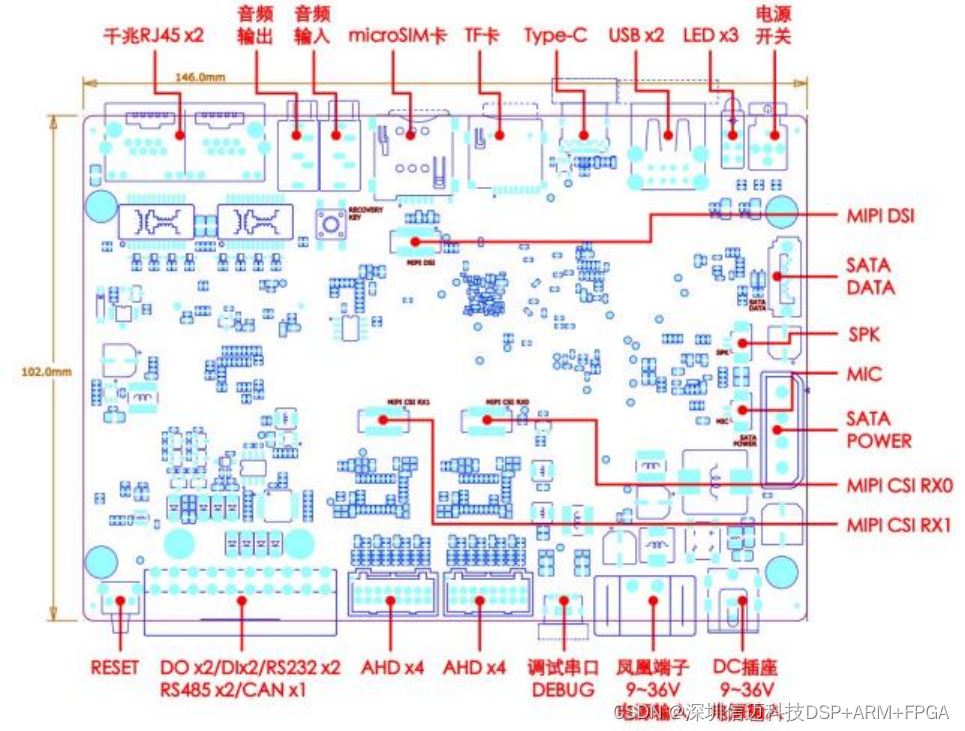
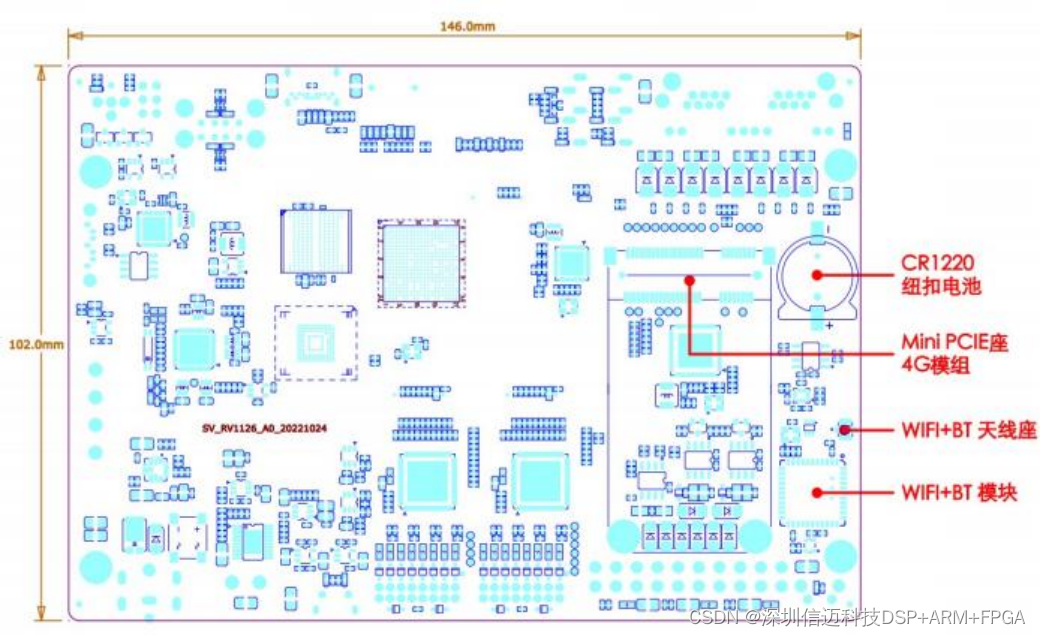
3 Motherboard Block Diagram
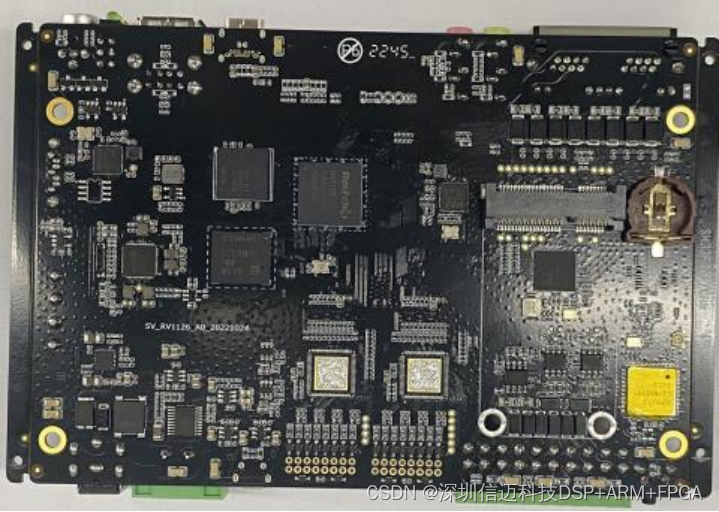
4 Motherboard Photos
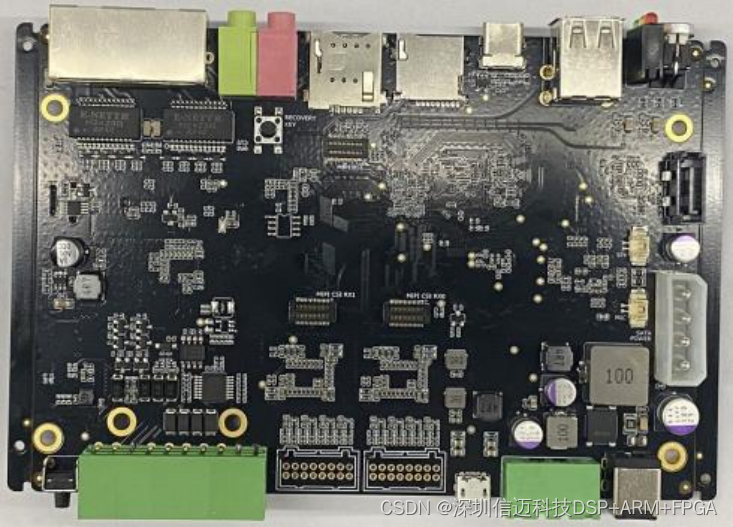
5 Motherboard Interfaces
RV1126 AI Edge Computing Interfaces
Function Definition
Remarks
Board Size
3.5-inch motherboard 146*102
EMMC
8GB
LPDDR3
2GB
AHD Interface
8-channel AHD interface, with audio
Dual Gigabit Ethernet Ports
1 WAN port, 1 LAN port
Sensor Interface
Reserved 6-axis sensor, gravity, gyroscope
SATA Hard Drive
2.5-inch mechanical hard drive
WIFI/BT&WIFI 2-in-1
Supports WIFI, BT data transmission function
USB Interface
2 USB 2.0 ports, OTG/HOST
Supports 4G/5G Module
Mainstream 4G/5G modules, supports MicroSIM card
Digital Input (DI), Digital Output (DO)
2 each
RS485, RS232
2 each
Audio Input/Output Interface
3.5-inch jack, can connect external headphones or speaker AUX input
Type-C Interface
Supports ADB debug port
Micro USB Port
GND/RX/TX for UART debug serial port
CAN
1 channel
TF Card
Supports 128GB TF card mounting, supports TF card hot-swapping.
MIPI Display Interface
Board-to-board connector reserved on board
6-pin Touchscreen Interface
Connector reserved on board
Supports RTC Function
Supports RTC function;
Reset Button
Supports 1 reset button;
Encryption IC
Reserved encryption function
9V-36V Power Supply
Phoenix terminal + standard round hole
5 Design and Production Recommendations
5.1 Reference Circuit
As reference designs are updated periodically, please obtain relevant reference design materials through official channels.
5.2 Baseboard Layout Design
It is necessary to implement appropriate ESD protection design for all peripheral interfaces;
5.2 Heat Dissipation Treatment
As multi-core high-performance processors generate significant heat when running at full load, system-level heat dissipation must be considered when using the product.
5.4 Transportation and Production
As modules are paired with different baseboard characteristics, the specific reflow oven temperature settings during production and material placement vary by product, please evaluate specifically during production;
Since modules may have experienced different times and environments from production to final product assembly, it is essential to perform dehumidification and drying treatment for the core board before component placement;
As the module is fully exposed and is an electrostatic sensitive device, ESD protection measures must be properly implemented during handling and transportation;