SPM Vibration Monitoring System for an Offshore Platform Using Domestic Instruments
Abstract: Using distributed data acquisition units and a cloud-based intelligent monitoring system, single point SPM (steel structure with bearings above and below water) vibration monitoring for an offshore Floating Production Storage and Offloading (FPSO) vessel was achieved. The system has successfully withstood the test of variable climatic environments, including high humidity and large temperature fluctuations.
Keywords: Offshore platform, Vibration monitoring, Environment
An offshore Floating Production Storage and Offloading (FPSO) vessel is moored to a single point SPM (steel structure with bearings above and below water). The FPSO rotates around the single point with the current, at a very slow speed. The FPSO rotates around the single point via Mooring chains and a Yoke. The rotation speed is related to tides and sea conditions, and the direction of rotation changes with the current. The inner turret of the single point is connected to the seabed and does not rotate, while the outer turret rotates with the FPSO. Typically, there are four tides per day. The FPSO rotates around the single point due to the action of the tide. The single point also, influenced by the tide, rotates left for a period and then right for a period. On average, the entire structure does not complete many full rotations in a day. The structural diagram and on-site photos are shown below.
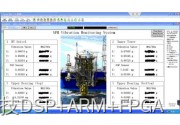
Due to significant impact vibrations at the single point, online vibration monitoring of the entire single point is required. The hardware and software used for monitoring consist of the 3060 system data acquisition unit and SPM vibration monitoring software, produced by Beijing Oriental Vibration and Noise Technology Research Institute. This monitoring system can display time-domain waveforms or spectra in real-time, or dual displays, or display values. It provides color or sound alarms for channels exceeding limits; simultaneously saves alarm logs; features trend analysis; generates reports; and allows remote configuration or viewing of various data for the monitoring system. The monitoring interface is shown below.
Remote monitoring of the system status is achieved through the central control room.
The SPM vibration monitoring system, located on the offshore platform, has withstood the test of variable climatic environments such as high humidity and large temperature fluctuations, ensuring the system's normal operation. From its installation and commissioning on December 6, 2011, to the present day, it has operated continuously, uninterrupted, and without faults.