NI 9234 4-Channel, ±5 V, 24-bit Software-Selectable IEPE and AC/DC Analog Input Module for Vibration Testing: A Domestic Alternative
NI's automated test and measurement systems empower you to break through barriers and make the impossible possible. Let us work together to select the optimal combination of hardware, software, and services, fully equipping you to achieve extraordinary results.
Purchasing NI products or services is not merely a one-time transaction. Should you have any questions or require support, our industry experts are always available to assist you.
We want to understand what is preventing you from achieving your goals. You can always discuss your challenges with a solutions expert. No matter the situation, we are always by your side. We will accompany you throughout the entire application lifecycle, providing service and support.
Growing energy demands and increasing interest in sourcing various energy types make stable production and distribution more critical than ever. NI solutions help ensure equipment quality and output consistency throughout the entire process.
Ensure Quality
NI's unparalleled measurement stability and hardware reliability ensure you have confidence in every product shipped.

Design for Future Changes
The NI platform offers faster development and maximum flexibility, easily adapting to new requirements and policy changes.

Minimize Downtime
NI asset management and simulation tools help you maintain peak productivity and prevent future downtime.

Reduce Total Cost
By utilizing standardized design and test methods with customizable equipment, users can reuse equipment across multiple applications.
Instructions for Use and Product Specifications
NI 9234
4-Channel, ±5 V, 24-bit Software-Selectable IEPE and AC/DC
Analog Input Module
Connecting the NI 9234
The NI 9234 has four BNC connectors, providing connections for four simultaneously sampled analog input channels.
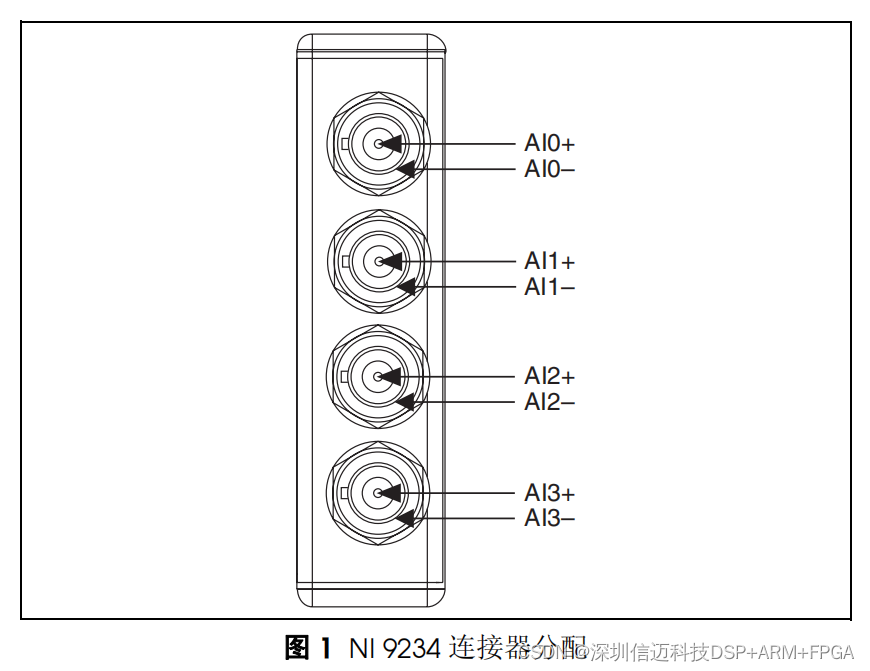
Each channel features a BNC connector for connecting signal sources. Users can also enable channel excitation current for connecting IEPE sensors. For more details, refer to NI 9234 Circuitry.
The center pin of the connector, AI+, provides DC excitation and positive input signal connection (when enabled). The connector's outer shell, AI–, provides the excitation return path and signal reference ground.
Connecting Signal Sources to the NI 9234
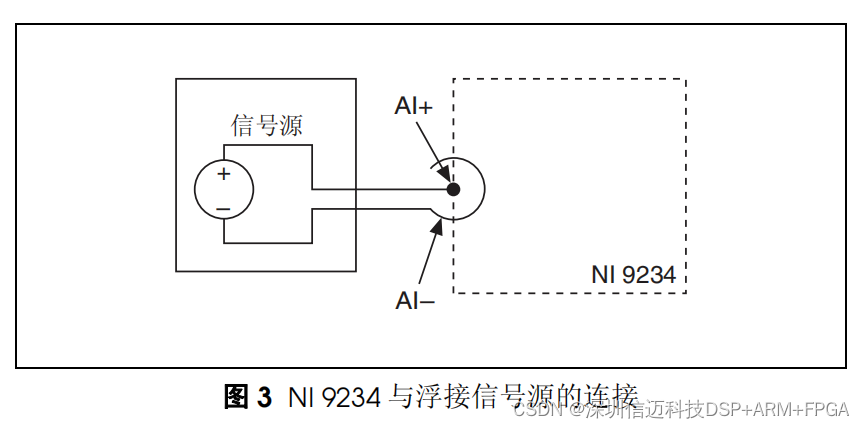
Grounded or floating signal sources can be connected to the NI 9234; using floating connections helps avoid ground noise. Avoiding contact between the metal shells of BNC connectors and with the module or chassis can further reduce ground noise.
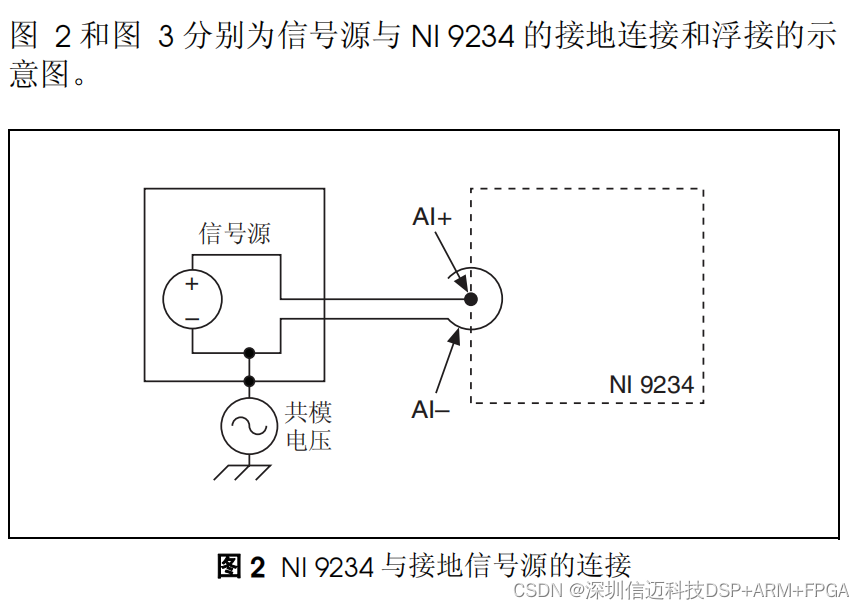
If the signal source is grounded to the NI 9234, ensure that the voltage on the AI– shell is within the common-mode range for proper operation of the NI 9234. Within the overvoltage protection range, the AI– shell voltage is prevented from accidentally reaching excessive levels. For detailed information on operating voltage and overvoltage protection, refer to Product Specifications.
The NI 9234 can provide IEPE excitation current for both grounded and floating IEPE sensors used for measurements. Typically, the IEPE sensor housing is electrically isolated from the IEPE device, so even if the sensor housing is grounded, the connection between the NI 9234 and the sensor remains floating.
NI 9234 Circuitry
The NI 9234 analog input channels are connected to chassis ground through a 50 Ω resistor. To minimize ground noise, ensure the chassis is grounded. Each channel features overvoltage protection. The input signal for each channel is buffered and conditioned, then sampled by a 24-bit Delta-Sigma analog-to-digital converter. Channels can be configured for AC or DC coupling via software. For channels configured for AC coupling, users can enable or disable IEPE excitation current. For detailed information on configuring NI 9234 channels, refer to the software help documentation.
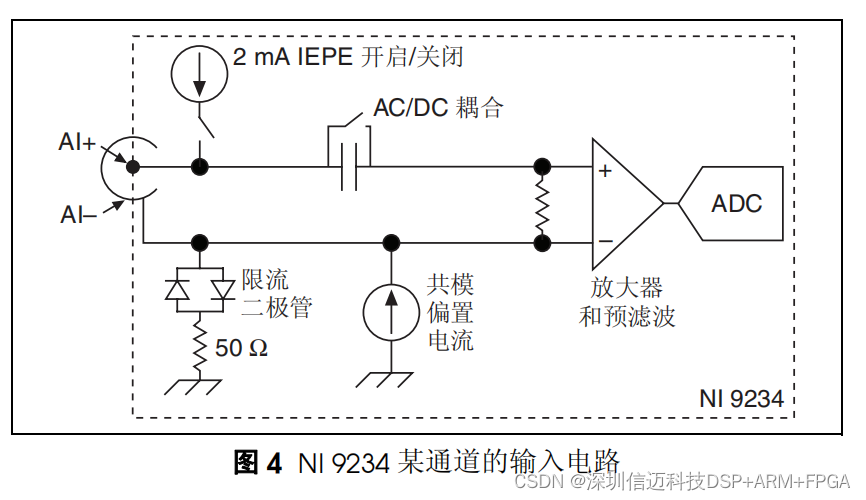
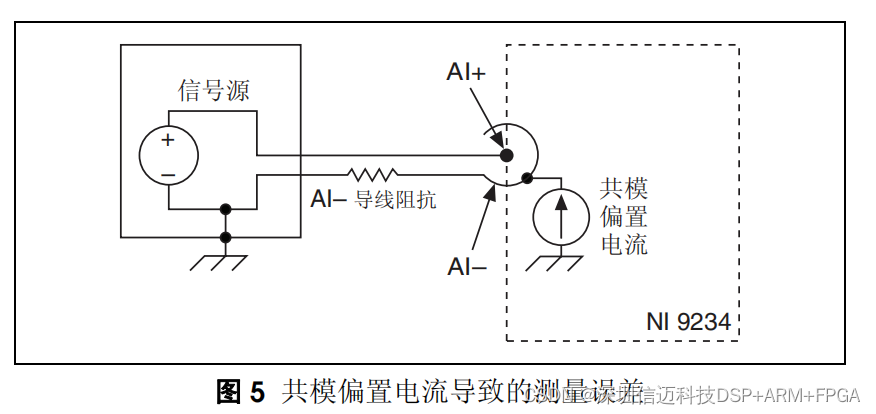
When IEPE current is not enabled, the NI 9234 uses a common-mode bias current to bias the current-limiting diodes. When using a grounded signal source, this current will cause an error, the magnitude of which depends on the AI– wire impedance. The error is approximately (50 ppm of range + 15 ppm of reading) / AI– impedance (Ω). This common-mode bias current error only occurs when using grounded signal sources; it is not a concern when using floating signal sources. For optimal accuracy, use a floating connection or connect grounded signal sources with low-impedance wires.