ARM/X86 Industrial PC Applications in Rail Transit Ground Control Systems (2)
Ground Control System
The XM-2000 series can serve as a front-end wayside controller, compliant with the EN50121-4 standard, making it an ideal ground controller product perfectly suited for various systems such as Centralized Traffic Control (CTC) and Automatic Train Control (ATC). Sinmai's robust and reliable systems and platforms enable precise monitoring of ground control applications, thereby enhancing safety in railway operating environments.
System Architecture
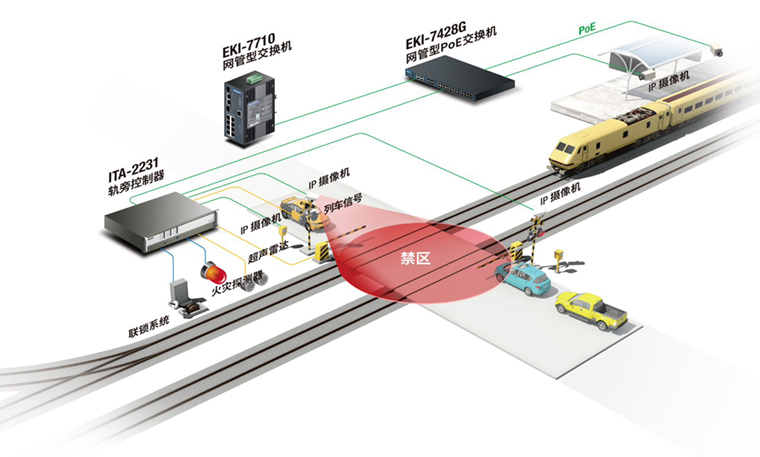
Ground Control System Products
-
Fully compliant with EN 50121-4 standard
-
Wide operating temperature range
-
Supports easy-to-install power modules
-
Rich serial, Ethernet, and other I/O connectivity
Application Cases
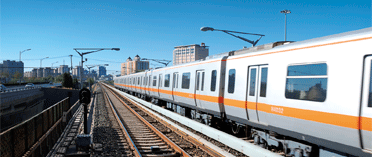
Automatic Train Control
System Requirements Automatic Train Control (ATC) plays a crucial role in railway transportation; it is used to detect train positions at specific times, control train speed, and monitor train operational status in real-time. ATC generally includes Automatic Train Protection (ATP), Automatic Train Operation (ATO), and Automatic Train Supervision (ATS); it utilizes trackside detectors, signal processing equipment, and interlocking systems to maintain minimum safe headways between operating trains. ATC must employ a complete integrated system for calculating and controlling train positions, setting routes and determining track status, displaying and managing synchronized station data information, and performing train inspections upon arrival at stations. In mainland China, some Sinmai products have been applied in the railway transportation sector, and their safety and convenience have been proven in numerous successful cases.
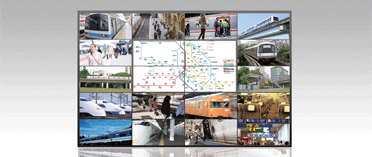
Centralized Traffic Control
System Requirements The Centralized Traffic Control (CTC) system is responsible for collecting and displaying the current status of all operating vehicles, tracks, and stations, dispatching backup equipment or responding to emergencies, and connecting to subsystem interfaces and architectures, such as interlocking systems and automatic train control systems. As the name suggests, CTC is a platform for station managers or other personnel to centrally and effectively command and control trains. At the station level, the CTC system records the train numbers of arriving and departing trains, as well as their precise arrival and departure times; in the central control room, CTC displays the positions of trains operating on the tracks, records detailed station statuses, and issues commands based on the collected data. Therefore, the function of CTC is to control subsystems to ensure normal train operation. Sinmai will spare no effort to provide stable and reliable integrated platforms, thereby injecting continuous power into modern railways.
Interlocking
System Requirements In modern railway systems, interlocking is controlled by stable integrated computing systems; it translates all signal and route locks into logical patterns, thereby providing higher safety and comprehensive diagnostics, and automatically reporting them to maintenance personnel. SSI (Solid State Interlocking) consists of Central Interlocking (CI) and Trackside Function Modules (TFM). CI achieves fault-free safe interlocking control through logic circuits, while TFM executes signal or route locking upon receiving CI commands. SSI is the most important equipment for operations such as route locking and proximity switching, ensuring trains run correctly according to preset routes, thereby preventing train collisions or derailments caused by human error. Sinmai's robust and reliable systems and platforms enable precise monitoring of SSI, thereby enhancing the safety of railway transportation.
Industrial Communication Solutions for Ground Control
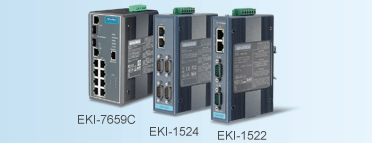
EKI-1500 Series and EKI-7000 Series Ground control systems require higher safety and stability. For such systems, products need to connect multiple RS-485 serial devices to an Ethernet network without the need for dedicated transmission lines, which facilitates the construction of redundant Ethernet networks for backup connections. After connecting EKI-1500 series serial device servers to field serial devices via RS-485 interfaces, engineers can use computers in the control room to monitor the status of protective relays and further control RTUs. On the other hand, EKI-7000 series Ethernet switches provide a simple method for building redundant networks, allowing recovery times to be reduced to less than 20ms. Both product lines support wide operating temperatures (-10~60℃) to adapt to outdoor environments, and their robust metal shielded enclosures also protect the products and prevent external interference.