Application of ARM/X86 Industrial PCs in Rail Transit Station Management Systems (1)
Station Management System
A Station Management System (SMS) is an integrated platform, including the Integrated Supervisory Control System (ISCS), Fire Alarm System (FAS), Building Automation System (BAS), and more. Due to its complexity, the SMS requires hardware that is stable and scalable to ensure 24/7 continuous operation. Xinmai's industrial server-grade systems are renowned for their ruggedness and extensive expandability, which often play a crucial role in specialized applications.
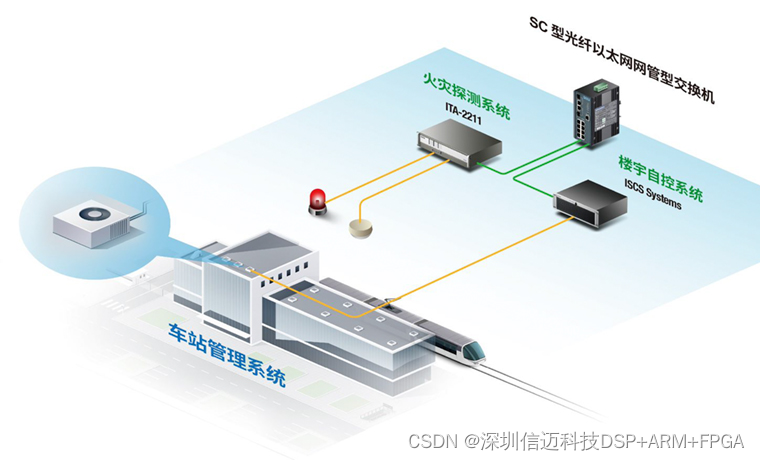
Station Management System Products
- Rugged Design
- Stable, Scalable System for Easy I/O Expansion
Application Cases
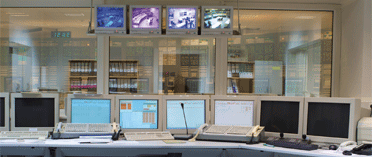
Integrated Supervisory Control System
System Requirements The Integrated Supervisory Control System (ISCS) includes: various levels of railway operation control centers that ensure the effective and smooth operation of the railway system; a comprehensive Station Management System (SMS) that monitors the status of station power, signals, and environmental control systems; and a Plant Management System (PMS) that ensures all subsystem interfaces between the Central Management System (CMS) and the SMS are correctly connected. Within this scope, each system must operate 24/7 without failure to provide critical information and emergency solutions. This system must be built upon a reliable hardware and software platform, such as redundant, real-time servers, and support remote access control. Xinmai industrial-grade computers and I/O controllers are designed for multi-I/O connection application environments, making them an ideal ISCS solution.
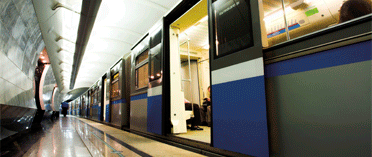
Fire Alarm System
System Requirements The Fire Alarm System (FAS) plays a critical role in station management and monitoring, preventing hazards, receiving alarm signals and alerts, and issuing disaster relief commands. FAS functions can be divided into central-level and station-level. In the event of a fire alarm, the central FAS server acts as a control center, automatically collecting, displaying, recording, and storing information for document processing and management. The station-level control system is used to send evacuation commands or execute disaster relief commands. FAS can provide information and resources via LAN connection, as well as implement and direct disaster relief activities, thereby enhancing the safety of subway stations.
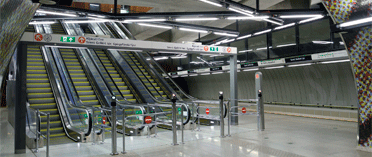
Building Automation System
System Requirements In modern railway systems, the Building Automation System (BAS) is controlled by a stable, integrated computing platform. Station management consists of various systems, including control of elevators, escalators, lighting systems, indoor temperature systems, and more. Industrial computers will operate or maintain these systems 24/7 without interruption based on preset data. Thanks to the built-in Xinmai remote control management software, SUSIAccess, BAS can monitor the current status of systems, and supports automatic alarming and health checks, thereby reducing system downtime and maintenance. Furthermore, SUSIAccess also allows BAS to actively control operational systems for troubleshooting. Well-functioning station elevators and appropriate indoor temperature environments can provide a more comfortable experience for end-users. Xinmai systems can effectively manage all equipment and facilities within the station.
Industrial Ethernet Switches for Station Management
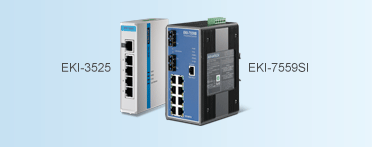
Fiber Optic Managed Switch Series and EKI-3000 Series Field control systems need to consider high security and stability factors. For such systems, products need to connect multiple RS-485 serial devices to an Ethernet network without laying dedicated transmission lines, which facilitates the construction of redundant Ethernet networks for backup connections. After connecting EKI-1500 series serial device servers to field serial devices via RS-485 ports, engineers can use computers in the control room to monitor the status of protective relays and further control RTUs. EKI-7000 series Ethernet switches provide a simple way to build redundant networks, allowing recovery time to be reduced to less than 20ms. Both product lines support wide operating temperatures (-10~60℃) to adapt to outdoor environments, and rugged metal shielded enclosures protect the products and prevent external interference.