LS1028-Based TSN Switch Software System Design and Implementation (Part 3)
NXP launched OpenIL as a Linux distribution for industrial applications. New additions in OpenIL include extensions supporting real-time operating systems and Time-Sensitive Networking for automated OEMs in industrial plants. The biggest advantage of OpenIL as an open industrial Linux system is that it removes obstacles to real-time computing in networks. OEMs will gradually enter the Industry 4.0 era by leveraging the standard, community-driven OpenIL distribution.
4.1 Basic Design Philosophy of TSN Switch Software
In this paper, the switch software supporting the TSN system uses the Open Industrial Linux system (OpenIL). This is because a key characteristic of TSN is strong real-time performance, and OpenIL is a specialized Linux version developed for industrial applications. It extends real-time operating systems and supports Time-Sensitive Networking for automated OEMs in industrial plants (including stream filtering and policing, time-aware shaper, and 802.1AS time synchronization, etc.). The overall block diagram of the software system is shown in Figure 4-1.
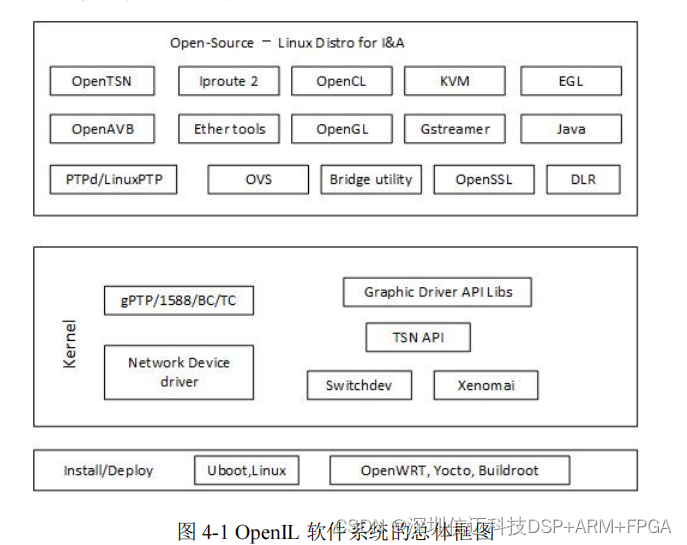
OpenIL not only includes IT infrastructure software such as network protocol stacks, web services for configuration management, and scripting tools, but also practical system programs typically found in a Linux distribution. In addition, it includes the following software features for industrial applications:
(1) Xenomai real-time extensions for Unix, simplifying RTOS porting (e.g., VxWorks, pSOS). (2) Extensible Markup Language (XML) and NETCONF-based TSN network configuration utilities. (3) linuxptp daemon supporting General Precision Time Protocol (gPTP). (4) Support for edge computing services. (5) SeLinux for security.
Adopting OpenIL can not only enable the TSN features of the switch, but also allow this switch to be used as a TSN END POINT in future large-scale industrial internet platforms, connecting to the entire TSN network**[26]**. The directory structure of the OpenIL system is shown in Figure 4-2, with the second and third layers generated during compilation.

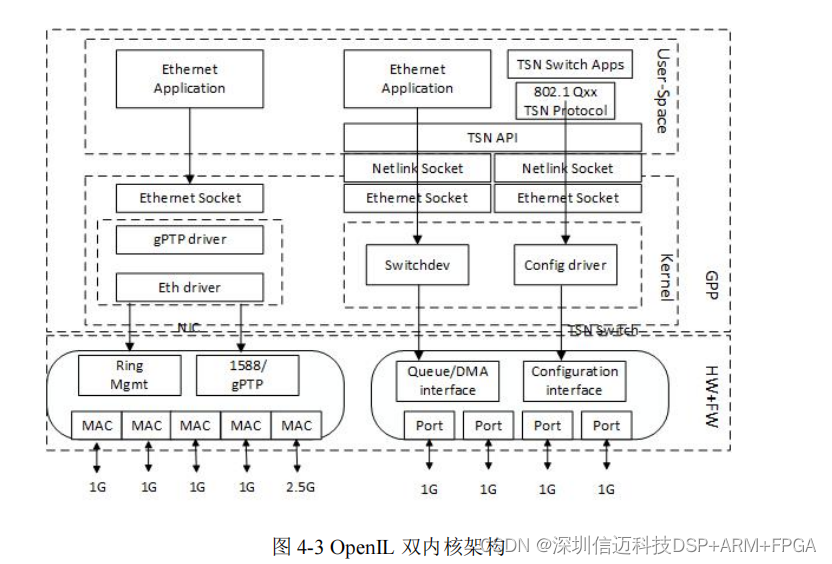
OpenIL provides the determinism, manageability, industrial networking, and security required by OT (Operational Technology) on top of general-purpose Linux. Xenomai Cobalt is a real-time framework that ports traditional RTOS applications to OpenIL, extending a single Linux kernel into a dual-kernel system (real-time kernel and native Linux kernel [27]). This way, by deploying a single IEEE standard Ethernet network, it can transmit both high-real-time control traffic for OT systems and best-effort ordinary Ethernet traffic for IT systems. In this research, the main work focuses on the implementation of the Xenomai Cobalt dual-kernel in OpenIL.
Figure 4-3 shows the dual-kernel architecture in the OpenIL system. The TSN API is called by applications with real-time requirements, configuring the TSN switch via the real-time Xenomai Cobalt kernel. The kernel also supports the gPTP protocol (General Precision Time Protocol) for time synchronization. The user-space supports general Ethernet applications, as well as TSN-related applications, so a single system can meet both IT and OT requirements, simplifying network deployment and management.
4.3 Functional Modules of TSN Switch Software
4.4 TSN Switch Software Functions
The software functions of TSN are jointly implemented by three main components: the user-space TSN API interface, the in-kernel TSN configuration interface, and the switchdev driver. Figure 4-8 shows the software-level call relationship.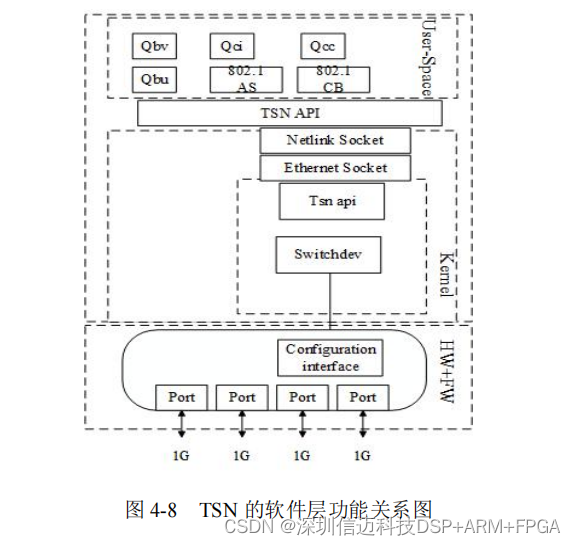
The user-space TSN API is distributed as a shared library (libtsn.so), providing a unified interface for developers. All API interfaces are in the form of tsn_xx_set or tsn_xx_get, where xx represents a functional abbreviation. For example, the qbv function setting interfaces are tsn_qbv_set and tsn_qbv_get.
The implementation principle is to communicate with the kernel's TSN API module via Netlink sockets. This is a common method for user-space to kernel-space communication in Linux, so it will not be elaborated further. We also provide the tsntool executable for interactive configuration, and tsntool is implemented using libtsn.so.
The kernel-space TSN API is compiled into the kernel as a built-in feature. Its compilation can be configured in menuconfig. This module primarily provides the tsn_port_register(port, optfunc, enable) interface for the switchdev driver to call. The configuration functions of the interface are ultimately implemented by the callback function optfunc. On the other hand, the kernel-space TSN API receives Netlink socket messages (from user-space TSN), parses them, configures via the optfunc function, and returns the result to the user.