Design of a Medical Video Terminal Based on RK3399+5G
Driven by various advanced information and communication technologies, the healthcare industry is currently showing a trend towards informatization, mobility, and intelligence. In particular, the practical application of 5G communication technology has propelled the vigorous development of the smart healthcare industry, leading to a surge of 5G-based medical and health applications and services. This further integrates advanced information technologies such as 5G, IoT, and big data, making the transformation and upgrade of traditional medical services towards digitalization, informatization, and intelligence a hot topic in industry research and application. Among these, mobile telemedicine scenarios, as a crucial application area within the smart healthcare system, effectively leverage the technical advantages of 5G mobile communication networks to achieve mobile collection and high-speed real-time transmission of large volumes of heterogeneous medical data, such as images and physiological signs. Therefore, this paper, based on a high-performance domestic processor, researches and designs a mobile medical terminal integrating 5G communication technology, and completes the development of application software for medical image, detection, and other data collection and transmission on the terminal.
The main research work and content of this paper are as follows:
-
Researched and analyzed the current status and trends of the deep integration of 5G communication technology with mobile healthcare and its application research. Based on the actual application scenarios and technical requirements of mobile medical rescue, the functions and technical indicators of the 5G medical terminal were studied and analyzed. A high-performance domestic RK3399Pro processor was selected, and based on this, an overall hardware and software solution for the 5G medical terminal system was proposed, primarily completing the functional design for 5G network access, heterogeneous device data collection, and high-definition video transmission on the terminal.
-
Completed the schematic design of the 5G medical terminal's functional circuits and the entire system using the Cadence circuit design software platform. The terminal hardware platform mainly includes a core motherboard centered around the RK3399Pro processor, equipped with a 4GB LPDDR4 memory module, a 64GB eMMC storage module, and a power management module, as well as a communication interface board containing a 5G communication module, Wi-Fi module, Ethernet port module, display module, power module, and general-purpose serial peripheral interfaces. Subsequently, the PCB layout design for the 12-layer core motherboard and the 4-layer communication interface board was completed, along with the hardware manufacturing of the 5G medical terminal.
-
Based on the completed terminal hardware prototype, a 64-bit ARM cross-compilation environment for the RK3399Pro processor was established. U-Boot, the Linux kernel, the Ubuntu root file system, and corresponding device drivers were ported. Subsequently, application program design and development for 5G medical terminal data collection and transmission were completed based on Ffmpeg and an I/O multiplexing mechanism. Finally, functional testing and application verification were performed on the functional modules and the entire system of the 5G medical terminal based on the high-performance domestic processor.
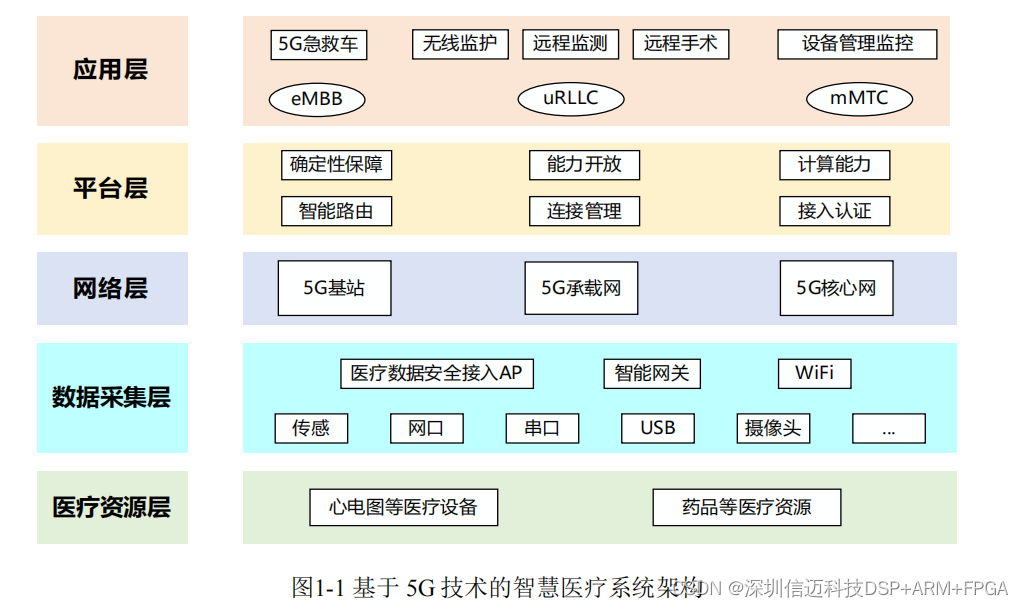
As one of the important vertical application fields of 5G technology, since its advent, 5G technology has been continuously implemented across various industries, and its application in improving the healthcare sector has consistently been a research hotspot. Through 5G technology, existing medical resources can be utilized more effectively, and medical services will no longer be limited by geographical location. Research on 5G and healthcare primarily includes 5G smart healthcare system architecture, the integration of 5G with IoT medical technology, and 5G healthcare technology in mobile environments. According to the "5G Era Smart Healthcare White Paper" [4], the structure of a 5G-based smart healthcare system is summarized as shown in Figure 1-1, which can generally be divided into the Medical Resource Layer, Data Collection Layer, Network Layer, Platform Layer, and Application Layer.
The Medical Resource Layer provides material assurance for the medical system, primarily including pharmaceutical resources and medical equipment used for diagnosis and treatment, laying the foundation for the medical system and serving as the source of medical IoT data. The Data Collection Layer corresponds to the perception layer technology in the IoT system, aiming to achieve data collection from various medical devices. Through heterogeneous communication interfaces and physiological sensors configured in various medical devices, medical information is collected in real-time, and then the collected data is provided to specific interfaces of the hospital management system for further processing and management. Technologies at this layer include, but are not limited to, gateway APs, IoT terminals, and other related technologies. The Network Layer utilizes 5G base stations, bearer networks, and core networks as transmission media for digital information within the medical system. The Platform Layer primarily achieves intelligent, accurate, and efficient medical information processing, leveraging new technologies such as advanced edge computing, artificial intelligence, cloud computing, and big data to output valuable information for front-end applications. The Application Layer mainly addresses the actual needs of the industry, realizing mature and diverse medical informatization applications.
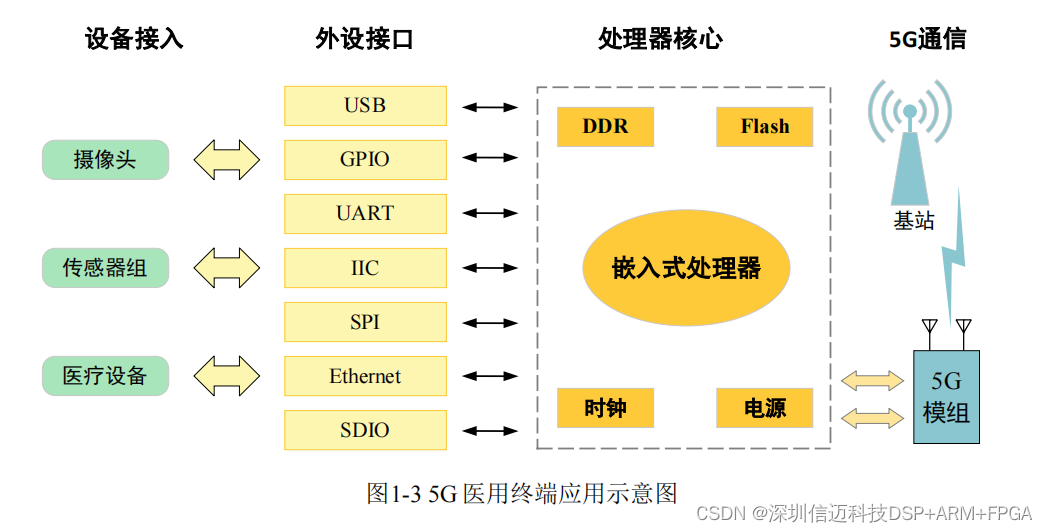
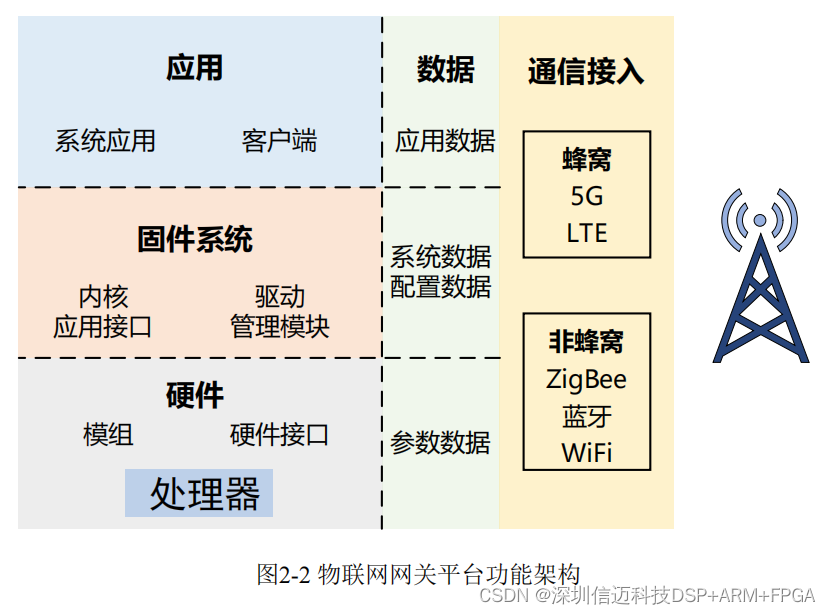
After analyzing the application requirements for the 5G mobile medical terminal system, the overall structure of the terminal system based on the RK3399Pro processor is designed as shown in Figure 3-2. The terminal uses the Rockchip RK3399Pro processor as the main processing unit, and by configuring memory, storage, power, and various peripheral interfaces, it provides the terminal with the hardware configuration of a full-featured medical IoT gateway.
Regarding the key points of the terminal's hardware design, the first is to improve PCB integration, aiming to minimize area and manufacturing costs while ensuring full functionality. The second is to ensure the integrity of high-speed interface signal transmission, so that high-speed data transmission performance is not limited by hardware design, fully leveraging the hardware capabilities.
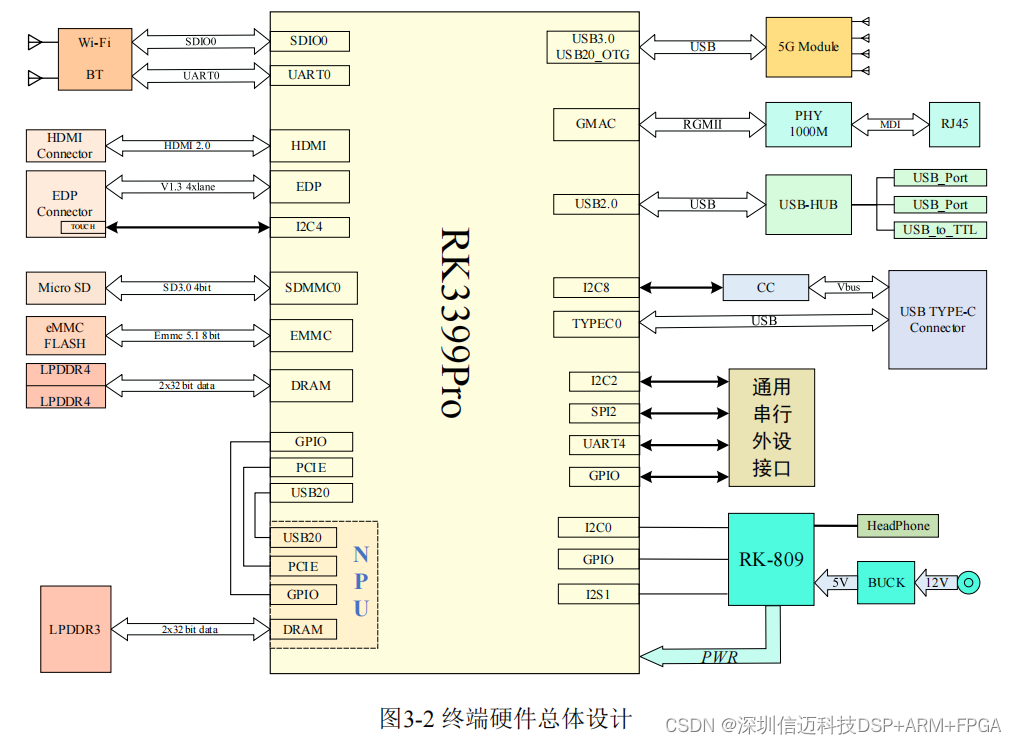
In modern smart terminal devices, Double Data Rate Synchronous Dynamic Random Access Memory (DDR SDRAM) is a standard component, and the operation of system applications relies on DDR. Under the same hardware conditions, larger memory leads to higher system performance. The RK3399Pro can be broadly viewed as consisting of an RK3399 CPU part and an independent NPU (Neural Processing Unit) computing unit. The NPU part can be configured with independent 2GB LPDDR3 memory to accelerate various intelligent algorithms. Therefore, to further enhance terminal performance, DDR devices selected include Low Power Double Data Rate 3 (LPDDR3) and Low Power Double Data Rate 4 (LPDDR4) devices.
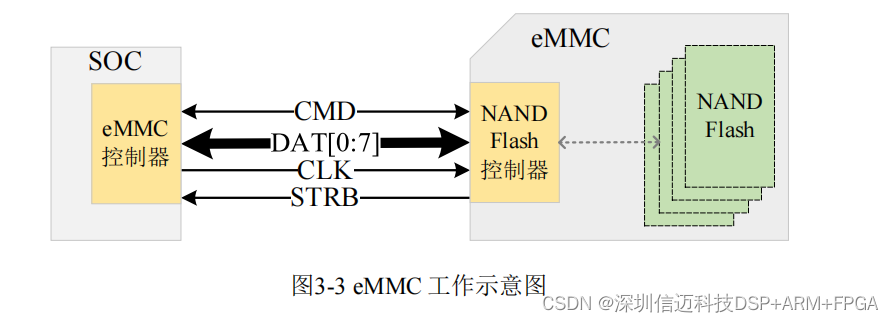
For the terminal's storage functionality, two storage methods are provided in the design. One is the Embedded Multi Media Card (eMMC) [39], commonly used in modern mobile terminal devices (smartphones, tablets). In embedded systems, eMMC acts as a storage device, similar to a hard drive, used for storing system images and booting the operating system. The other method is external SD card storage; for large-capacity data that needs to be stored, an external high-speed memory card can be equipped. eMMC contains a NAND Flash controller and NAND Flash storage media. The NAND Flash is managed by an internal controller, which handles ECC, wear leveling, and bad block management. The eMMC controller provides a standard integrated package for managing complex NAND Flash. The SOC accesses the NAND Flash via the NAND Flash controller to perform data read and write operations. The packaged interface module can be connected to the SOC via a simple connection. The working relationship between eMMC and SOC is shown in Figure 3-3.
3.4 Terminal Software System Architecture Design
The 5G medical terminal software system architecture is shown in Figure 3-4, comprising a Linux system and applications. The software system needs to be based on the RK3399Pro processor hardware. Under the Linux system, BootLoader, kernel, device drivers, and other components are ported to adapt to the hardware layer, providing a runtime environment for terminal applications. Therefore, the development and design of the terminal software system encompass hardware drivers, operating system, application software, and other aspects.
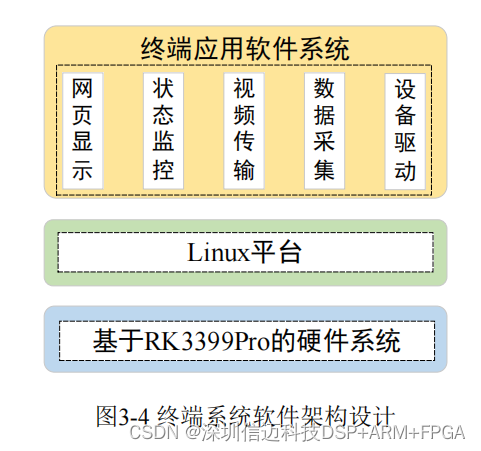
The core implementation of the device driver part is to achieve full functionality of hardware modules under the Linux system based on board-level hardware information, providing application software with data read/write capabilities for peripheral interfaces. The use of the Linux system and its driver framework is key to realizing hardware function drivers.
The implementation of the data collection part needs to ensure the parallelism and real-time nature of multi-device interface collection. Therefore, the program must not only target specific medical device interfaces, parse the required target values from the interface data according