Control and Implementation of a DSP+FPGA-Based High-Speed Macro-Micro Semiconductor Motion Platform
In semiconductor chip manufacturing equipment, to achieve high quality and high efficiency in semiconductor chip manufacturing, its moving parts typically require high motion performance. For example, in high-end wire bonders, the motion platform is usually required to achieve a positioning accuracy of 1-2 μm at an acceleration of 15-20g and a motion frequency of 15-20Hz [3]. For typical chip lithography machines, the motion platform needs to achieve tens of nanometers of positioning accuracy over a long stroke of 100-150mm [4]. Furthermore, as semiconductor chips continue to evolve towards higher efficiency and greater precision, to further meet the high-end demands of the microelectronics manufacturing industry, high-acceleration precision motion platforms in semiconductor chip manufacturing equipment must simultaneously satisfy comprehensive requirements for large stroke, high dynamic response, and high-precision positioning. Macro-micro motion platforms combine the characteristics of high-speed, large-stroke motion with high-precision positioning, making them an important method for achieving high-speed, large-stroke, and precise positioning. Therefore, this project conducts in-depth research on high-speed, high-acceleration, large-stroke macro-micro precision motion platforms, focusing on solving the critical problem of rapid high-precision positioning for macro-micro motion platforms under high-speed and large-stroke conditions. This is of great significance for enhancing China's independent capabilities in microelectronics manufacturing equipment and promoting the vigorous development of China's microelectronics manufacturing industry.
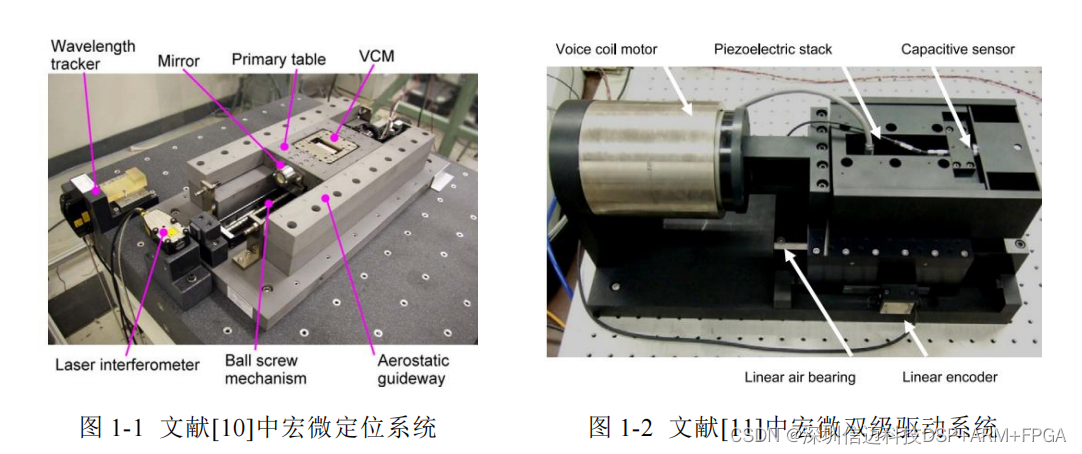
To achieve rapid and high-precision positioning of macro-micro motion platforms, the design of their control systems is particularly crucial. Especially when the platform operates with nanometer-level positioning requirements, various complex disturbances such as external disturbances, electrical noise, model parameter perturbations, and nonlinear friction inevitably affect the platform's positioning performance during motion and positioning. A macro-micro composite platform, being a dual-stage drive system, is essentially a Dual-Input Single-Output (DISO) system. However, considering the respective characteristics and functions of the macro and micro parts, in practical control, a time-sharing activation and switching control approach is often adopted to divide the macro-micro dual-stage system into two Single-Input Single-Output (SISO) systems. Therefore, the control strategies for macro-micro composite dual-drive platforms are mainly divided into: macro-motion control—where the controlled object is often a direct-drive system represented by a linear motor; micro-motion control—represented by a micro-drive system consisting of piezoelectric ceramics and a flexible mechanism; and macro-micro switching control strategies to achieve composite positioning of the macro-micro motion platform.
Controller Design