3D Vision Application Cases: Automated Loading of Flange Parts, Engine Hoods, Control Arms, and Wheel Hub Picking for Racking
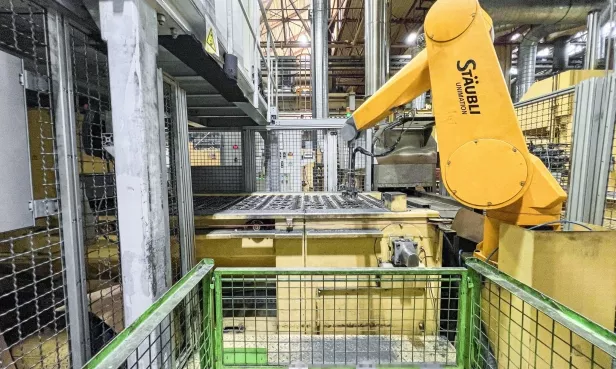
Flange Part Loading
A Large Automotive Parts Manufacturer
Project Background
The client is a well-known foreign-funded automotive parts enterprise. Its factory located in East China requires 3D vision to automate the loading of sandblasting machines. The workpieces are plate-shaped, porous metal parts, with a thickness of only 5mm. They are neatly stacked in deep bins and need to be loaded at high speed onto the sandblasting machine.
Operation Process
• Manual transport of material bins into position, vision system locates bin position.
• Vision system captures images to guide the robot to pick up 4 pieces in a row, placing them in parallel onto the sandblasting machine.
• Repeat the above actions until the bin is empty.
Solution Highlights
• Uses XM-GX-L camera, with an accuracy of ±2mm.
• Vision cycle time <3s, overall cycle time <5s, maximizing machine production efficiency.
• Workpiece thickness is only 5mm, vision system effectively identifies, enabling efficient bin emptying.
• Supports quick registration and switching of workpieces, adaptable to over ten specifications, enabling flexible production.
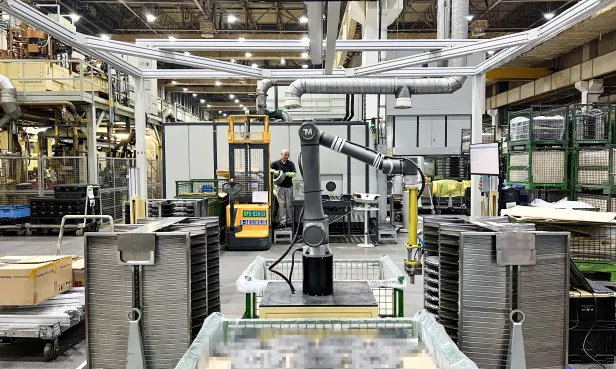
Wheel Hub Picking and Racking
A Large Automotive Parts Manufacturer
Project Background
The client is a well-known foreign-funded automotive parts enterprise. Its factory in East China requires 3D vision to automate the racking of wheel hubs. The workpieces are porous, disc-shaped steel parts with a reflective surface. They are laid flat layer by layer, separated by anti-rust paper, in deep bins. The bins are wrapped with plastic film. After picking, the workpieces need to be placed one by one onto racks for the next process.
Operation Process
• Manual transport of material bins into position, vision system locates bin position.
• Vision system captures images to identify wheel hub pose, guiding the robot to pick them up one by one and place them onto racks.
• After emptying one layer, the anti-rust paper is removed before proceeding to the next layer, until the bin is empty.
Solution Highlights
• Uses XM-GX-L camera, mounted on a mobile module, capable of high-precision identification of reflective workpieces and bins at dual workstations.
• Can handle a certain degree of plastic film obstruction, enabling stable identification and picking.
• Supports quick registration and switching of workpieces, enabling flexible production.
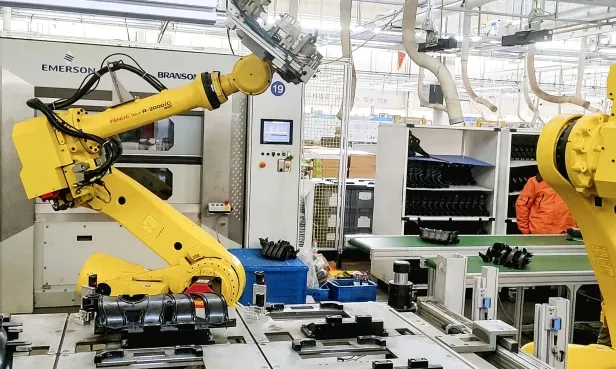
Engine Hood Loading
A Listed Automotive Parts Enterprise
Project Background
The client is a listed automotive parts enterprise in East China, requiring 3D vision to achieve automatic loading and mating of engine hoods. The workpieces are pure black POM injection-molded material, slightly reflective, with a complex external structure. They are transported via a conveyor belt to the robot workstation, then downstream connected to ultrasonic welding equipment for assembly and welding.
Operation Process
• The lower part arrives at the photography position, triggering the camera to capture an image, guiding the robot to pick it up and place it onto the fixture.
• The upper part arrives at the photography position, triggering the camera to capture an image, guiding the robot to pick it up for mating.
Solution Highlights
• Uses XM-SP-L camera, with an accuracy of ±2mm.
• Vision photography time <3s, meeting production cycle time requirements.
• Supports 24-hour production line operation, significantly reducing operating costs.
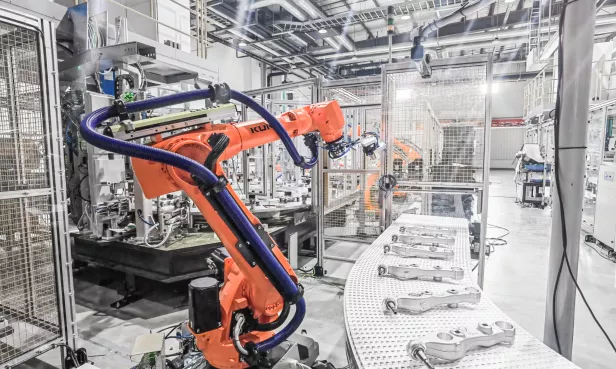
Control Arm Loading
A Large Automotive Parts Manufacturer
Project Background
The client is a well-known foreign-funded automotive parts enterprise. Its factory in East China requires 3D vision to automate the loading of control arms. There are 9 specifications of workpieces, all made of cast aluminum alloy, with highly reflective surfaces. The workpieces are transported via a conveyor belt and need to be picked up and placed onto a fixture table.
Operation Process
• Conveyor belt transports workpieces to the robot workstation.
• Vision system captures images to identify workpiece pose, guiding the robot to pick them up.
Solution Highlights
• Uses XM-GX-M camera, installed in a fixed manner, capable of identifying and locating highly reflective workpieces with an accuracy of ±3mm in XY directions and ±1mm in Z direction.
• Supports quick registration and switching of new workpieces, fixtures, and picking methods, enabling flexible production.
返回列表