RK3588 AI Edge Computing Smart Transportation Intelligent Security Industrial Motherboard Design Solution
This article provides a detailed introduction to the form factor, dimensions, technical specifications, and detailed hardware interface design reference for the AI edge computing motherboard based on the Rockchip RK3588 chip. This enables customers to quickly apply the RK3588 edge computing motherboard to intelligent terminal devices in AI fields such as industrial internet, smart cities, smart security, smart transportation, and smart healthcare.
- Product Overview
Xinmai has launched an AI edge computing motherboard based on the Rockchip RK3588 architecture. The RK3588 is a new generation domestic flagship high-performance 64-bit octa-core processor, built on an 8nm process. It features high computing power, low power consumption, powerful multimedia capabilities, and rich data interfaces. It is equipped with an octa-core CPU (quad-core A76 + quad-core A55) and an ARM G610MP4 GPU, with a built-in NPU offering 6 TOPs of computing power. It supports 8K@60fps video decoding and 8K@30fps encoding, boasts a wide array of peripheral interfaces, and offers excellent expandability. The RK3588 integrates an embedded Neural Processing Unit (NPU) with up to 6.0 TOPs of computing power, supporting PCI-e/USB3.0/RGMII, capable of structured video recognition and analysis for 32 channels of 1080P network cameras.
The edge computing motherboard powered by the Rockchip RK3588 chip offers robust computing power and rich, highly expandable input/output interfaces. The PCB is designed with a 10-layer immersion gold process, providing excellent electrical characteristics and anti-interference capabilities, ensuring stable and reliable operation, and meeting industrial-grade standards. It can be widely applied in AI terminal fields such as smart cities, smart security, smart healthcare, and industrial internet.
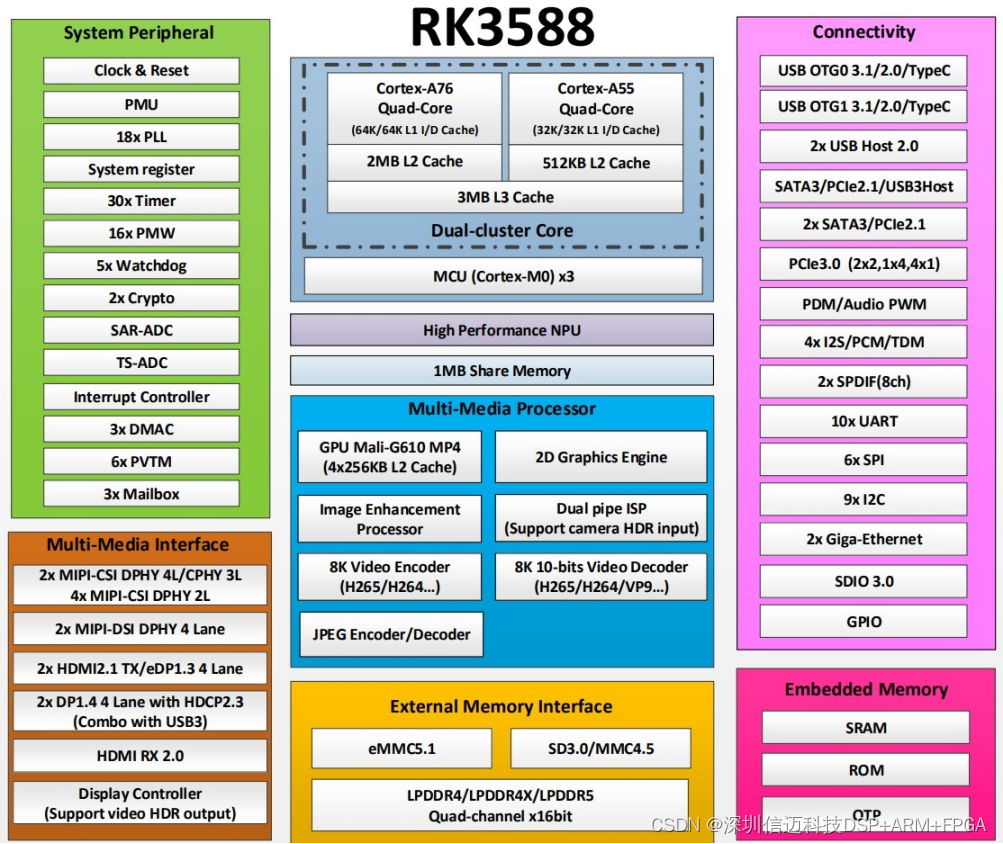
Chip Block Diagram
- Platform Features
- Built-in 3D GPU, compatible with OpenGL ES1.1/2.0/3.2, OpenCL 2.2, and Vulkan1.2. Special with MMU.
- Supports 32-channel 1080P decoding, with multiple powerful embedded hardware engines built-in, supporting 8K@60fps H.265 and VP9 decoders, 8K@30fps H.264 decoder, and 4K@60fps AV1 decoder; supports 8K@30fps H.264 and H.265 encoders, high-quality JPEG encoder/decoder, dedicated image pre-processor and post-processor. GPU performance is 6 times higher compared to RK3399.
- The built-in NPU offers up to 6.0 TOPs of computing power, with a tri-core architecture for flexible power allocation. This high-performance NPU supports INT4/INT8/INT16/FP16 mixed precision operations, and its strong compatibility allows for easy conversion of network models based on frameworks such as TensorFlow / MXNet/PyTorch/Caffe.
- The Rockchip RK3588 adopts an 8nm LP process, featuring a 64-bit ultra-high-performance processor based on a quad-core Cortex-A76 and quad-core Cortex-A55 big.LITTLE CPU architecture, with a main frequency up to 2.4GHz. The powerful RK3588 delivers excellent performance for various AI application scenarios, with CPU performance 3 times higher compared to RK3399; the 2D hardware engine will maximize display performance and provide a smooth operating experience.
- Built-in Rockchip self-developed 48M pixel ISP (Image Signal Processor), supporting numerous algorithm accelerators such as HDR, 3A, LSC, 3DNR, 2DNR, sharpening, defogging, fisheye correction, gamma correction, etc.
- Supports up to 32GB of ultra-large operating memory for faster and more real-time response, featuring a high-performance 4-channel external memory interface (LPDDR4/LPDDR4X/LPDDR5) capable of supporting demanding memory bandwidths.
- Features HDMI 2.1/MIPI-DSI/DP1.4/VGA multi-channel video outputs and HDMI RX2.0/MIPI-CSI video input interfaces, supporting multi-channel 8K video output and 4K video input, capable of achieving up to four-screen heterogeneous display.
- Operating temperature range up to -20℃ ~ +70℃, with an optional automotive-grade RK3588 chip version supporting -40℃ ~ +85℃.
- Equipped with expansion interfaces such as RS485, RS232, I2S, I2C, UART, CAN, SPDIF, MIPI CSI, MIPI DSI, USB3.0, USB2.0, SPI, GPIO, covering the interface requirements for smart terminals in edge computing, smart healthcare, industrial control, and other fields.
- Onboard standard PCIe 3.0 (4 Lane) interface, with each lane achieving a data transfer rate of 8Gbps, and a maximum transfer rate of 32Gbps for 4 lanes, enabling high-speed and stable transmission for expanding standard PCIe 3.0 devices.
- Four standard SATA 3.0 interfaces, allowing simultaneous expansion of multiple 2.5/3.5-inch SSD/HDD drives; onboard high-speed M.2 SATA 3.0 interface, supporting M.2 2242 high-speed solid-state drives; enabling devices to easily expand to TB-level ultra-large capacities.
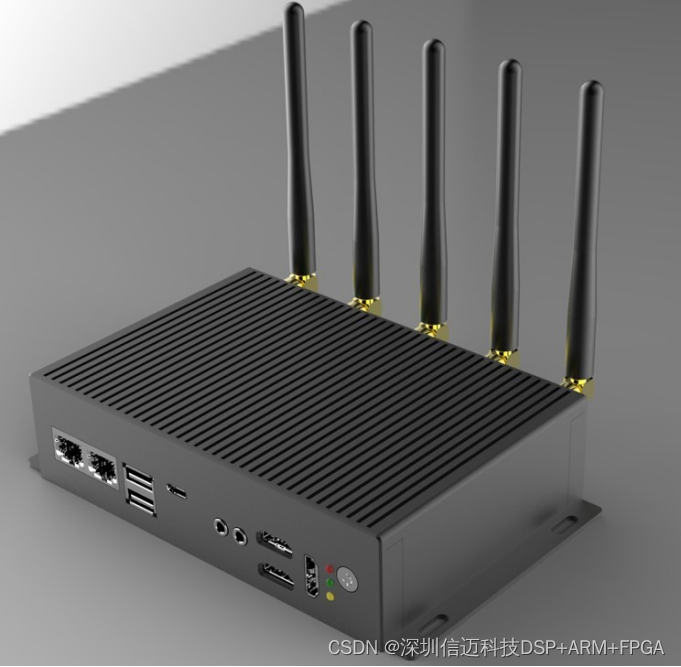
RK3588 AI BOX Appearance

Motherboard Images
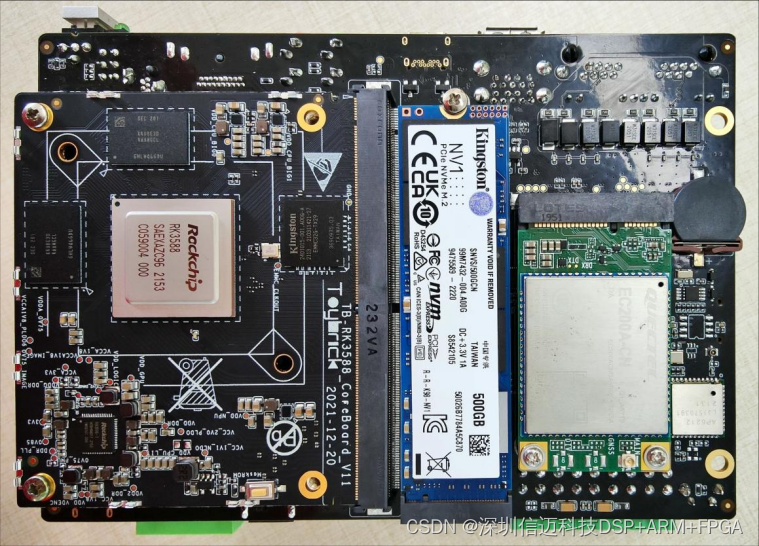
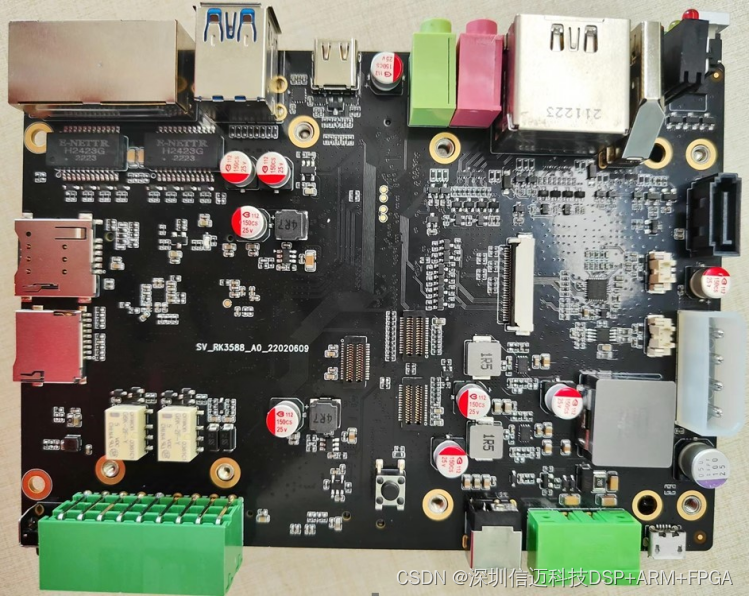
Motherboard Dimensions: 146102mm*
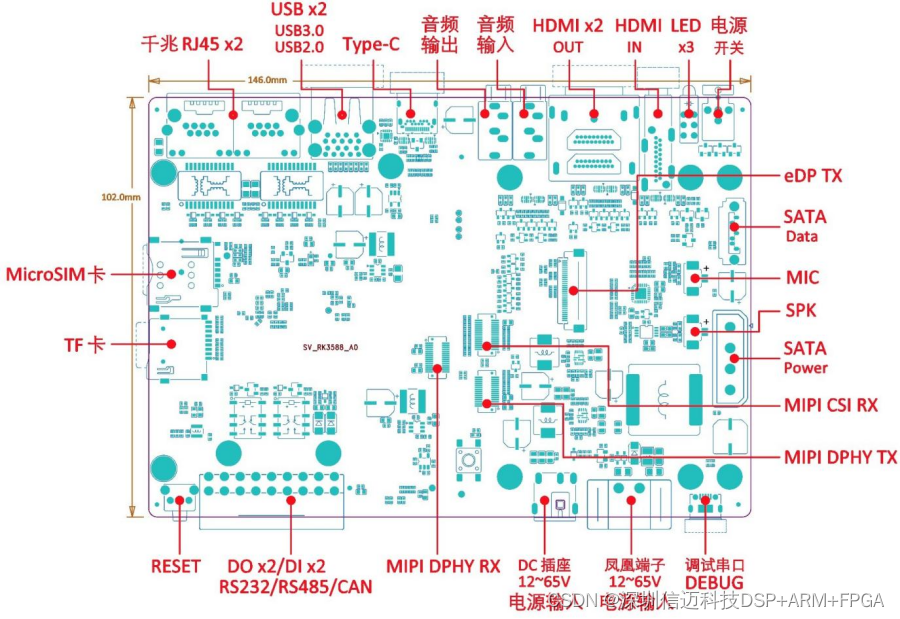
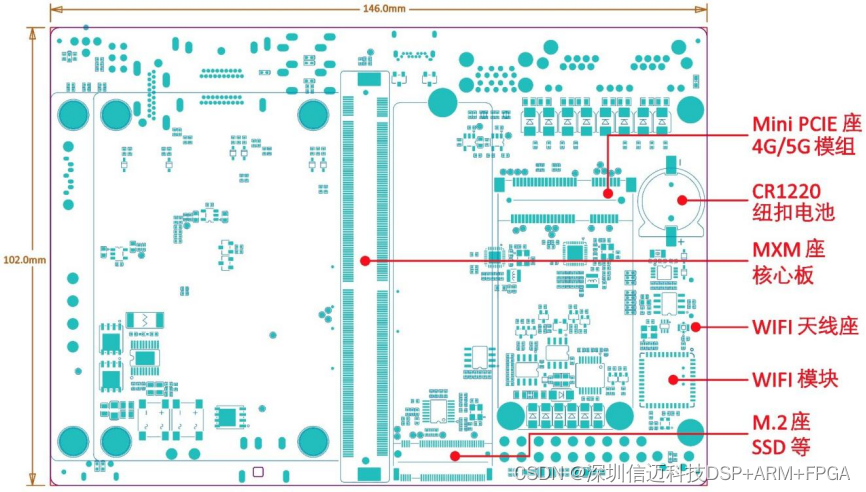
Motherboard Interfaces
RK3588 Edge Computing Motherboard Interface Description
Function
Interface Description
Network Features
Supports single-band (2.4GHz) / dual-band (2.4GHz/5GHz) WIFI, with AMPAK, B-Link, and other brands optional.
Supports mainstream 5G/4G modules from Quectel and others.
Supports dual RJ45 Gigabit Ethernet ports.
Motherboard Interfaces
Supports eDP, MIPI, DP display interfaces, and touchscreen (TP) interfaces.
Supports dual MIPI-CSI camera interfaces, supports MIPI DSI camera input.
Supports one Headphone, one MIC, one Speaker, and one LINE-IN interface.
USB3.01, USB2.01, Type-C*1
TF Card*1
DI*2, DO (Relay)*2
RS4851, RS2321
CAN*1
HDMI IN1, HDMI OUT2
5G/4G Mini-PCIe Interface*1
5G/4G SIM Card*1
SATA Interface*1
M.2 Interface*1
RTC Battery*1
POWER Button1, RESET Button1, RECOVERY Button*1
LED Status Indicators*4
Debug Serial Port*1
DC IN*2 (DC Jack + Phoenix Terminal, 12V~65V)
Application Areas: Edge computing and AI product terminals in smart healthcare / smart transportation / smart security / digital cockpit / edge computing, etc.
-
Design and Production Recommendations
-
Reference Circuitry
As reference designs are updated periodically, please obtain relevant reference design materials through official channels.
2. Baseboard Layout Design
It is necessary to implement appropriate ESD protection designs for all peripheral interfaces.
3.Thermal Management
As multi-core high-performance processors generate significant heat when operating at full load, system-level thermal management must be considered when using the product in practice.
4.Transportation and Production
As modules are paired with different baseboard characteristics, the specific reflow oven temperature settings during production and mounting vary by product; please evaluate them specifically during production. Since motherboards may experience different times and environments from production to final assembly, it is crucial to perform dehumidification and drying treatment on the motherboard before mounting components. As the motherboard is fully exposed and is an electrostatic sensitive device, ESD protection measures must be properly implemented during handling and transportation.