CNC Machine Tool On-site Data Acquisition and Edge Computing Solution
With the introduction of the "Made in China 2025" strategy, "intelligence" has become the core keyword. Smart factories, smart manufacturing, and smart logistics are the directions for industrial development. CNC machine tools operate on the front lines of production, directly participating in processing, and are a crucial part of smart manufacturing. The demand for CNC machine tool equipment has significantly increased. Due to the wide product coverage and extensive after-sales service areas of machine tool manufacturers, equipment after-sales maintenance has become a major challenge:
- Unable to ensure reliable and stable operation of equipment, reducing unnecessary downtime.
- Inconsistent skill levels among equipment operators, meaning even minor issues might require on-site after-sales personnel, which reduces maintenance staff efficiency and increases maintenance costs.
- Greater pressure on services: When equipment problems arise during production, manufacturers' customers are no longer satisfied with a 24-hour resolution but demand immediate response and problem-solving.
- When manufacturers' customers report equipment issues, discrepancies or inaccuracies in the reporting personnel's descriptions can lead to reported problems not being truly existent.
System Topology Diagram
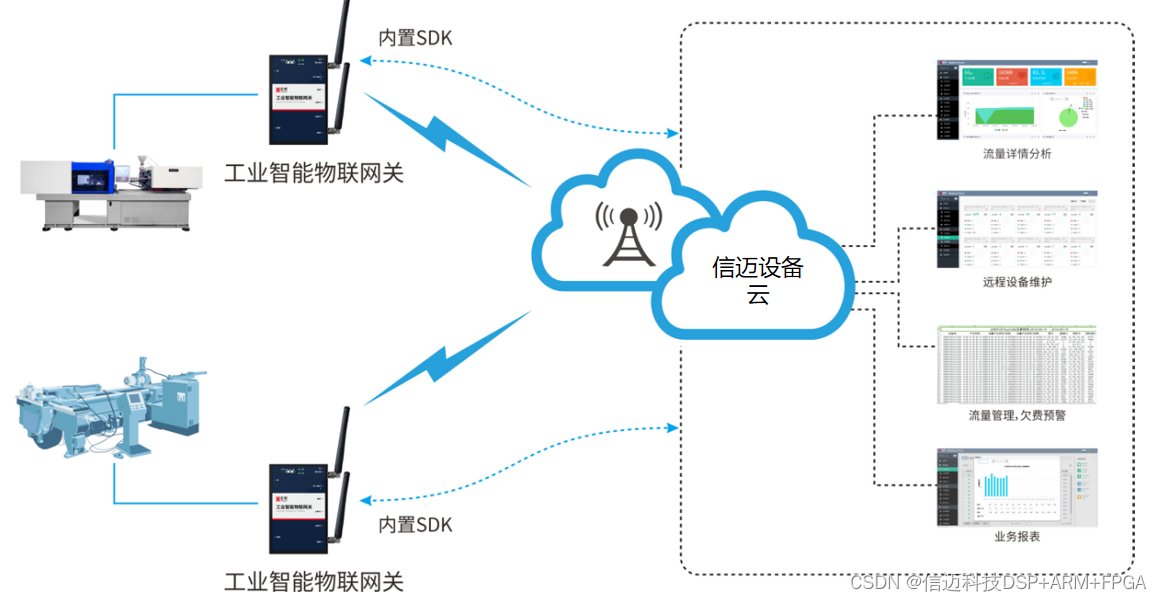
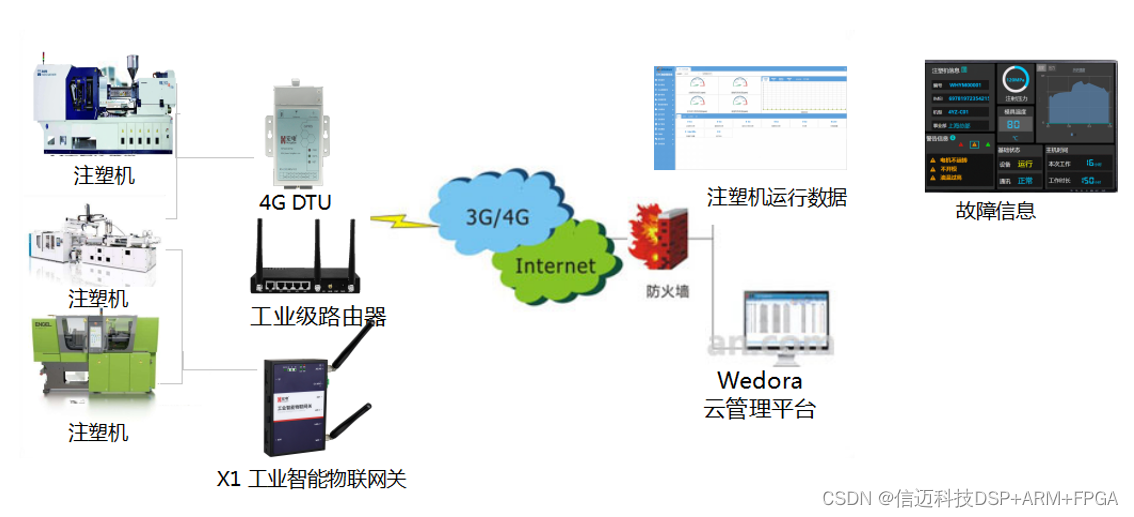
Xinmai deeply understands the needs of CNC machine tool manufacturers and provides them with a CNC machine tool data acquisition and edge computing solution. The system uses Xinmai Industrial Smart IoT Gateways to achieve wireless networking between the equipment manufacturer's technical service center and machine tools in various locations. Through the stable 4G transmission channel provided by X1, data such as machine tool operation and processing status are transmitted in real-time to the technical service backend. This allows for remote management of on-site equipment and data, real-time alerts on basic equipment management status, real-time machine perception, alarms for incorrect operations, and reminders for periodic maintenance. This enables proactive service, reduces problem occurrences, and facilitates repair and maintenance.
System Functions
1. Real-time On-site Data Acquisition, Real-time Monitoring of Machine Tool Operating Status
Industrial Smart IoT Gateways have rich interfaces, including RJ45/RS232/RS485/CAN/IO/USB/WIFI, etc., and are compatible with various industrial protocols such as Modbus and Profinet, ensuring accurate and complete data acquisition. They support access for equipment and systems from different manufacturers to achieve interconnection and information exchange between systems and machines. They can transmit data such as the status of the machine tool's communication port, the name of the currently transmitted program, and the transmission progress in real-time. This provides critical equipment data to factory users and forms relatively complete and accurate data storage in the cloud.
2. Network Edge Interconnection and Interoperability, Achieving Localized Data Storage and Processing
Deploying industrial smart IoT gateways as edge computing nodes at the field level, aggregating data from machine tool production sites, as well as data from industrial control systems like PLCs, historical databases, and process control systems. This achieves horizontal interconnection of underlying devices and vertical interoperability with upper-level systems. Edge processing of data reduces network overhead and backend platform pressure. It also enables local pre-judgment of potential faults, allowing for the immediate discovery of potential issues and reducing the risk of production downtime.
- Remote Maintenance, Reducing O&M Costs
Remote maintenance for each machine tool, enabling remote diagnosis, remote control, automatic system software updates and downloads, information transmission, and other functions. O&M personnel can resolve fault issues promptly without needing to go on-site.
- Enhancing User Experience
Timely resolution of equipment problems, improving work efficiency, and simultaneously enhancing the user experience for manufacturers' customers.
- Cloud Platform Remote Management
Industrial Smart IoT Gateways support access to the Xinmai Wedora Cloud Management Platform. Through the Wedora device management cloud, users can view the actual operating status of devices in real-time, perform remote upgrades, data configuration, and other functions for online devices. The operating status of devices can be statistically analyzed and viewed in chart form, and also exported for record-keeping. The device management platform enables centralized management, remote monitoring, and maintenance of terminal transmission devices.
System Advantages
Simple and Fast System Deployment
Short construction period, simple deployment.
Equipment ports are easy to connect, configuration is simple and easy to understand.
Mature, stable, and reliable network architecture; cloud management platform environment can be deployed using existing server resources.
Convenient and Fast User Experience
Simple deployment of terminal devices, network devices, and cloud management platform, with visualized parameter configuration pages.
Users can directly view industrial site conditions via PC or APP.
Open Interfaces, Strong Scalability
Xinmai 4G communication terminals feature high-speed data processing, large memory and storage space, support standard serial ports and interfaces, and can be extended to connect various lower-level machines, providing strong overall system scalability.
The cloud platform provides application interfaces, supports secondary development, and allows for the deployment of enterprise private industrial cloud platforms.