OMAPL138 TI Official Website Development Resources Collection
OMAPL138 TI Official Website Development Resources Collection
https://wenku.baidu.com/view/321349309b6648d7c0c74612.html
1 Evaluation Board Introduction Based on TI OMAP-L138 (fixed-point/floating-point DSP C674x + ARM9) + Xilinx Spartan-6 FPGA processor; OMAP-L138 FPGA connects via uPP, EMIFA, I2C bus, with communication speeds up to 228MByte/s; OMAP-L138 main frequency 456MHz, with computing power up to 3648MIPS and 2746MFLOPS; FPGA compatible with Xilinx Spartan-6 XC6SLX9/16/25/45, strong platform upgrade capability; The development board exposes rich peripherals, including Gigabit Ethernet, SATA, EMIFA, uPP, USB 2.0 and other high-speed data transfer interfaces, as well as common interfaces such as GPIO, I2C, RS232, PWM, McBSP; Certified through high and low-temperature tests, suitable for various harsh working environments; DSP+ARM+FPGA triple-core CPU module, with dimensions of 66mm*38.6mm, using industrial-grade B2B connectors to ensure signal integrity; Supports bare-metal, SYS/BIOS operating system, and Linux operating system.
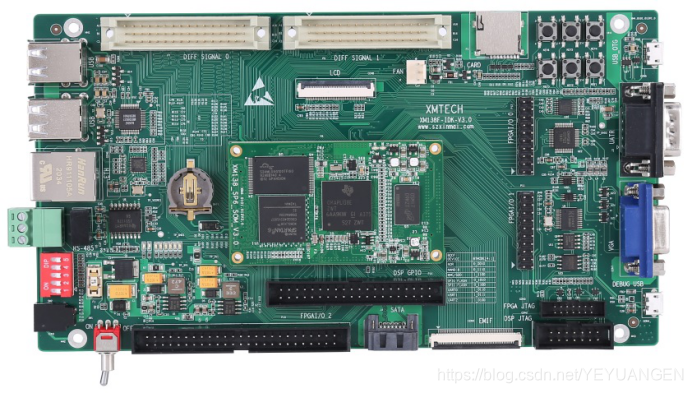
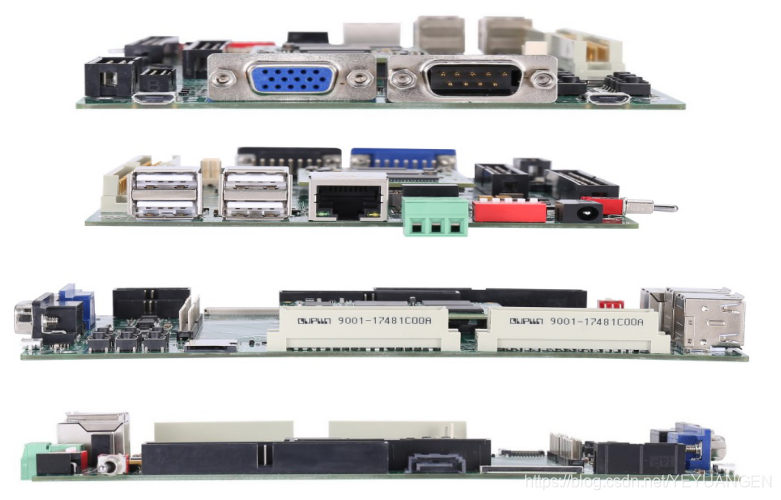 Figure 1 Front and side views of the development board
The XM138F-IDK-V3.0 is a development board designed based on Shenzhen Xinmai XM138-SP6-SOM core board, adopting a 4-layer board design with immersion gold lead-free process. It provides users with a test platform for the XM138-SP6-SOM core board, used for quickly evaluating the overall performance of the XM138-SP6-SOM core board.
The XM138-SP6-SOM exposes all CPU resource signal pins, making secondary development extremely easy. Customers only need to focus on the upper-layer applications, greatly reducing development difficulty and time costs, allowing products to be quickly launched and seize market opportunities in a timely manner. It not only provides rich demo programs but also detailed development tutorials and comprehensive technical support to assist customers with baseboard design, debugging, and software development.
2 Typical Application Areas
Data acquisition, processing, and display systems
Smart power systems
Image processing equipment
High-precision instrumentation
Mid-to-high-end CNC systems
Communication equipment
Audio and video data processing
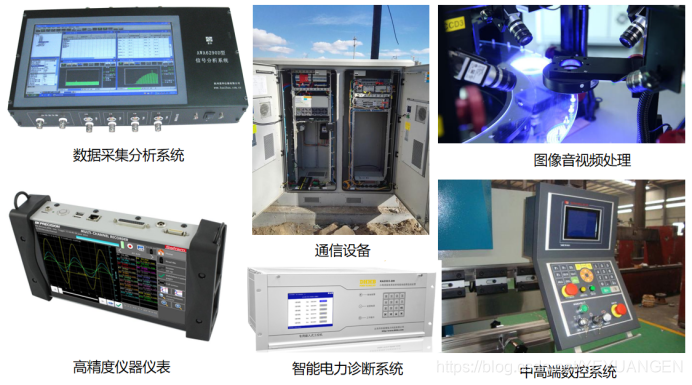
Figure 2 Typical application areas