Large-Scale Blood Analyzer Based on AM5728 DSP+ARM+FPGA
Large-Scale Blood Analyzer
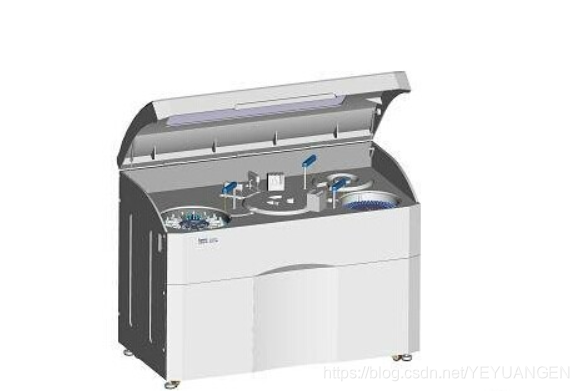
Industry: Medical Devices
Solution Overview: Blood analyzers are a popular type of medical analysis instrument in China's medical device industry. Due to their widespread adoption, the market demand is substantial. Large-scale blood analyzers have relatively complex hardware architectures, typically requiring a combination of ARM and FPGA. This solution implements the necessary hardware functions at the ARM level, enabling medical device customers to rapidly develop complete system solutions.
Implementation:
Module development and customization based on the Xinming XM5728-IDK-V3 platform.
Features:
- Based on the TI AM5728 floating-point dual DSP C66x + dual ARM Cortex-A15 industrial control and high-performance audio/video processor;
- Multi-core heterogeneous CPU integrating dual-core Cortex-A15, dual-core C66x floating-point DSP, dual-core PRU-ICSS, dual-core Cortex-M4 IPU, and dual-core GPU, supporting multi-core development with OpenCL, OpenMP, and SysLink IPC;
- Powerful video encoding and decoding capabilities: supports 1×1080P60, 2×720P60, or 4×720P30 hardware video encoding/decoding, and H.265 software decoding;
- Supports up to 1×1080P60 full HD video input and dual outputs via LCD and HDMI 1.4a;
- Dual-core PRU-ICSS industrial real-time control subsystem supporting industrial protocols such as EtherCAT, EtherNet/IP, and PROFIBUS;
- High-performance GPU with dual-core SGX544 3D accelerator and GC320 2D graphics engine, supporting OpenGL ES 2.0;
- Rich peripheral interfaces including dual Gigabit Ethernet, PCIe, GPMC, USB 2.0, UART, SPI, QSPI, SATA 2.0, I2C, DCAN, and support for high-speed USB 3.0;
- Development board exposes V-PORT video interface for flexible connection to video input modules;
- Ultra-compact size: only 86.5mm × 60.5mm;
- Industrial-grade precision B2B connector with 0.5mm pitch, stable, easy to plug/unplug, reverse-insertion proof; high-speed connectors used for critical high-data-rate interfaces to ensure signal integrity.
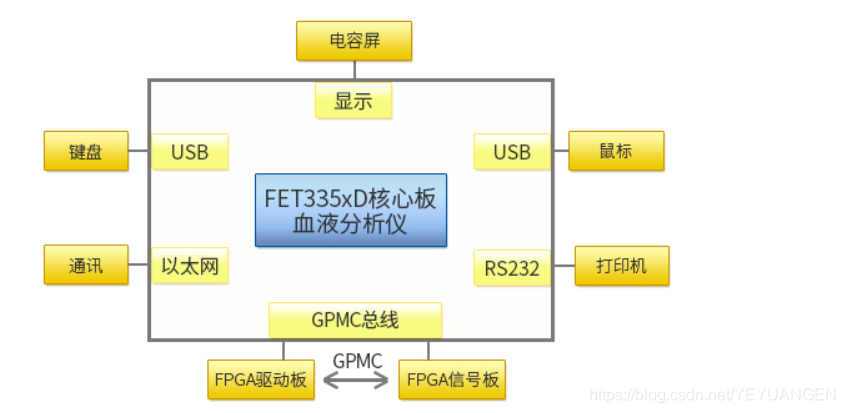
Solution Characteristics: This is a commonly used hardware architecture for large-scale blood analyzers. Blood analyzers are generally categorized into three-part and five-part differential types (the three-part differential classifies white blood cells into neutrophils, lymphocytes, and intermediate-sized granulocytes; the five-part differential further divides them into neutrophils, lymphocytes, eosinophils, basophils, and monocytes). The FPGA signal board acquires analog signals of white blood cells, red blood cells, and platelets via impedance or laser scatter methods (white blood cells only), and converts them into digital signals. The FPGA driver board primarily controls motors, valves, and other fluidic pathway components. The ARM architecture handles data processing, result analysis, and display output. Communication between ARM and FPGA, as well as between FPGAs, is achieved through the GPMC bus. By using Xinming’s AM5728 core board, users can significantly reduce ARM-side development effort, focusing only on FPGA development, thereby saving considerable R&D and time costs.